Friday, October 26, 2007

Achtung! Waschbaeren!


Previously on this blog, I have referred to Alfred Crosby's concept of the Columbian Exchange - the exchange of plants, animals, microorganisms, and humans between the Old World and the New that accompanied and followed Columbus's voyages. As Crosby observed, the transfer of species was almost entirely one-way: Eurasia and Africa contributed far more people, pathogens, and animals to the Americas than the reverse. The only American species to flourish in the Old World were domestic crop plants - maize, potatoes, and cassava in particular - one disease organism, treponema (which causes syphilis), and a few small animals, such as gray squirrels.

To the last group, we may now add one of the most distinctive small American mammals, the raccoon. Introduced to Germany during World War Two, procyon lotor is now flourishing in that nation's woods and cities. This article, while a bit old, tells the story - and features the best headline I've seen since I started this weblog. This article, from May 2007, observes that many Germans have adopted raccoons, or "wash-bears," as pets (one 80-year-old woman had 50 of them in her home), and that they have now spread into France and Belgium and as far east as Chechnya. It now seems only a matter of time before the Nazi raccoon invasion of Britain begins.

Wednesday, October 03, 2007

October 4, 1957


"One day in 1957 everybody in the United States was minding his or her own business when suddenly the Russians launched a grapefruit-sized object called Sputnik (literally, ‘Little Sput’) into Earth orbit, from which it began transmitting back the following potentially vital intelligence information (and we quote): ‘Beep.’ This came as a severe shock to Americans, because at that point the best our space scientists had been able to come up with was a walnut-sized object that went: ‘Moo.’”
(Dave Barry Slept Here, pp. 139-140 [1989 edition].)

Friday, September 28, 2007

Ostalgie


The June 15th issue of the Chronicle of Higher Education included an article on an odd phenomenon known as "Ostalgie" - nostalgia for the symbols and commodities of the defunct Eastern Bloc. In Eastern Europe, Ostalgie generally manifests itself as a demand for replicas of the old, badly-made consumer goods of the Communist era, like Trabant cars in the former East Germany, Tisza sneakers in Hungary, and Kofola Cola in the former Czechoslovakia. It can also take the form of nostalgia for the rhetoric and professed ideals of the old regime, as in Wolfgang Becker's 2003 movie Goodbye Lenin! Eastern European Ostalgie is most likely the product of middle-aged Hungarians' and Germans' nostalgia for the kitsch of their youth - similar to the wave of '70s nostalgia that washed through American movies and TV shows in the 1990s. It may also be an expression of residual nationalism in countries that are otherwise integrating themselves as quickly as possible into the European Union.

I suspect that few Eastern Europeans pine for a return to the actual conditions of Communist rule - secret police, travel restrictions, and food shortages. We were recently reminded of those conditions by an unusual story out of Poland: the emergence of Jan Grzebski, a former railway worker, from a 19-year-long coma on June 2nd, 2007. Grzebski's last memories were of the final year of Communist rule in Poland, and he was anything but nostalgic: "When I went into a coma," he told a Polish TV station, "there was only tea and vinegar in the shops, meat was rationed and huge petrol queues were everywhere." Economic conditions had, he said, improved drastically in the intervening two decades - though, like most 65-year-olds, he found at least one thing to complain about in the new Poland (namely, people who complained about how rotten life was).

Ostalgie has taken a somewhat darker form in the former Soviet Union, where many Russians now remember the Soviet era as one of order and strength, and the 1990s as a "time of troubles" filled with strife, poverty, and national humiliation. The Putin regime is encouraging this revisionist view in the new history standards it recently issued to Russian high school teachers, reported in the New York Times last August. The new standards are particularly kind to Joseph Stalin, whom they compare to Peter the Great and Chancellor Bismarck. Under his rule, "victory in one of the greatest wars was won, industrialization of the economy and cultural revolution were carried out successfully...The U.S.S.R. joined the leading countries in the field of science; unemployment was practically defeated." (Andrew Kramer, "Yes, a Lot of People Died, but..." New York Times, 12 Aug. 2007) Sure, there was a certain amount of suffering, but it was in a good cause. Even Stalin's purges had a good effect: the creation of "a new class of managers capable of solving the task of modernization in conditions of shortage...loyal to the supreme power and immaculate from the point of view of executive discipline."

A corollary to this longing for the Days of Uncle Joe is the belief that the Soviet Union fell not because of its own internal weaknesses, but because it was "stabbed in the back" by internal enemies - more specifically, meddling liberal reformers like Mikhail Gorbachev. Yegor Gaidar, the former economic minister of Russia under Boris Yeltsin (1991-94), observed in a paper given to the American Enterprise Institute last November that "at least 80 percent of Russians" now believe that "the Soviet Union was a dynamically developing world superpower until usurpers initiated disastrous reforms." To this Weimarian view of the fall of Communist Russia, Gaidar opposes his own thesis, which he calls "Grain and Oil." Essentially, Stalin's decision to collectivize agriculture in the late 1920s led to a severe shortfall of grain in the U.S.S.R. by the early 1960s. Soviet Russia could only feed its people by importing grain, and the only Russian commodities anyone would buy in exchange were oil and natural gas. High oil prices in the 1970s allowed the Soviet government to continue feeding its populace, but when Saudi Arabia dropped the floor out of the oil market in 1985, the Politburo could only continue to buy grain by borrowing money from the West. By 1989, private banks were no longer willing to loan money to the Soviets, and Western governments agreed to do so only on condition that the Red Army withdrew from Eastern Europe. Which it did. Sic transit the Russian Communist Empire.

Gaidar’s paper deserves to be read in full: it is elegant, well-illustrated with charts and historical evidence, and even witty. (He summarizes the intellectual quality of Brezhnev-era Soviet leadership with this quote from Politburo minutes: "Mr. Zasiadko has stopped binge drinking. Resolution: nominate Mr. Zasiadko as a minister to Ukraine.") He does tend to gloss over the other weaknesses of the Soviet economy, such as the total stagnation of its industrial sector - by the 1980s, Soviet citizens viewed consumer goods like the Trabants mentioned above as evidence of Eastern Europe's wealth and sophistication. An American historian might also note that the Reagan administration took an active role in undermining the Soviet oil and gas export industry in the 1980s, first by allowing Soviet spies to steal bugged computer software for their gas pipelines that later caused immense explosions, then by pressuring Saudi Arabia to drop oil prices in the mid-'80s. But his essential point, taken in conjunction with Mr. Grzebski's recollections, is sound: repressive governments can only survive as long as there is food in the shops. If there is no bread, all the military glory and shoddy sneakers in the world won't be enough to save your regime. Trite, perhaps, but easy enough for autocrats to forget.

Friday, September 14, 2007

Now Silent, Upon a Peak in Darien

On May 1st I reported on the 300th anniversary of the Act of Union, whereby Scotland formally surrendered its independence to England and became part of the United Kingdom of Great Britain. I implied that English anti-Catholicism and English bribes had much to do with the end of Scotland's sovereignty. However, in a new article in the Guardian, Rory Carroll attributes the end of Scottish independence to the kingdom's disastrous attempt to colonize Panama in the late 1690s. The now-obscure Scottish colony of New Caledonia cost Scotland hundreds of lives and one-fifth of its national wealth, and its collapse both bankrupted and demoralized the Scottish government. According to archaeologist Mark Horton, however, the failure of New Caledonia was not due to Scottish incompetence - the site was well-chosen and the death rate no higher than in 17th-century Virginia - but rather to Spanish military opposition and English indifference. The story reminds us, at any rate, that the margin of survival in Europe's 17th-century colonies was quite thin, and the consequences of failed colonies could be quite severe for the mother country.

Sunday, September 09, 2007

Voyagers to the East: An Updated Census

For the previous entry in this series, click here.

After my four-post digression on the South American Indian slave trade, I thought it would be useful to compile a new census of all the Indian travelers to Europe, involuntary or otherwise, that I've discussed in this series. Herewith I present an updated head count, by year, of the "voyagers to the east:"

1493: 17 Tainos brought to Spain by Columbus
1494: 26 Carib and Taino captives shipped to Spain
1495: 350 Tainos and Caribs brought to Spain as slaves
1496: 30 Tainos brought by Columbus to Spain
1500: 200 Indians (probably Taino or Arawak) sold by Vespucci in Cadiz
1501: 50 Micmacs brought to Portugal as slaves by Corte-Real expedition
1501: 3 Brazilian Indians brought by Vespucci to Lisbon
1502: 3 Micmacs (or Inuit) brought to England by Fernandes & Gonsalves
1503: 260-350 Brazilian Indians sold in Seville by Spanish slavers
1505: 1 Brazilian (Carijo) boy brought to France by de Gonneville
1508: 7 Micmacs brought to France by Aubert
1513: 35 Brazilian Indian slaves sold in Spain
1513: 3 Brazilians (Tupinikin) visit King Manoel I in Lisbon
1515: 50-100 Brazilian men and women brought to Spain as slaves
1523: 1 Florida Indian (Francisco de Chicora) brought to Spain
1524: 1 southeastern Algonquian boy brought to France by Verrazzano
1525: 58 Penobscots taken by Gomez to Spain as slaves
1526: 4 Brazilian (Carijo) chiefs' sons enslaved in Spain
1531: 1 Brazilian chief taken to England by Hawkins
1532-49: About 670 Brazilian Indian slaves shipped to Portugal
1535-36: 10 Hurons (Donnaconna et al.) brought to France by Cartier
1550: 50 Tupi-Guarani taken to France and displayed in Lyons
1550-1600: 10-20 Brazilian boys sent to Portugal for education
1560s: 1 Powhatan, Luis Velasco (later Opechancanough), travels to Spain
1567: 2 Inuit taken to Belgian Netherlands
1576-77: 4 Inuit captives taken to England
1584: 2 Carolina Algonquian chiefs travel to England
1586: 2 Carolina Algonquians taken to England (not including repeat traveler Manteo)
1595: 4 men from Trinidad and Guiana sail to England; one boy and four men from Trinidad and Guiana to England (5-9 altogether, depending on how many of the four adults belonged to both groups)
1613: 6 Tupinambas baptized in Paris

The total so far, for the years 1493-1613 AD, is 1,862-2,016 people. Of these:

1,098 - 1,252 came from South America (including Trinidad)
623 came from the Caribbean
and 141 came from North America.

Their destinations were as follows:

To England: 17-21
To France: 75
To Spain: 1,032-1,172
To Portugal: 736-746
Elsewhere (modern Belgium): 2

About 90% of these Indians were brought to Spain or Portugal to be sold as slaves. Many of the remaining travelers were captives, brought to England, France, or Flanders for display as curiosities or training as interpreters. This fits the general pattern of trans-Atlantic migration in the early modern period. At least two-thirds of the migrants from the Old World to the New between 1500 and 1850 were African slaves, and a majority of European colonists also traveled involuntarily, as orphans or criminals bound to service, as the dependent female relatives of male migrants, or as indentured servants destined to serve (for a term) a Euro-American master.

Why did so many of the early Indian migrants travel to Spain or Portugal? Partly, because Spanish and Portuguese mariners controlled the Atlantic throughout the sixteenth century, until the defeat of the Armada and the ensuing Anglo-Spanish War of 1588-1603 ended Spanish naval dominance. Then, too, most of the early Indian travelers to Europe were slaves, and slavery was virtually extinct in Europe outside of the Iberian peninsula by 1500. More on the latter subject in a later post.

For the next entry in this series, click here.

Wednesday, August 29, 2007

Voyagers to the East, Part XVI

For the previous entry in this series, click here.

As I've noted in the previous two posts in this series, during the first half of the 16th century Portuguese and Spanish sailors transported at least 500, and perhaps more than 1,000 Brazilian Indians to southwestern Europe for sale as slaves. These were not the only native Brazilians to cross the Atlantic, however. In 1549, for example, the city fathers of Rouen employed fifty Tupi-Guarani people in their pageant for King Henry II (see "Voyagers to the East," Part VIII). Moreover, there were a few Indians who voluntarily traveled from Brazil to Europe in the 1500s. In 1501, Amerigo Vespucci brought three Indian volunteers to Lisbon, presumably to display them as curiosities, while in 1505 the French explorer Binot Paulmier de Gonnevile took the son of a Carijo chief to France, where de Gonneville renamed the boy for himself, educated him, and (in 1521) married him to his daughter, Suzanne. Meanwhile, in 1513 three Tupinikin men from the region of Porto Seguro visited King Manoel I of Portugal, who received the Indians while they were attired in feathers and carrying bows. (John Hemming, Red Gold, 11-12.)

During the second half of the 16th century, Jesuit missionaries in Brazil selected a few Indian boys to send to Portugal, where they were baptized and educated. I am uncertain of their numbers - 10-20 is a guess - and their eventual fate, though I think it unlikely that all of them survived to return home. Metropolitan Portuguese interest in evangelizing native Brazilians appears to have declined in the seventeenth century, but the French elite remained fascinated with the region and its inhabitants. In 1613 French missionaries brought six Tupinambas to Paris for baptism, with King Louis XIII and Marie de Medici serving as godparents. Later in that same century, incidentally, Jean Paulmier de Courtonne, a descendant of the Carijo boy Binot de Gonneville and his wife Suzanne, became an abbot in Lisieux, in Normandy. (Hemming, op. cit., 103, 532; Luca Codignola, "The Holy See and the Conversion of the Indians in French and Spanish North America," in Karen Kupperman, ed., America in European Consciousness [Chapel Hill, NC, 1992], p. 217.)

For the next entry in this series, click here.

Friday, August 17, 2007

Steam-Engine Time


Another anniversary: two hundred years ago today, on August 17, 1807, the first commercial steamboat in American history began its maiden voyage. Developed by Robert Fulton and named the North River Steamboat, the 130-foot-long vessel (also known as the Clermont) ascended the Hudson River to Albany in record time, covering 160 miles in just 32 hours. The North River's average speed – five miles per hour – may seem slow to modern readers, but it achieved that velocity against both the current and a strong headwind, proving the feasibility and reliability of steam transportation.

While first tested on the Hudson River, steamboats had a more revolutionary impact when brought to the shallow interior rivers of the United States – the Ohio, Mississippi, Missouri, and others. Shallow-draft steamboats could navigate rivers as low as 10 feet in depth, could attain speeds as high as 25 m.p.h., and could carry up to 70 tons of cargo. The first steamboat on the western waters traveled from Pittsburgh to New Orleans in 1811; by 1820 there were over 400 of them in the greater Mississippi Valley; and by the 1830s they had lowered interior transport costs by 75%, dramatically easing trade and travel between the East and the Midwest and accelerating the economic integration of the United States.

Steam navigation also enlivened the existence of villagers in the Midwest, one of the duller parts of the United States. In Old Times on the Mississippi, Mark Twain recalled the excitement that attended the arrival of a steamboat in his home town:

"The town drunkard stirs, the clerks wake up, a furious clatter of drays follows, every house and store pours out a human contribution, and all in a twinkling the dead town is alive and moving. Drays, carts, men, boys, all go hurrying from many quarters to...the wharf. Assembled there, the people fasten their eyes upon the coming boat as upon a wonder they are seeing for the first time. And the boat is rather a handsome sight, too. She is long and sharp and trim and pretty; she has two tall, fancy-topped chimneys…a fanciful pilot-house, all glass and "gingerbread," perched on top of the 'texas' deck behind them; the paddle-boxes are gorgeous with a picture or with gilded rays above the boat's name; the boiler deck, the hurricane deck, and the texas deck are fenced and ornamented with clean white railings; there is a flag gallantly flying from the jack-staff; the furnace doors are open and the fires flaring bravely; the upper decks are black with passengers; the captain stands by the big bell, calm, imposing, the envy of all; great volumes of the blackest smoke are rolling and tumbling out of the chimneys - a husbanded grandeur created with a bit of pitch pine just before arriving at a town; the crew are grouped on the forecastle; the broad stage is run far out over the port bow, and an envied deck-hand stands picturesquely on the end of it with a coil of rope in his hand; the pent steam is screaming through the gauge-cocks; the captain lifts his hand, a bell rings, the wheels stop; then they turn back, churning the water to foam, and the steamer is at rest. Then such a scramble as there is to get aboard, and to get ashore, and to take in freight and to discharge freight, all at one and the same time; and such a yelling and cursing as the mates facilitate it all with! Ten minutes later the steamer is under way again…After ten more minutes the town is dead again, and the town drunkard asleep by the skids."

Wednesday, August 15, 2007

Voyagers to the East, Part XV

For the previous entry in this series, click here.

Hoping to secure his kingdom's contested claim to Brazil, in 1532 King Joao III of Portugal divided the Brazilian coast into colonial districts, or donatories, which he then granted to fourteen Portuguese magistrates and noblemen. The donatory grants placed the grantees, also known as captains, under a number of legal restrictions. One of these pertained to Indian slaves: the captains could employ Native American slaves on their plantations in Brazil, but could only export 24 to Portugal each year.

I don't know the reason for this restriction – I suspect that Joao was trying to protect the interests of merchants involved in the African slave trade – but whatever the cause, it seems likely that the Brazilian captains followed the Indian slave-export rule. I base this guess upon a simple economic fact: the demand for Indian slave labor on the Brazilian side of the Atlantic far outweighed the European demand. By 1526, Portuguese settlers had learned that coastal Brazil had an ideal climate for sugar cultivation, and sugar cane was as labor-intensive as it was profitable. By 1540 Joao's donatory captains had lined the Brazilian coast with plantations, each manned by hundreds of Native American slaves who (under threat of torture and death) spent their days planting, weeding, cutting, and pressing sugar cane. The cane fields were graveyards for Indian laborers, who died from hunger, exposure, overwork, and imported Old World diseases, like malaria and amoebic dysentery. (John Hemming, Red Gold, 36-39; Alfred Crosby, The Columbian Exchange [Westport, CT, 1972], 39-40, 69).

The combination of intense local demand for slave labor and high indigenous mortality naturally limited the supply of Brazilian Indian slaves for the European market. John Hemming, an expert on Indian-white relations in colonial Brazil, gives no estimate of the number of slaves taken to Portugal during the first period of Brazilian colonization (1534-49), but he does note that one of the most successful donatory captains, Alfonso de Sousa, only sent 48 Indian slaves across the Atlantic during his entire career. (Hemming, op. cit., 538.) If we assume that this was an average per capita figure, then the fourteen captains would have shipped about 670 Indian slaves to Europe by 1550. This is probably a high estimate, because some of the donatory captains never actually claimed their grants.

After 1549, when Brazil became a royal colony, several new developments further curtailed (and probably stopped) the shipment of Brazilian Indian slaves across the Atlantic. First, the demand for slave laborers in Portugal and Spain declined in the second half of the sixteenth century, as Europe finished replacing the population losses it had sustained in the Black Death. (George Huppert, After the Black Death [Bloomington, 1986], 112.) Second, the Brazilian Indian population began to collapse as smallpox, the most consistently lethal of Old World diseases, arrived in the ports and plantations. A 1562 smallpox epidemic killed 30,000 Indians within four months, then attacked and annihilated countless coastal Indian villages. Portuguese and allied Tupi Indian slave raiders were forced to conduct long-range slaving expeditions into the Brazilian highlands, and the captives they brought back to the coast were just as short-lived as their predecessors. By 1576, Portuguese planters in Brazil were beginning to meet their labor demands by importing African slaves – 40,000 by 1600, and hundreds of thousands in the subsequent century. These new bondsmen brought with them additional smallpox outbreaks which decimated both the Brazilian Indian population and the colony's Indian slave trade. (Dauril Alden and Joseph Miller, "Out of Africa: The Slave Trade and the Transmission of Smallpox to Brazil, 1560-1831," Journal of Interdisciplinary History 18 (1987), 195-224.) I've not located any accounts of Brazilian Indian slaves traveling to Europe after 1550, though a few Tupi-Guarani Indians did cross the Atlantic voluntarily, of whom more later.

For the next entry in this series, click here.

Friday, July 06, 2007

Voyagers to the East, Part XIV

For the previous entry in this series, click here.

During the first quarter of the sixteenth century, Spain maintained a near-monopoly on the exploration and exploitation of the Americas. In only two regions of the Western Hemisphere did other Western European nations challenge Spain's dominance: Newfoundland, where sailors of nearly every seafaring country came to exploit the cod fisheries, and Brazil. While claimed by Portugal under the Treaty of Tordesillas (1494), Brazil remained outside of the effective control of any single European power, and it possessed two commodities Europeans desired: brazilwood (the source of a bright and cheap red dye), and human slaves. The latter were either the prisoners of internecine wars, or captives taken by well-armed European slaving parties. Most were destined to end their lives on plantations in the West Indies or on the Brazilian coast, but a fair number, according to John Hemming's Red Gold (Cambridge, Mass., 1978), wound up in Western Europe. The following is a short summary of the cases Hemming reports, by year:

1503: Four Spanish ships brought gold, brazilwood, and Indian slaves to Seville in this year. There is no indication how many people were on each ship, but 100 seems a likely maximum - the ships were carrying other cargo, so it is doubtful that the crewmen packed in as many slave passengers as did Columbus's men in 1495. Fatalities en route probably ranged from 13% (Vespucci's figure in 1500) to 35% (Columbus's figure), leaving 260-350 survivors to be sold in Seville. This is, of course, only a guess. (Hemming, 531)

1513: The ship Bentoa brought 35 Indian slaves from Brazil to Lisbon, where they were probably sold as household servants or field hands. (Hemming, 10-11)

1515: A German correspondent described a Portuguese ship bringing "young [Indian] men and women" to Lisbon. Apparently, the ship captain had duped these passengers into coming to Europe voluntarily, then sold them into slavery after landing. The correspondent did not record the number of passengers, but 50-100 seems a reasonable range. (Hemming, 11)

1526: Sebastian Cabot, the son of John Cabot, took four chiefs' sons captive while in southern Brazil (Carijo), and sold them in Spain. (ibid)

This gives us a range of 349 - 489 Brazilian Indians sold as slaves in Iberia between 1503 and 1526. These figures are speculative and imprecise, but are based on the solid research in Hemming's book and thus at least convey the order of magnitude of this involuntary migration.

The sale of Brazilian Indian slaves in Portugal increased somewhat after the Portuguese began formally colonizing Brazil in 1534. That is a story for my next entry in this series.

For the next entry in this series, click here.

Thursday, June 14, 2007

Voyagers to the East, Part XIII

For the previous entry in this series, click here.

In discussing Christopher Columbus's shipment of 550 Indian slaves to Europe (Voyagers to the East, Part II, 2/21/06), I neglected to mention that his contemporary, Italian explorer Amerigo Vespucci, also engaged in the Indian slave trade, and from a very early date. In 1499 Vespucci undertook a reconnaissance voyage to the eastern coast of South America on behalf of the Spanish Crown. In a subsequent letter to Lorenzo de Medici (18 July 1500), Vespucci reported on the many wondrous things he and his companions had seen: new species of serpents and songbirds, new stars and constellations (Vespucci was the first modern European to see Alpha Centauri, which is only visible from the Southern Hemisphere), and many different nations of Indians, speaking at least 40 different languages. Some of the Native Americans whom Vespucci encountered were friendly and gave gifts, some the explorers fought. He opined that the lands he explored had to belong to an entirely new continent, owing to the many varieties of land animals he had encountered – an observation that had eluded his predecessor Columbus, even though Columbus had also explored the South American coast.

After thirteen months of voyaging, around May 1500, Vespucci observed that his men were exhausted and short of food, and so he determined to return home. Before doing so, he resolved to bring back one last treasure: 232 human slaves, procured from "certain islands" off the Atlantic coast of North America. Vespucci did not identify these islands, but he and his followers had just sailed 600 miles north of Hispaniola, through "a shoal of islands, more than a thousand in number" that were probably the Bahamas. These may have been the "certain islands" to which Vespucci refers.

In any event, Vespucci reported that he and his companions made the voyage back to Cadiz in 67 days, during which time about thirty of the captives died. The explorers sold the surviving 200 Indians as slaves, but apparently the transaction wasn't very profitable: Vespucci wrote that "After deducting the expense of transportation we gained only about five hundred ducats, which, having to be divided into fifty-five parts, made the share of each very small." (Frederick Ober, Amerigo Vespucci [New York: Harper and Brothers, 1907], pp. 109-124, quote 122.)

It's worth mentioning that one needs to take all of Vespucci's travel accounts with a large grain of salt, as he tended to embellish his stories with exaggerated or entirely fictional details. (For instance, he claimed that he and his men had encountered a tribe of giant female warriors in the South American interior, and that some of the other Indian peoples he encountered showered the explorers with gold and precious gems.) It is quite possible that Vespucci also invented his story of bringing Indian slaves back to Spain. But it seems unlikely that he would have lied about this particular incident. When Vespucci embellished or bent the truth, he usually did so to glorify himself or add color to his story. There was nothing particularly colorful or glorious about slave trading, an enterprise regarding which Ferdinand and Isabela had already expressed their displeasure. On the contrary, Vespucci's report on his slave-trading is quite mundane and bare-boned: he tells us nothing about the slaves except their numbers, how many survived the voyage, and how little money he obtained for them. One might find Vespucci's inability to identify the precise provenance of his Indian prisoners a little suspicious, but then, such vagueness was common in early narratives of exploration, and to be expected given the absence of good maps. Vespucci appears to have had no motive for lying about his enslavement of Native Americans, and so one may assume that he was telling the truth, and that he did indeed destroy the lives of over 200 people in the interest of making his second exploratory voyage a "success."

For the next entry in this series, click here.

Tuesday, May 01, 2007

Such a Parcel of Rogues in a Nation


Today is the 300th anniversary of the effective date of the Act of Union, whereby the English and Scottish Parliaments merged into one national legislature and created the United Kingdom of Great Britain. Under the act Scotland was allowed to retain its court system and its national church (known in the United States as the Presbyterian Church). But Scotland's independence effectively ended with Union, which liquidated the Scottish government and incorporated the country into the English economy as well.

The two kingdoms had shared a sovereign since 1603, when Elizabeth I died childless and James VI of Scotland accepted the English Crown, becoming England's King James I . Eighty-five years later, however, a small group of English Protestant aristocrats and generals, in league with Prince William of Orange, deposed James I's Catholic grandson, James II, in a bloodless coup d'etat. James II's daughter Mary and William of Orange, her husband and cousin, became co-monarchs of England and Scotland, and the English Parliament legalized their rule on the condition that they accepted a Parliamentary bill of rights. Among other provisions, the English Bill of Rights stipulated that no Catholic could ever again be King or Queen of England, and that the Crown would henceforth pass only to James II's Protestant heirs: either Mary's children, William's children by a later marriage, Mary's younger sister Anne, or Anne's children.

However, Mary died childless in 1694, and William did not remarry prior to his death. Anne, who reigned as Queen Anne from 1702 to 1714, made a concerted but unsuccessful effort to produce an heir: she had eighteen pregnancies, of which thirteen ended in miscarriages. None of her five children lived past the age of ten. The author of The Sickly Stuarts makes a convincing argument that Anne probably had lupus, a disease which in pregnant women often leads to late-term miscarriages. In any event, by 1700 (when Anne's only surviving son, pictured above with his mother, died) it was clear there would be no Protestant Stuarts to succeed Anne. It was also clear that her nearest Protestant male relative was, in fact, German: specifically, the Elector of Hanover (future King George I). Determined to keep England Protestant, Parliament passed a law in 1701 settling the English and Scottish Crowns on the House of Hanover after Anne's death. Scotland's Parliament balked at accepting a German King, and England's aristocrats and gentry worried that Scotland might proclaim its loyalty to the Catholic Stuart heir, the soi-disant James III. To head off this possibility, England's Parliament imposed full legislative and economic union on Scotland in 1707, bribing Scotland's MPs into accepting the settlement and granting them 45 seats in the English House of Commons and sixteen in the House of Lords.

The union eventually brought considerable economic benefits to Scotland's gentry and aristocracy, in the form of a free-trade agreement with England and access to England's overseas empire. Many Scotsmen became prominent traders and officials in the American colonies, while others grew rich marketing American staple crops and loaning money to Virginia tobacco planters. Yet there was always a subcurrent of nationalism in Scotland, expressed by Robert Burns in a 1791 poem and, closer to our own time, by one of George Orwell's correspondents, who wrote in 1947 that "Scotland experienced her Yalta in 1707 when English gold achieved what English guns could not do. But we will never accept defeat." (Orwell, Collected Essays, Journalism, and Letters [Boston, 2000 (orig. pub. 1968), 4: 284]) Scottish nationalists finally won a symbolic victory in 1999, when Tony Blair's Labor government rewarded them for their help in the 1997 general election by creating a separate Scottish Parliament in Edinburgh. As far as I can tell, though, it wields about as much power as the average American high-school student government. I suspect there are still many Scottish nationalists who would agree with Mark Renton's assessment of Scottish identity.

Friday, April 27, 2007

The Printed World

Library Thing, the site that brought us the "Unsuggester," contains a link to a fascinating, if less interactive, book-related Web page: Matthew Gray's Earth Viewed from Books. As most of my readers know, Google is in the midst of a multi-year project to digitize every printed book in the world. As part of that project, the digitizers are generating maps of all the place names mentioned in each volume. Matt Gray, a software engineer and Google employee, has taken this a step further: he has plotted all of these place-name references onto a map of the world. Furthermore, he has prepared several historical maps showing the gradual spread of place-name references from books published between 1800 and 1900, graphically demonstrating the growing Western awareness of North America, India, Japan, and Australasia. He also shows that Patagonia, the Sahara, most of Australia, and most of the former Soviet Union still lie outside of the world's literary consciousness, either because they are lightly populated or because they are too isolated to draw writers' attention. True "globalization" is apparently still years away.

It would be interesting to extend Mr. Gray's historical maps back into the eighteenth, or even the sixteenth century, and to watch as Europeans gradually learned about (and wrote about) the Americas and East Asia. For now, though, he has produced some food for thought - or at least a few intellectual hors d'oeuvres.

Friday, April 20, 2007

You Probably Won't Like...

Amazon's book-recommendation service now has an opposite number: LibraryThing's "UnSuggester," which you can use to find out which books you probably don't want to read. Examples:

If you liked The Wind-Up Bird Chronicle by Haruki Murakami,
you probably won't like Basics of Biblical Greek by William D. Mounce

If you liked Parliament of Whores by P.J. O'Rourke,
you probably won't like A Walk to Remember by Nicholas Sparks

If you liked Knitting Rules! by Stephanie Pearl-McPhee,
you probably won't like V by Thomas Pynchon

If you liked Phenomenology of Mind by Georg Hegel (and who doesn't?),
you probably won't like Moreta: Dragonlady of Pern by Anne McCaffrey

And so forth. The program is based on the personal libraries of the site's registered members; after you type in the title of a book, it scans the collections of LibraryThing members who own the same book, then calculates which other books those members are least likely to own. Of course, the same program can also determine which books you might actually like to read, but that's not nearly as entertaining.

Saturday, March 31, 2007

Enter, To Grow in Wisdom

The March 30th issue of the Chronicle of Higher Education contains an article by Fred R. Shapiro, co-editor of the Yale Book of Quotations, on the origins of the most famous quotations from the academic world (e.g. "Publish or perish," "You can always tell a Harvard man..."). One of these quotes caught my fancy, perhaps because I'd never heard it before, but also because it too often reflects reality. Asked why universities were such great repositories of learning and wisdom, A. Lawrence Lowell, president of Harvard University (1909-1933), replied "The freshmen bring a little in and the seniors take none out, so it accumulates through the years."

Sunday, March 18, 2007

And in Other War News...

Military historians may long debate which conflict deserves the title "Most Obscure War in History," but a couple of weeks ago Europe submitted a strong contender. On March 1st, 2007, Switzerland invaded Liechtenstein.

To be honest, the invasion was accidental, and the 170 Swiss soldiers involved weren't very well armed - they were carrying unloaded rifles and (of course) Swiss Army knives. Nor did the good people of Liechtenstein seem particularly worried about Switzerland's act of aggression. Markus Amman, an employee of Liechtenstein's ministry of the interior, remarked that "nobody in Liechtenstein had even noticed the soldiers. 'It's not like they stormed over here with attack helicopters or something.'"

Commentators on world politics rarely use the words "war" and "Liechtenstein" in the same sentence, because the tiny nation's military history has been both brief and inglorious. The principality last sent troops into battle in 1866, dispatching an 80-man contingent to Italy to assist the Austrians in the Third War of Italian Unification. However, the expeditionaries saw no fighting and sustained no casualties. "In fact," wrote Bill Bryson, "they came back with 81 men, because they had made a friend on the way." (Neither Here Nor There [New York, 1992], p. 194.) In 1868, Liechtenstein dissolved its army and went about its other business, which currently consists of three enterprises: printing postage stamps, serving as a corporate tax shelter, and manufacturing false teeth.

Monday, February 19, 2007

Why I'm Not a Political Forecaster

This weblog passed its one-year anniversary last week, and by way of celebration I thought I would post one of the blog entries I wrote last year but decided, for one reason or another, not to publish. The essay, which I completed in early October, was entitled "Electoral Predictions," and used a simple but persuasive (or so I thought) statistical model to determine the likely outcome of the 2006 U.S. Congressional elections. How accurate was my prediction? Take a look:

It's never wise to make predictions in American politics, and historians are traditionally the worst political prognosticators. Nonetheless, with 5 1/2 weeks to go before the fall Congressional elections, let me briefly observe that history does not appear to be on the Democrats' side.

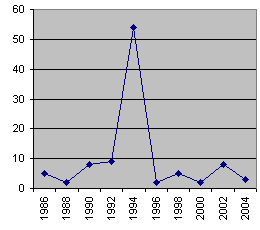
In the 1930s, Congressional elections sometimes led to quite dramatic swings in the partisan composition of the House of Representatives. There were several elections in which one party picked up 80 or more seats, followed by elections in which the other party recaptured 60 or more seats. These oscillations, however, have become much smaller in recent decades, as redistricting has made more House districts "safe" for either Democrats or Republicans, and as the realignments caused by the New Deal and the Civil Rights movement have reached completion. There have been only a few dramatic midterm elections in the last forty years, and only one in the last twenty: the 1994 "revolution," in which a wave of Democratic retirements in Republican-trending districts helped give the Republican Party control of the House.

The chart above demonstrates just how anomalous the 1994 election was. The X-axis identifies each of the last ten House elections, and the Y axis indicates the net change in House seats from one party to the other. Since 1986, this figure has usually been less than 10 seats, sometimes less than 5. The average change (factoring in 1994) has been 10-11 seats. If this twenty-year trend continues in 2006, the minority party -- the Democrats -- will probably pick up some seats in the House of Representatives. The historical odds, however, indicate that they'll only win 10-11 seats, leaving the Republicans with a 219-216 (or so) majority. It's a thin margin, but enough to keep Dennis Hastert ensconced in the Speaker's office.

The Senate race is more interesting because it's more personal -- and thus harder to predict. I will guess that Democratic challengers will win Republican seats in Pennsylvania, Montana, and Ohio, but Republican Thomas Kean is polling ahead of his Democratic challenger in New Jersey, and name recognition may be enough to get him the seat. The McCaskill-Talent race in Missouri is rated a tossup by Slate Magazine. George Allen is unlikely to lose in Virginia, "macaca" reference or no, because his opponent is weak and inexperienced. Lincoln Chafee has run far enough away from the president to keep his seat in Rhode Island. Tennessee will not vote for a black Democrat, no matter how conservative he is or how much name recognition he enjoys.

So the Democrats will pick up 2-3 seats in the Senate, giving the Republicans a 52-46 majority -- still larger than their majority in the 109th Congress. The other two seats will almost certainly be held by Bernie Sanders, a Vermont Socialist who will caucus with the Democrats, and Joe Lieberman, the newly-independent Connecticut Senator who will probably caucus with the Democrats.

Well, I was right about a few of the Senate races. Otherwise, my predictions were wrong. The Democrats picked up 31 seats in the House of Representatives, and Kean, Talent, and Chafee all lost their races; moreover, George Allen's "macaca" gaffe ("macacalypse," if you prefer) helped the "weak and inexperienced" Jim Webb defeat him, thus giving the Democrats control of the U.S. Senate. Perhaps historians really do make bad "political prognosticators."

There's another way to look at my lousy prediction, though. A Republican economist friend of mine, whom I now owe a pizza (we made a bet about the outcome of the House race), says that I should have used the 1966 House race as my model for the 2006 race. In that year, voters punished an increasingly unpopular president who had mired the nation in an foreign war by "shellacking" the president's party in the midterm elections. (Republicans picked up 47 House seats in 1966.) What's interesting is that my economist friend used a historical model to predict the outcome of the election, and was proven right, whereas I, a historian, used a statistical model to predict the election and was dead wrong. Sometimes it pays to stick with what you know.

Wednesday, February 07, 2007

Donnaconna's Entourage: Voyagers to the East VI (addendum)

Here is an addendum to my earlier account of Donnaconna, the Huron chief whom Jacques Cartier took back to France in the 1530s: James Axtell reports that in May 1536 Cartier invited Donnaconna, two other chiefs, and two Indian interpreters - Donnaconna's sons Domagaya and Taignoagny - to meet him at the French camp near the town of Stadacona, then abducted all five men. According to Axtell, Canadian Indians (Hurons or Iroquois) had previously given the explorers five boys as "tokens of alliance" and, presumably, for training in the French language, so when Cartier sailed for France later that year he had ten Indians on his ship.

When in 1541 Cartier returned to Quebec to establish a (short-lived) mining colony, he told the Stadaconans that his Indian companions had all married and become "great lords" in Europe, and no longer wished to return home. This may have been partially true, and (as I mentioned in a previous post) the Huron travelers may have enjoyed very good living conditions in France. For diplomatic reasons, however, Cartier declined to mention that nine of the ten travelers (including Donnaconna) had in fact died during the preceding half decade, and so could not be consulted on their future travel plans. (Axtell, The Invasion Within [New York: Oxford University Press, 1985], p. 27.)

Sunday, January 21, 2007

Voyagers to the East, Part XII

For the previous entry in this series, click here.

Hoping to recoup his fortunes in the wake of the Roanoke fiasco, Sir Walter Raleigh in the 1590s decided to embark on a new American venture: searching for El Dorado. The Spanish had undertaken two unsuccessful expeditions to find the fabled city (more precisely, man) of gold – one of which is chronicled in this film – but Raleigh, who probably heard of El Dorado from Spaniards captured by English privateers, thought he could succeed where Pizarro and Aguirre had failed.

Raleigh believed that El Dorado could most likely be found on the Orinoco River in present-day Guiana, and in 1594 he sent a ship to explore the Guianan coast and gather intelligence. The vessel returned the following year with its logs, charts, and four Indian passengers, two from Guiana and two from Trinidad. Thomas Hariot set to work teaching the new visitors the English language and interrogating them about Guiana's geography, wildlife, and people. At least one of these translators accompanied Raleigh when he embarked for Guiana later that year.

Raleigh's 1595 Guiana expedition was short but (from our standpoint) consequential. After pausing to defeat the Spanish garrison on Trinidad, the adventurer and his 100 or so companions ascended the Orinoco River into present-day Venezuela, and made an alliance with Topiawari, the cacique (chief) of the Arromaia Indians. To seal the pact, Raleigh left behind two Englishmen to learn the Arromaian language, and took with him to England Topiawari's 19-year-old son, Cayowaroco, and 3-4 other South American Indians (from Guiana and Trinidad), to instruct them in the English language.

Two of the Native Americans from the 1594-95 expeditions, whom Raleigh and his associates renamed John Prevost and Henry, returned to Guiana in 1596 and 1597 with the English navigators Lawrence Keymis and Leonard Berry. These translators helped their captains establish diplomatic relations with other Guianan caciques, and by the early 17th century England had established a commercial presence on the northeast coast of South America. (Source: Alden Vaughan, "Sir Walter Raleigh's Indian Interpreters," pp. 358-365; see also Charles Nicholl, The Creature in the Map: A Journey to El Dorado [Chicago: University of Chicago Press, 1997.)

For the next entry in this series, click here.

Monday, January 08, 2007

Returning to His Plow


The recent death of Gerald Ford has caused me to reflect on the awkwardness of presidential retirement in the United States. Monarchies, or nations whose chiefs of state serve for life, don't have to consider how they will treat former chief executives. Other republics (like ancient Rome or modern Chile) provided ex-consuls or ex-presidents with lifetime appointment to their senate, thus giving them a place of honor and influence commensurate with their former power. Americans, however, expect their presidents to go home and die quietly after they finish their terms of office.

This is largely the fault of George Washington, who, following the example of Lucius Quinctius Cincinnatus (fl. 5th century BCE), voluntarily relinquished supreme command not once but twice. In 1783 General Washington, then commander-in-chief of a victorious revolutionary army, surrendered his sword to the Continental Congress - then a rather scruffy and fugitive assembly - and retired to his plantation in Virginia. This first retirement so impressed American electors that they unanimously chose Washington to be the first president of the national government, knowing he could be trusted to walk away from power. Moreover, as president Washington refused to serve more than two terms, even though he could have served as many as he wanted (the Constitution did not impose presidential term limits prior to the 22nd Amendment). He thereby established a precedent that only a few of his successors had the nerve to try to break.

Washington retired from the presidency in 1797, went back to Mount Vernon, and died less than three years later. His successors, however, were only rarely able to contrive so fitting an end to their public service. Of 41 past American presidents, 8 died in office (W.H. Harrison, Taylor, Lincoln, Garfield, McKinley, Harding, F.D. Roosevelt, and Kennedy) and 6 lived less than five years after retiring (Washington, Polk, Arthur, Wilson, Coolidge, and L.B. Johnson). The remaining 27 lived for an embarrassingly long time, which most spent writing their very dull memoirs and making money.

Has anyone had a memorable post-presidential career in the United States? Only a few examples come to mind:

* Thomas Jefferson, who helped found the University of Virginia;
* John Quincy Adams, who served in the House of Representatives for 17 years, fought against slavery, and played a major role in the founding of the Smithsonian Institution;
* William Howard Taft, who served as Chief Justice of the U.S. Supreme Court (1921-30), the only position in the federal government co-equal to the presidency;
* Herbert Hoover, who served as a government commissioner in Germany after World War Two and helped set up emergency food programs there;
* Jimmy Carter, who served as an international election monitor, helped (and still helps) raise millions of dollars to fight tropical diseases, and won the Nobel Peace Prize.

Ford, by contrast, appears to have done approximately nothing in retirement, except make money, go to church, and play golf. In his defense, one can merely say that he was following Washington's example, in his own humble way. And one can also say that Ford's retirement years were not an embarrassment to the nation - unlike those of Franklin Pierce, who after leaving the White House became a supporter of the Confederacy, ran over an old woman with his carriage, and purportedly said "there's nothing left to do but get drunk."

Friday, December 08, 2006

Voyagers to the East, Part XI

For the previous entry in this series, click here.

The first Native Americans to visit England were brought over by English mariners for display as curiosities. There was no shortage of Englishmen interested in viewing see Brazilian "princes" or Inuit hunters, even if it meant paying for the privilege. Shakespeare observed that men who "will not give a doit to relieve a lame beggar...will lay out ten to see a dead Indian" (The Tempest, Act II, Scene ii.)

A change occurred in the 1580s, after Queen Elizabeth I chartered the first English colonial venture to North America, the Virginia Company. In 1584 the company's chief proprietor, Sir Walter Raleigh, dispatched a vessel to survey the North American coast, look for settlement sites, and procure local Indians who could be trained as interpreters. The ship returned later that year with two Algonquian werowances (or petty chiefs), Manteo and Wanchese, from Croatan and Roanoke Islands off the coast of present-day North Carolina. The chiefs had come voluntarily, probably because they and their kinsmen had heard of other European incursions in the area (like the Spanish Jesuit mission in present-day Virginia) and wanted to gather intelligence on these new intruders.

The two chiefs resided for several months in London, more specifically at Durham House, the royal mansion that Elizabeth I had loaned to Walter Raleigh. There Raleigh's friend Thomas Hariot learned some of the visitors' language and prepared a rudimentary Algonquian syllabary for future colonists, along with a 36-letter alphabet for spelling Algonquian words. Hariot also taught the Indians a fair amount of English.

In the spring of 1585 Manteo and Wanchese returned home on one of the ships that the Virginia Company sent to Roanoke to establish its first settlement. Manteo subsequently became a close ally of the Roanoke colonists, probably because he regarded them as useful trading partners - and because his continued relationship with the English strangers provided him with political prestige. Wanchese, by contrast, turned his back on the English, probably because his people had to leave Roanoke Island after the colonists proved quarrelsome and warlike.

In 1586 Manteo returned to England with a Croatan companion, Towaye. The two men lived in London for nearly a year, and returned to Roanoke in 1587 with the second major party of Virginia Company colonists. Meanwhile, another Algonquian captured by Virginia Company officer Richard Grenville arrived in England in the fall of 1586. Grenville brought the captive to Devonshire, where he was baptized (March 1588) as "Rawly, a Wynganditoan." Perhaps Grenville intended to train Rawly as a translator, but he soon died and was buried in Bideford Parish, Devonshire, in April 1589.

Back in the Roanoke colony, Manteo remained a strong English ally and was baptized by colonial officials in August 1587. His subsequent fate is unknown, but Alden Vaughan speculates that his kinsmen, or other coastal Algonquians, may have killed him after one of many skirmishes between the trigger-happy English settlers and their Indian neighbors. As for the Roanoke colonists, it seems likely that they left their island early in 1588 and (as they had been planning to do) relocated to the shores of Chesapeake Bay. The Virginia Company lost contact with the colony during the Armada crisis of 1588 and the long Anglo-Spanish war that followed; relief expeditions in 1590 and 1603 found no trace of the colonists but were probably looking in the wrong place. There is documentary evidence that the relocated colonists were killed or captured by warriors of the Powhatan confederacy in 1607, just as another English expedition arrived in the Chesapeake to establish the colony of Jamestown. (Alden Vaughan, "Sir Walter Ralegh and His Indian Interpreters," William and Mary Quarterly 59 [April 2002]), 346-357.)

For the next entry in this series, click here.

Thursday, November 30, 2006

Pine Trees and Penobscots

In my post of June 9th, I discussed Mark Peterson's article on the Pine Tree shilling, the first coin minted by an American colonial government, and its significance as a symbol of Massachusetts's imperial ambitions. A couple of weeks ago I discovered another historical use of the Pine Tree shilling: as an ad hoc medal given to Indians to display (and to secure) their friendship to the colony.

In January 1714 General Francis Nicholson held a peace conference (most likely in Nova Scotia, of which he was the governor) with 5 sachems of the Penobscot, Norridgewock, and Kennetuck divisions of Abenakis. The general presented each man with two Pine Tree shillings, placing one in the recipient's hand and the other in his mouth, that he might never act or speak against the English Crown or its subjects. He declared that the pine tree on the coins symbolized the unity of the English and Abenakis - "they and the English should be like that tree - but one root tho' several branches" - and noted that it was always green, symbolizing truth. (James Baxter, ed., Documentary History of the State of Maine [23 volumes; Portland, ME, 1869-1916], Vol. 23, pp. 53-54.)

Nicholson did not record the Abenakis' reaction, but it's likely that they understood what they were receiving - the Woodland Indians were sufficiently familiar with coins by the early 18th century that some were learning how to counterfeit them. (Colin Calloway, New Worlds for All [Baltimore, 1997], pp. 47-48.) It also seems likely that the sachems were unimpressed with the display: shillings were not valuable coins and Nicholson's metaphors were ersatz.

Tuesday, October 17, 2006

Voyagers to the East, Part X

For the previous entry in this series, click here.

From the sixteenth-century Spanish viewpoint, North America was a backwater. Explorers like De Soto and Coronado had found no mines of gold and silver, and the indigenous population was too decentralized and too hostile (thanks to Soto and Coronado's tender mercies) for Spain to exploit. The southern Atlantic coast of the continent, however, was very familiar to home-bound Spanish mariners, who generally followed that coast after they left the Gulf of Mexico and picked up the Gulf Stream. In the 1550s King Phillip II of Spain supported the establishment of Spanish outposts in Florida to guard the treasure fleets and provide aid to shipwrecked sailors. In 1565, Spanish officer Pedro Menendez de Aviles finally accepted the king's commission and built a string of settlements on the Florida and South Carolina coast, anchored by the garrison town of Saint Augustine. Menendez didn't think small: he hoped one day to establish Spanish colonies in the Chesapeake Bay region, and so he encouraged Jesuit missionaries to open a mission for the Algonquian Indians living there.

Eight Jesuits did set out for the Chesapeake in 1570, accompanied by an Indian translator who was very familiar with the area and its native population. This man, the son of an Algonquian chief, had been captured by Spanish sailors in present-day Virginia in 1561. The mariners had brought him to Mexico City, where he learned Spanish, became a Christian, and adopted the name of his godfather, Viceroy Luis de Velasco. On at least two occasions during the next five years, Velasco traveled to Spain and was presented to Phillip II. By 1570 he was one of the most well-connected people in Spanish Florida, and not surprisingly the Jesuits named their new home on Virginia's York River after him: "Don Luis's Land." (David Weber, The Spanish Frontier in North America [Yale, 1992], 64-71.)

Unfortunately for the Jesuits, they established their mission during a time of prolonged famine, and the Algonquians declined to provide them with food. Moreover, "Don Luis" soon abandoned the missionaries and moved to a Native American village, where he proceeded to marry several women and live like the chief's son that he actually was. Facing mounting criticism and hostility from the Jesuits, Velasco soon decided to terminate their mission with extreme prejudice. In early 1571 he organized a war party which killed the eight missionaries and burned their chapel. (ibid, 71-72.)

Nor was that Luis de Velasco's last act of defiance toward Europeans. He later took the name Opechancanough, "He whose soul is white," and became an adviser to his brother, paramount chief Powhatan. When Powhatan died in 1617, Opechancanough became the military leader of Powhatan's confederacy, and in 1622 organized the military strike that killed over 300 English colonists and nearly destroyed the colony of Virginia. Opechancanough somehow survived the bloody ten-year war that followed, and was reportedly around 100 years old when, in 1646, an English settler finally shot him in the back near Jamestown. So ended the life of one of the first inhabitants of Virginia to have visited Europe.

For the next entry in this series, click here.

Saturday, October 14, 2006

The End of History


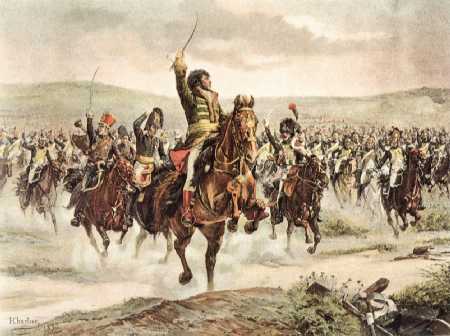
In addition to other important historical anniversaries (Happy Birthday, Mom!), today is the 200th anniversary of the battles of Jena and Auerstadt, at which Napoleon's Grande Armee (particularly its cavalry) destroyed the Prussian army and drove Prussia out of the Third Coalition. Georg Wilhelm Friedrich Hegel later described the battles as "The End of History," which should warn all of us not to read too much into current events.

Monday, October 09, 2006

Arresting the Lollypop Guild

Many adjectives can be used to describe the American misadventure in Iraq, but "funny" has never really been one of them. Military occupation and counter-insurgency don't lend themselves to humor. There are always exceptional moments, however, like the one described by an anonymous Marine in this unclassified September 14th letter:

"[My] Most Surreal Moment [in Iraq] - Watching Marines arrive at my detention facility and unload a truck load of flex-cuffed midgets. 26 to be exact. I had put the word out earlier in the day to the Marines in Fallujah that we were looking for Bad Guy X, who was described as a midget. Little did I know that Fallujah was home to a small community of midgets, who banded together for support since they were considered as social outcasts. The Marines were anxious to get back to the midget colony to bring in the rest of the midget suspects, but I called off the search, figuring Bad Guy X was long gone on his short legs after seeing his companions rounded up by the giant infidels."

The letter deserves to be read in full -- it's a great primary source, filled with telling details ("Favorite Iraqi TV Show - Oprah. I have no idea. They all have satellite TV") and laced with dry wit. One hopes that the author makes it home safely.

Wednesday, September 20, 2006

The Cows, and Coming Home

This week (Saturday the 23rd) marks the 200th anniversary of the return of the Lewis & Clark expedition. Earlier in the month the Corps of Discovery passed several traders' pirogues heading up the Missouri River, but on September 20th, 1806 -- two centuries ago today -- they encountered their first definite sign of European settlement in two years: cattle. "We saw some cows on the bank," William Clark reported, "which was a joyful sight to the party and caused a shout to be raised for joy." (William Bakeless, The Journals of Lewis and Clark, 382.)

It may seem a comical episode, but it also helps affirm Alfred Crosby's observation that the most important feature of early modern European expansion was the "portmanteau biota" Europeans brought with them: cattle, sheep, horses, swine, rabbits, wheat, grapes, peaches, various weed species, and epidemic diseases like smallpox. These plants, animals, and microbes provided European colonists with larger and more reliable supplies of food, fiber, and animal energy than their indigenous competitors, not to mention a biological arsenal (however inadvertantly used) that was far more lethal than Europeans' muskets and artillery. William Clark didn't mention all this in his journal entry, of course, but he did suggest that the most characteristic sound of Euro-American civilization in 1806 was not the pealing of church bells or the clanking of steam engines, but rather the mooing of American settlers' bovine vanguard.

Monday, September 18, 2006

The Latest Craze with All the Kids Today

In last week's post I mentioned that one of the Inuit who sojourned in Europe in the 1560s had facial tattoos, which were quite common among 16th-century Eskimo men and women. Such tattoos fell out of fashion by the early 20th century, but appear to be making a partial comeback, according to a story in the September 17, 2006 issue of the Anchorage Daily News. Author Alex Demarban reports that several women from the Inupiat community of Barrow, Alaska are reviving the practice of tattooing their chins (usually with blue stripes or circular patterns of dots), as a way of honoring their ancestors and cultural heritage. One man, a whaler, is planning to tattoo a whale-tail necklace on his chest to record his kills.

"Tattoos were common throughout Alaska for hundreds of years," Demarban reports. "Some elder seamstresses used bird-bone needles...sinew, thread, and soot to decorate human canvasses, said Lars Krutak, an anthropologist who studied the custom in Alaska and elsewhere. For women who bore elaborate designs across faces and necks to enhance beauty or fertility, it was a painful rite of passage...For hunters, the etchings - usually dark blue - boosted bravery and could ward off evil spirits."

According to Demarban and Krutak, Christian missionaries and boarding schools were responsible for "stamping out" Inuit facial and chest tattoos, though the indigenous inhabitants of St. Lawrence Island continued the practice into the 1920s. It remains to be seen whether the current revival of facial tattoos is just a quirky decision by a few isolated people, or whether it becomes a larger cultural trend. If the latter is the case, we will at last be able to use the words "major cultural trend" and "Barrow, Alaska" in the same sentence.

Monday, September 11, 2006

New Prey: Voyagers to the East Part IX (redux)

For the previous entry in this series, click here. For the original Part IX, click here.

In their essay "This New Prey: Eskimos in Europe in 1567, 1576, and 1577" (in Christian Feest, ed., Indians and Europe: An Interdisciplinary Collection of Essays [Nebraska, 1999], 61-140), William Sturtevant and David Quinn provide some additional information on these involuntary travelers. The Inuit who came to Europe in 1567 were a woman and her 7-year-old daughter, captured by French or Basque sailors in Labrador the previous year, and put on display in Antwerp and the Hague. A contemporary woodcut portrays the two captives wearing hooded sealskin parkas and shows the unidentified woman's facial tattoos; a German handbill describes them as "wild people and man-eaters" and expresses the hope that mother and daughter were both converted to Christianity (130-131). Sturtevant and Quinn assert, however, that "they cannot have survived long and certainly never saw their homeland again" (68).

It's a fair guess, because none of the four Inuit whom Frobisher took to England in 1576 and '77 survived for more than a few weeks. The unnamed Inuit man captured in 1576 caught cold while at sea and "died about 15 days after arriving in London" (72). Frobisher and his partners bought medicine and bedding for the man, and paid for his coffin and burial in Saint Olave churchyard, at a total cost of 8 pounds sterling. The three Inuit captured in 1577 -- a man named Kalicho, a woman named Arnaq, and a baby named Nutaaq -- lived only slightly longer. Kalicho was well enough to display his canoeing and duck-hunting skills on the Avon River in October 1577, but he soon sickened and died, probably of an infected lung. Arnaq and Nutaaq died of unspecified causes in early November. Kalicho and Arnaq were interred at St. Stephen's Church in Bristol and Nutaaq at Saint Olave Church in London. (84).

For the next entry in this series, click here.

Thursday, September 07, 2006

Plus ca Change...


While reading Georges Lefebvre's 1939 history of The Coming of the French Revolution , I was struck by the uncanny similarities between the French monarchy's fiscal crisis -- the same crisis that destroyed Louis XVI's government -- and the financial problems of the modern United States government. The Bourbons ran regular budget deficits for most of the 18th century, and by 1788 the annual French deficit had grown to one-fifth of the size of total government outlays. Lefebvre quotes a 1788 budget forecast projecting public expenditures of 629 million livres and revenues of 503 million livres, resulting in a nominal deficit of 126 million livres. The actual deficit, however, was ultimately higher because a poor harvest throttled tax revenues.

Meanwhile, decades of borrowing had created a mammoth national debt and interest payments that crowded out other forms of public spending. In 1788 the French government spent 25% of its money on royal and civil expenses, another 25% on its army and navy -- and a crippling 50% on debt service. France's creditors had reached the end of their patience and would no longer loan money without huge concessions: the national Bank of Discount, for instance, only agreed to float a 100-million-livre loan if the King allowed its notes to circulate as legal tender. (Lefebvre, pp. 21-22)

The regime could not raise existing taxes to cover the shortfall because the commoners, who paid most taxes, had no more money to give. Between 1741 and 1785 "prices had risen 65 per cent and wages only 22 per cent" (p. 23); meanwhile, rents rose by 98%. As in the modern United States, the earnings of ordinary workers -- laborers and tenant farmers, in this case -- were stagnating or declining relative to inflation, while a few landlords and merchants were getting quite rich. Moreover, the wealthiest Frenchmen -- bishops, aristocrats, and rich bourgeois -- were partially or totally exempt from paying taxes. Sound familiar?

The French monarchy had only two ways out of its bind: it could inflate its debt out of existence, which in practice it was beginning to do (by monetizing the Bank of Discount's notes), or require the privileged orders to pay their fair share of taxes. When the King and his councillors chose the latter course, they caused the Breton nobility to rise in rebellion, and other nobles and jurists to demand the calling of the Estates-General, a concession which Louis XVI finally granted and which led to the end of the Old Regime.

The early 21st-century United States hasn't reached the same crisis point, but the comparable data are not reassuring. In FY 2006 U.S. tax receipts equalled $2.18 trillion, over 80% of which came from income and FICA taxes, while outlays equalled $2.57 trillion. 11% of last year's outlays ($390 billion) were financed with deficit spending. Interest payments on the national debt ($210 billion) equalled 8.2% of federal expenditures -- well below the French level, but greater than annual federal spending on Medicaid or combined annual federal spending on education, the environment, and foreign aid, and close to half of the United States' current defense spending (17%).* Finally, median household income in the United States has been stagnant since 1973 and has dropped an average of 2.8% since 2000, while prices have risen 17.5% during the past six years and 365% since 1973. (Sources: Concord Coalition, Washington Monthly [citing U.S. Census Bureau figures], Inflation Calculator.)

Is the United States on the verge of its own Bastille Day? Not exactly -- but we've been headed in that direction for thirty years (the late 1990s excepted), and some of our leaders seem determined to speed up the parade.

* The largest federal expenditures remain Social Security, Medicare, and Medicaid, which collectively account for 45% of the budget; Paul Krugman isn't exaggerating when he calls the U.S. government "a mammoth insurance company with an incorporated army."

Thursday, August 24, 2006

Voyagers to the East: A Preliminary Head Count

For the previous entry in this series, click here.

How many Native Americans visited Europe, willingly or unwillingly, during the first few centuries of European contact? My essay series on these early voyagers is far from complete, but the first nine entries provide enough information to support a preliminary headcount and some early observations.

1493: 17 Tainos brought to Spain by Columbus
1494: (See below)
1495: 350 Tainos and Caribs brought to Spain as slaves
1496: 30 more Tainos taken by Columbus
1501: 50 Micmacs, brought to Portugal as slaves by the Corte-Real expedition
1502: 3 Micmacs (or Inuit) brought to England by Fernandes and Gonsalves
1508: 7 Micmacs brought to France by Aubert
1523: 1 Florida Indian (Francisco de Chicora) brought to Spain
1524: 1 southern Algonquian boy brought to France by Verrazzano
1525: 58 Penobscots taken to Spain as slaves by Gomez
1531: 1 Brazilian chief taken to England by Hawkins
1535-36: 3 Hurons (Donnaconna et al.) brought to France by Cartier
1550: 50 Tupi-Guarani brought to France
1567-77: 5-8 Inuit brought to France and England

In my earlier posts on Columbus I failed to note that the explorer sent over two dozen Carib and Taino captives back to Spain in 1494. Giovanni de'Bardi wrote that several Spanish caravels had returned from the West Indies carrying spices, gold, sandalwood, and "twenty-six Indians of diverse islands and languages." ("Letter from Seville," 19 April 1494, in Geoffrey Symcox and Blair Sullivan, Christopher Columbus and the Enterprise of the Indies [Boston: St. Martin's, 2005], p. 100.) Adding these 26 men and women to those listed above makes a total of 603-605 Native Americans brought to western Europe between 1493 and 1577.

Of these about 420, or 70%, were Tainos and Caribs brought to Spain by Columbus and his associates between 1493 and 1496. Another 130 were Inuit or Indians from the northeastern edge of North America (Micmacs, Penobscots, and Hurons). Nearly all of the rest were Tupi-Guarani villagers from Brazil. Apart from the aforementioned Hurons, none came from the North American interior.

At least 460 (75%) of these travelers were kidnapped o Spain and Portugal and sold as slaves. The rest accompanied European explorers as trophies, translators, or living advertisements for colonization (as with the 50 Tupi-Guaranis displayed at Rouen in 1550). We may speculate that as Europeans stopped bringing Indians to Europe as slaves -- due to legal prohibitions and the greater demand for slave labor in the Caribbean -- the total number of Indians brought to Europe in the late 16th and 17th centuries also fell. Forthcoming entries in this series will determine whether or not this is an accurate guess.

For the next entry in this series, click here.

Tuesday, August 15, 2006

Voyagers to the East, Part IX

For the previous entry in this series, click here.

As educated Europeans' interest in the New World and its inhabitants continued to grow, mariners continued to bring captive Native Americans to Europe, either to help promote colonial ventures or as money-making exhibits in their own right. During the second half of the 1500s, several navigators succeeded in accomplishing what Thomas Hore and his colleagues had failed to do in the 1530s: capturing Inuit men and women and returning with them to Europe. In 1567 French or Flemish sailors brought several Eskimo captives back to the Continent, and in 1576-77 the English explorer Martin Frobisher captured four Inuit -- two men, a woman and a baby -- during two separate voyages along the coast of Baffin Island. Frobisher was searching for a Northwest Passage to China, but during his reconnaissance he discovered what he believed to be rich gold deposits, and he brought his hostages back to England to build support for a mining colony in far northern North America. Frobisher's colony in "Meta Incognita" (as Queen Elizabeth I called it) died quickly, once the "gold" deposits turned out to be iron pyrite, and his Inuit captives almost certainly died within a few months of reaching England -- though they apparently lived long enough to allow John White to paint their portraits in watercolors. (Goertzman and Williams, The Atlas of North American Exploration, 28-29.)

For the next entry in this series, click here.

Sunday, July 16, 2006

Target-Rich Environment

Several weeks ago, the U.S. Department of Homeland Security caused considerable alarm by announcing substantial cuts in anti-terrorism funding for major American cities, and by declaring that there were no significant terrorist targets in New York City. Now, thanks to an internal audit of the department's National Asset Database (detailed in The Carpetbagger Report), we know what the DHS considers likely targets for terrorist attack:

* Old MacDonald's Petting Zoo (Huntsville, AL)
* The Amish Country Popcorn factory (Berne, IN)
* Kangaroo Conservation Center (Dawsonville, GA)
* Bourbon Festival (Bardstown, KY)
* The Mule Day Parade (Columbia, TN)
* The Sweetwater Flea Market (Sweetwater, TN)
* Bean Fest (Mountain View, AR)
* Nix's Check Cashing
* Mall at Sears
* Ice Cream Parlor
* Donut Shop

Most of these strategic installations are in Midwestern and Southern states whose voters have been more supportive of the current presidential administration than New Yorkers. In fact, the state with the longest list of potential targets is Indiana, which has voted Republican in every presidential election since 1964, and whose current governor used to direct George W. Bush's Office of Management and Budget. Indiana's homeland security department identified 8,500 vital assets in need of federal protection -- nearly as many as California and New York combined. (Last Thursday the Indiana DHS claimed that they were "confused." No doubt.)

It's tempting to argue that this list demonstrates the incompetence of the Homeland Security Dept. It's equally tempting to speculate that our Protectors of the Homeland have concluded, after reading several Philip K. Dick novels (Time Out of Joint in particular), that such seemingly mundane places as "Tackle Shop" and "Beach at End of a Street" are actually of vital importance to national security. Homeland Security Inspector General Richard Skinner, whose audit of the National Asset Database led to this story, doesn't seem to agree that the database is "an accurate representation of the nation's...critical infrastructure and key resources," but perhaps he just can't perceive the hidden truths to which his more illuminated colleagues are privy.

Friday, July 07, 2006

No Land War in Asia

Apropos of the United States' current round of mutual saber-rattling with North Korea, and for the edification of those who may feel that Kim Jong Il's pursuit of nuclear weapons and long-range missiles makes him more of an international threat than Saddam Hussein once was, I offer the following corrective primer, courtesy of my friend and Far Eastern Affairs consultant, Jon Lay:

TOP TEN REASONS TO REACT DIFFERENTLY TO NORTH KOREA IN 2006 THAN WE DID TO IRAQ IN 2003:

10) They actually have Weapons of Mass Destruction. You know what those do, right?

9) Restarting the Cold War will significantly diminish the value of Reagan Dimes.
8) Japan is asking us to intervene, and frankly, we're feeling like we've been doing a lot for Japan over the last 60 years.
7) Not threatening to invade them just because they're not Arabs, would – in its own way – also be racist, if you think about it. No, think about it some more. More. There you go.
6) The United States has no idea how to go about waging a war on the Korean Peninsula.
5) Toby Keith still negotiating soundtrack terms. Once we get that worked out, it's bombs away.
4) Disrupting the flow of cheap plastic crap from China is potentially more damaging to our economy than losing whatever it is that we import from the Middle East.
3) George Bush is a pacifist firmly committed to resolving all conflicts through dialogue, as Jesus would.
2) With Army enlistment and morale at such record heights, we're worried we'd beat them so badly other nations would feel bad about themselves.
1) Osama Bin Laden didn't tell us to get the hell out of South Korea like he did Saudi Arabia – so we don't need to move our troops to North Korea.

Wednesday, June 28, 2006

Voyagers to the East, Part VIII

For the previous entry in this series, click here.

A noteworthy feature of 16th-century French political culture was the ceremonial entry of a new king into each of the principal cities of his realm. These "joyeuses entrees" were festive events marked by parades, pageants, feasts, public addresses, and (usually) the city's presentation of a large gift to the king. The festival of entry satisfied the king's need for homage, but it also served two important purposes for the local citizens: it allowed them to re-affirm their special corporate identity as city-dwellers, and it gave them the opportunity to express their community's aspirations. (Frederic Baumgartner, Henry II: King of France, 1547-1559 [Duke University Press, 1988], 92-93.)

In October 1550 the city fathers of Rouen, a maritime community on the Seine estuary, organized an unusual entry festival for King Henri II and Catherine de Medici, one intended to promote royal interest in overseas colonization. In a field outside of the city walls the inhabitants prepared a simulated Brazilian forest and village, complete with fake brazilwood trees, imported parrots and monkeys, log huts with thatched roofs, hammocks, and dugout canoes. The tableau included over three hundred "Brazilians," who paraded before the monarchs and conducted a mock battle with bows and clubs.

Fifty of these tribesmen were actual Brazilians, probably Tupi-Guarani kidnapped by Portuguese slavers and sold to sailors involved in the lumber trade. (Brazil's primary export in the early 16th century was brazilwood, which Europeans used as a dyestuff.) Some of the other 250 participants were French sailors familiar with the Brazilian coast, its inhabitants, and their language. Most were ordinary young French men and women dressed, or rather undressed, as Indians, wearing little more than a coating of red dye. (This must have been chilly in early October). The pageant thus represents one of the earliest recorded examples of a cultural activity that would, in time, become quite popular in British America: "playing Indian."

Rouen's merchants and sailors hoped that the pageant would build political support for trade with the Indies and colonization in America, and their hopes were soon realized. In 1555 Henri II commissioned a party of adventurers to establish a French colony in southern Brazil, near the site of present-day Rio de Janeiro. The settlement of "France Antarctique" survived for twelve years, and descriptions of its Native American neighbors inspired Michel de Montaigne to write his essay "Of Cannibals," an early exploration of the theme of the "noble savage." (Parts of his theme found their way into Act II, Scene 1 of The Tempest). It seems possible that some of the kidnapped Tupi-Guaranis who participated in the 1550 pageant came to the new colony as guides and translators, though there is no certain documentary proof of their fate.

A contemporary description of the Brazilian pageant, titled La deduction du sumpteux order plaisantz spectacles et magnifiques theatres dresses ... par les citoiens de Rouen ... a la sacrée maieste du treschristian roy de France, Henry seco[n]d ... et à tresillustre dame, ma dame Katharine de Medicis [Rouen, 1551], p. 67, can be found here on the British Library website. A 2006 book on the pageant, Michael Wintroub's A Savage Mirror, is available from Stanford University Press.

For the next entry in this series, click here.

Saturday, June 17, 2006

Shocked, I Say

Occasionally, I come across a newspaper story so entertaining that it merits retelling without comment. The June 9th issue of the Chronicle of Higher Education carried such a story (page A25), from which comes the following excerpt: "The University of Missouri at Columbia is having a difficult time making use of a $1.1 million donation that Kenneth L. Lay gave in 1999 to establish the Kenneth L. Lay Chair in Economics." According to the story the university offered the job to three different professors between 2000 and 2003, and all of them declined.

I will afford myself one small comment: a $1.1 million endowment would support a professorship whose annual salary would be around $60,000-70,000, plus benefits. This is only 1/3 to 1/2 of what a senior economics professor normally earns at a flagship research university. It's therefore entirely possible that Missouri can't fill the Lay Chair because its benefactor was too cheap, not because he's infamous. If Mr. Lay had instead donated $11 million, that chair would not have remained vacant for long.

[Update, July 6th: I guess it's now the Kenneth L. Lay Memorial Chair in Economics.]

Friday, June 09, 2006

Pine Trees and Sovereignty

June 10th marks the anniversary of the issuance of the Pine Tree Shilling (1652), the first coin minted by English-speaking settlers in North America. Those who might regard this as mere numismatic trivia are invited to read Mark Peterson's fascinating essay in the April 2006 issue of Common Place, "Big Money Comes to Boston." In it, Peterson notes the difference between what he calls "big money" (gold and silver coins issued by sovereign states) and "little money" (informal currencies like cowrie shells) in the 17th-century Atlantic world, and identifies the minting of the Pine Tree Shilling as the moment when Bostonians formally shifted to a big-money economy. He also explains how Bostonians' efforts to establish first a little-money economy, based on wampum, and then a big-money economy based on precious metals reflected the colony's ambitious territorial and commercial aspirations, linking coinage to the fur trade, the Pequot War, the silver mines of Potosi, and the West Indies. Finally, he describes the amusing -- and, for a long time, successful -- efforts of colonial officials to convince Charles II that they had not usurped his royal prerogative. (I particularly liked Sir Thomas Temple's insistence that the pine tree engraving was actually the Royal Oak, in which Charles II had hidden after losing the Battle of Worcester [1651], and that the coin was therefore a hidden tribute to the exiled king.) Charles' brother James was not taken in by such arguments and put an end to the new coinage when he became king, but this was merely a temporary setback for New England officials, who in the eighteenth century found a new way to produce money: by printing it.

(Image above is from the National Museum of American History, Washington, DC, via http://amhistory.si.edu/coins/printable/coin.cfm?coincode=1_00. Added 11 June 2018.)