Showing posts with label Diplomacy. Show all posts

Sunday, April 30, 2023

That's Quite Enough, Mister Manypenny


Your Humble Narrator occasionally still publishes A Thing (other than this blog). Last fall the online journal Cosmos & Taxis included my article "Mr. Manypenny's Millions: Freedom and Sovereignty in the Nineteenth-Century Native American Annuity Conflict." "Freedom" is what Commissioner of Indian Affairs George Manypenny feared Indigenous Americans would lose if they became dependent on U.S. government annuities; "Sovereignty" is what Native American recipients believed these annuities regularly demonstrated. (Also, they were usually payments for past land cessions.) Why some Indigenous American leaders nonetheless agreed to convert their annuities to lump-sum payments forms a significant part of the story.

Behold, the very source of one's enslavement.


Thursday, February 23, 2023

In the Army Now

When in 1948 the American ambassador to Egypt, Stanton Griffis, asked for an estimate of army strength in a nearby Southwest Asian country*, his attache replied “five thousand men under arms, half…usually absent without leave, and other half looking for them. When they find them they change places.” This seems an eminently sensible strategy to me, applicable to service in many non-military institutions as well.


Sources: Stanton Griffis, Lying in State (1952), p. 215; Douglas Dixon, Beyond Truman: Robert Ferrell and Crafting the Past (Lanham, MD, 2020), 135.


* The ambassador did not identify the country in question, but I suspect it was Lebanon, whose army was then new, small, and underfunded.


Monday, May 09, 2022

Diplomacy by Other Means


Conventional histories of the United States paint a lurid portrait of the republic’s early relationship with the Muslim world, especially with the so-called Barbary Coast states of northern Africa. The particulars of the Americans’ first violent encounter with a North African principality complicates the usual account of scimitar-wielding “Barbary corsairs” demanding tribute or enslaving white sailors. In October 1784 the American brig Betsey, en route from Boston to Tenerife, was captured by Moroccan raiders and by them taken to Sale. Perhaps the ten crewmen expected enslavement, but instead local officials held them as hostages, by order of the Moroccan sultan. Sidi Muhammad ibn Abdallah (r. 1757-90), the prince in question, had ordered the ship taken and its crew held not because he thirsted for blood and plunder, but as a diplomatic gambit. The United States, whose independence the sultan had recognized in 1777, had promised to send treaty commissioners to Morocco after the Revolutionary War. The increasingly moribund postwar Congress, however, dithered too long for Sidi Muhammad’s liking, and failed to send him either gifts or contrite sentiments by way of apology.


Modern brig (Maria Asumpta), by Murgatroyd49

Muhammad very much wanted trade with the United States and other Atlantic polities. His principality was poor in resources and its people were mostly self-governing nomads, from whom the sultan could expect little in taxes. Sidi Muhammad also wanted other nations to take him seriously as a sovereign. The capture of the Betsey was essentially a bit of princely throat-clearing. One could draw a comparison between this act of violent communication and the sharp but limited attacks - coups, as the historian Matthew Jennings calls them - that Native American nations sometimes made against the settlements of Europeans who had not treated them with proper respect. The goal, in each case, was not to start a war but to remind the other polity of the comparative benefits of peace, and to remind them too not to take the attacker for granted.


Sidi Muhammad’s act of diplomatic piracy paid off. The United States resumed communication with Morocco, and the sultan released his hostages into Spanish custody. In 1786 American commissions signed the Treaty of Marrakesh, a favorable commercial agreement with Morocco, henceforth a destination (if a marginal one) for American merchant ships. The treaty also clarified that the Moroccan state’s first attack on those ships was its last one: it guaranteed the Americans against detention and having to pay tribute to the sultan and his successors.


Sources: Linda Colley, The Ordeal of Elizabeth Marsh (Doubleday, 2009); Gary Wilson, "American Hostages in Moslem Nations, 1784-1796," Journal of the Early Republic 2 (1982): 123-141.


Friday, June 28, 2019

To Crush Your Enemies and See Them Driven Before You


Signed one hundred years ago today, the Treaty of Versailles contributed more to the outbreak of World War Two than any other event not named "Adolf Hitler." Meeting amidst the splendors of Louis XIV's palace with representatives of the German state, the victorious Allies kicked their Great War adversaries in the teeth, hard. Germany lost most of its armed forces and twenty-five percent of its territory, and took on a reparations bill of 130 billion marks (about 400 billion dollars in modern currency), a sum so great that it fueled the hyperinflation that ruined the Weimar Republic. Germans also had to accept responsibility for World War One, declaring themselves the sole guilty party and Britain and France spotless victims. The German commissioners had no choice but to accept this humiliating treaty: thousands of their countrymen were dying from Britain's blockade, which the Royal Navy continued after the Armistice to keep Germany on its knees. The British and French planned to keep the German nation in that posture for years to come.

Joseph Finnemore, Signing of the Treaty of Versailles (Public Domain, 1919)
As important as the onerous terms of the Versailles treaty was the Allies' decision to conclude it with a united Germany. The victors of World War One had broken up the other two empires in the Central Powers (Austria-Hungary and the Ottoman Empire), but left the German polity of 1871 intact. A.J.P. Taylor drew attention to this peculiarity of the post-1918 peace settlement in Origins of the Second World War (1962). He did not need to explain why the German exception proved a fateful one. When a violent nationalist regime took power in Berlin in the 1930s, and began looking for vengeance, a united Germany's population and resources ensured that it would be able to take revenge on its former conquerors.

Also worth noting: the statesmen at Versailles and the other post-WWI treaty conferences may have thought themselves makers of a lasting peace, but hundreds of thousands of more obscure men still had guns in their hands and wounded pride in their hearts. The guns fell silent in France and Italy but continued their deadly work elsewhere. Germany surrendered, but the reactionary freikorps kept killing in Bavaria and the Baltics, gunning down socialists and Latvian nationalists. Fighting continued on the old Eastern Front for years, until the Bolsheviks triumphed over the counter-revolutionary armies who opposed them. By then over a million people had died, not including those who succumbed to famine in southern Russia and Ukraine. Turkish nationalists did not accept the Allies' colonization of the Ottoman Empire. Under Kemal Ataturk they defeated a Greek army sent to colonize western Anatolia, forced Britain and France out of Istanbul, and created a united Turkish ethnostate. At the southern end of the Ottoman domain, the Saud family cancelled the political victory of Britain's clients, the Hashemites, seizing the Hejaz in 1924-25 and establishing the independent Kingdom of Saudi Arabia. Domination and humiliation make poor foundations for peace, particularly if those doing the dominating and humiliating are themselves exhausted by years of war. (See Robert Gerwarth, The Vanquished: Why the First World War Failed to End [2016].)

Monday, December 31, 2018

Any Good News in 2018?


Bad news is usually much easier to find than good, if only because good news usually unfolds at a slow pace. Plane crashes, volcanic eruptions, violent protests, and divisive legislative votes have both the brevity and drama best suited to a commercial news publication or broadcast. Yet good news is always there if we know how to look for it. FutureCrunch (h/t my sister Corinna) compiled a list of the 99 best pieces of good news reported during the past year, from which I offer the following sampling:  

Eritrean-Ethiopian Peace Run, Oct. 2018 (Madote.com)
In 2018, the West African nation of Niger reported it has planted 200 million trees since the late 1980s. India constructed 30-40,000 kilometers of roadway made with waste plastic. World wind and solar power production reached 1.0 terawatts, enough to power 300 million homes at U.S. consumption levels. A new cholera vaccine went into use. South Africa reported a 44 percent decline in new HIV cases in the last six years, and Paraguay officially eradicated malaria within its borders. Ethiopia and Eritrea signed a peace treaty. Canada legalized marijuana, Ireland legalized abortion, and Pakistan legally guaranteed transgender rights. Russia revealed a decline in drinking, though I’ll bet Russians can still drink any other nationality under the table. And NASA announced it will send a helicopter to Mars in 2020, because why not?

Monday, February 12, 2018

Cotton Mather and the Bomb

In British America, in the eighteenth century, the month of November became known for the destructive revelry of Pope's Day. It was not anti-Catholic enthusiasm, however, that induced someone to fling a very large firecracker - a bomb, actually - through Cotton Mather's window on the fourteenth day of that month, in the year 1721. Rather, the anonymous bomber wanted to lodge a protest against a controversial new medical technique, smallpox inoculation, that the clergyman had just introduced to Boston. Like other remote European colonies, Massachusetts suffered from repeated outbreaks of the dread pox. The epidemic of 1721 infected a quarter of the city and left hundreds dead. Normally New England colonists dealt with smallpox through quarantine. Deliberately inoculating a healthy person with infectious pus in order to induce a (usually mild) case of smallpox, thus bestowing immunity on whomever survived the treatment, seemed both dangerous and perverse. That Mather learned of inoculation from Boston's African slave community further undermined his credibility in the eyes of white colonists, even though West Africans had been dealing with smallpox for centuries.

The bomb, a gunpowder-and-turpentine-filled grenade, failed to detonate, allowing Mather to die peacefully in his bed six years later. It also allowed him to read the note attached to the deadly billet-doux: "Cotton Mather, you dog, damn you, I'll inoculate you with this." Such sentiments remained common in Boston for some years thereafter. Former Bostonian Benjamin Franklin declined to inoculate his own offspring, later lamenting his decision when one died of smallpox in childhood. Military necessity obliged George Washington to inoculate the Continental Army in 1777. His soldiers might have disdained the procedure but their commander didn't allow them to vote on it. Even quarantine could provoke violence, as during riots in early 1774 against the inmates of a Boston smallpox hospital. 

The notion of injecting oneself or one's children with a foreign substance, even through a very safe procedure like vaccination (inoculation with a dead or weakened microorganism), remained an uncomfortable one for many. Indeed, opposition to vaccination can be revived even in a more scientific age, and adults who religiously vaccinate their children still find the procedure creepy enough to ignore the needs of their own immune systems. How many of my readers get their flu shots every year?

*

Sources: Mark Peterson, "Life on the Margins: Boston's Anxieties of Influence in the Atlantic World," in Wim Klooster and Alfred Padula, eds., The Atlantic World: Essays on Slavery, Migration, and Imagination (Prentice Hall, 2005), 45-59, esp. 57-58; Pauline Maier, "Popular Uprisings and Civil Authority in Eighteenth-Century America," William and Mary Quarterly, Third Series, 27 (Jan. 1970): 3-35, esp. 5-6.

Wednesday, December 14, 2016

The Great Peace That Made No Peace


Indian treaties don’t receive much attention in the United States. Their dates sometimes adorn out-of-the-way plaques and monuments, and their terms repose in the historical memories of the Indian signatories (and their descendants), but none occupy a place in the mainstream American narrative comparable to the 1783 Treaty of Paris or the 1919 Treaty of Versailles. In Canada matters are somewhat different: Indians appear in Canadian historical memory more as allies than adversaries, and at least one Native American treaty, the Great Peace of 1701, became memorable enough to inspire a postage stamp and a tercentenary celebration in the host community (Montreal). The pageantry of the treaty conference certainly must have impressed both the Montrealais and the Indian conferees: 1,300 Native Americans from forty nations came to the small town for three weeks of feasting, speech-making, wampum belt exchanges, and solemn promises. French officials constructed a meeting hall and a 9,000-square-foot open-air arena for the meeting, and both French officers and Native American leaders wore their best attire.


While some French demands, like the requirement that the signatories return their captives, proved difficult to meet, at length the Indian diplomats and French governor Louis-Hector de Callieres signed the agreement. The treaty ended the on-again, off-again war between France, its Indian allies, and the Five Nations of Iroquois, a conflict that had lasted for a century. New France now had a secure southern flank for the next fifty years, and more stability than it had enjoyed since its founding.


Whatever else the 1701 treaty may have established, however, a “Great Peace” did not really come out of it. French officials’ commitment to returning captives led Callieres and his successors to promise Indian slaves in place of those whom they could not return. This initiated New France’s sixty-year involvement in the North American Indian slave trade. Concurrently, New France took advantage of its new security arrangements to send troops and officials into its march lands, building up its outposts of Detroit, Michilimackinac, and Vincennes.  French officials’ desire to impose peace and order on this far-flung region drew France into the bloody Fox Wars (1712-30), which led to the death or enslavement of more than 2,000 Indians. French authority began slipping nonetheless when Lakes Indians used the peace to travel to Albany or Oswego to trade with the English. The lure of cheaper English goods undermined the commercial power of French traders, and in the 1740s some French allies openly rebelled against those traders and opened negotiations with the English colonies. 

It would be fairer to say the treaty marked a shift to a more openly imperialistic policy on France's part, whereby France sought to establish sovereignty over its Indian "subjects," and forcibly to prevent them from warring on one another or coming under the authority of another European sovereign. If so, the Great Peace of 1701 actually set New France on the road to a new confrontation with the English colonies, and ultimately to the war that brought about the empire's collapse. 

Sources: Richard Aquila, The Iroquois Restoration (U. of Nebraska, 1983), 60-66; Brett Rushforth, Bonds of Alliance (UNC Press, 2012), 155-160.

Monday, November 30, 2015

Alexander McGillivray Strikes a Pose


Midway through my graduate studies, the editors of American National Biography commissioned me to write two entries on early American congressmen. Both of my subjects, William Loughton Smith and William Vans Murray, shared a common regional and party identity, apropos of which my adviser Lance Banning said I would soon become an expert on obscure Southern Federalists. Not a terribly marketable specialty, I had to admit. Fortunately, Lance's prediction did not come to pass, and the assignment instead brought me more tangible benefits: one of my first professional writing credits, a modest but welcome paycheck, and some useful bits of research.


Of the two congressmen Smith proved the less likable. He struck me as a typical spoiled conservative rich kid: born into money in South Carolina, educated abroad, lukewarm about the American Revolution but keen to draw a salary from the new government it created, and supportive of Alexander Hamilton's elitist national economic program. After his few minimally consequential terms in Congress, W.L.S. became the United States' minister to Portugal, a suitably obscure last chapter to an obscure public career. The men with whom Smith worked, however, were often quite famous, and one particularly intriguing acquaintance became directly relevant to my dissertation and first book.


In 1790 William Smith attended the formal signing of the United States' first treaty with the Creek Indian nation, the Treaty of New York. After the main event, Smith exchanged a few pleasantries with the most famous Creek man at the conference, Alexander McGillivray. Since the end of the Revolutionary War, the biracial warlord had harried Southern white frontiersmen and perturbed American officials. Now assuming a more pacific and magnanimous posture, McGillivray told the congressman that “his Nation [the Creeks] had been always much pleased with the conduct of South Carolina and had been well treated by us.” By contrast, he continued, the white inhabitants of neighboring Georgia “thought too highly of their own power and too meanly of that of his [McGillivray's] nation.” The new treaty gave Georgia “a line more favorable than they had any right to expect” - an allusion to the Creeks' recent raiding campaigns against that state's frontier, the military power they had displayed, and chiefs' subsequent willingness to give Georgians some of the Creek lands they demanded. Smith closed by noting that George Washington and his secretary of war, Henry Knox, had been competing with one another in demonstrations of courtesy and hospitality toward the Creeks. Their solicitousness may have contributed to McGillivray's good humor, but probably had no bearing on the outcome of the treaty itself. 

Indeed, McGillivray displayed rather more hauteur in his conversation with Smith than one would expect from a southeastern Indian leader, especially one on a diplomatic mission. His arrogant posture toward Georgia, I suspect, was just that, a pose. Native Americans always made their diplomatic conferences stagy and dramatic events, though they differed in one significant way from stage plays: the Indian "actors" usually got to write their own parts. McG had apparently, in this exchange at least, decided to adopt the role of a triumphant but magnanimous general. Perhaps he modeled his part on some of the reading he had done while he was a boy, attending school with white colonists' children in Smith's own hometown of Charleston, South Carolina. The cultural distance between nabob and warlord wasn't always as great as one might assume.


Sources: George Rogers Jr., ed., "Letters of William Loughton Smith to Edward Rutledge" (8 Aug. 1790), South Carolina Historical Magazine 69: 135; Michael D. Green, "Alexander McGillivray," in R. David Edmunds, ed., American Indian Leaders: Studies in Diversity (Lincoln, 1980), 41-63.

Sunday, February 14, 2010

A Hard World for Little Republics

It's not easy being a small nation in a world of aggressive Great Powers. Consider the experience of diplomats from the short-lived Italian republic of Lucca, who in the spring of 1814 petitioned Emperor Francis of Austria for "the restoration of their independence." Francis replied - in Italian, graciously enough - "Tutti hanno fame, anch'io voglio mangiare, emmeglio che io vi mangi che se fosse un altro," which translates as "Everyone is hungry, and I need to eat too, and it is better I should eat you than another." (Adam Zamoyski, The Rites of Peace [New York, 2007], 234.)

I'll have to remember that line the next time I play Diplomacy.

Monday, August 24, 2009

Things I Learned at the SHEAR (2009)

The annual meeting of the Society for Historians of the Early American Republic (SHEAR) is one I've taken care not to miss. It differs from other professional conferences in that A) it occurs in the summer, B) there is no job registry, and C) it has a single chronological and national focus (the United States, 1776-1861). Consequently, the convention primarily attracts people who want to attend panels and talk about history, as opposed to the American Historical Association and OAH conventions, which are full of anxious job-seekers and junior professors trying to shmooze. The SHEAR is one of the few conventions devoted almost exclusively to its attendees' intellectual development. Well, that and founder James Broussard's nickel-ante poker games, at which I've lost about $50 since 2002.

This year's SHEAR conference took place in Springfield, Illinois from July 16th through 19th. Given the location, it's not surprising there were several panels devoted to my academic specialties, the early American frontier and early U.S. - Indian relations. For me, it was a productive meeting. Herewith, some of the things wot I learned:

Robert Owens ("A Tale of Two Treaties"), comparing the 1768 and 1784 treaties of Fort Stanwix, asserted that U.S. Indian policy after the Revolution was "more evolutionary than revolutionary," a point with which I am inclined to agree.

Susan Gaunt ("Markets and Liberal Rhetoric in Post-Revolutionary Kentucky") noted that American boatmen taken prisoner by Spanish patrols on the Mississippi River were put to work building fortifications for Spain. This both demonstrated American weakness in the 1780s - the U.S. government couldn't protect its citizens' presumptive right to navigate the Mississippi - and Spain's fear of the United States' future power (hence the fortifications).

Kristopher Maulden ("They Want to Do You Justice") argued that the Federalists' war against the Northwest Indians in the 1790s was too destructive to be considered just - the War Department deliberately targeted cornfields and villages in order to starve Indians into submission. He observed that the Federalists were less interested in frontier justice than in state-building, which they could only accomplish by creating a monopoly of violence.*

Gregory Nobles ("Looking Back at the Backcountry") reminded his audience of what Patrick Griffin called a "frontier commonwealth ideal," in his 2006 book American Leviathan, which I guess I'll have to re-read.**

Patrick Bollinger ("Prophetic Tools") observed that Miami Indian leaders who opposed Tecumseh and Tenskwatawa's prophetic movement nonetheless used it to their advantage, warning American officials that their young men would "go to Prophetstown" unless the U.S. increased gift payments and moderated its demands for land.

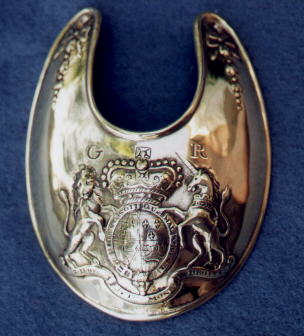
Brad Jarvis ("Our Father in Detroit") described an unusual way of recording the terms of treaties: Ottawa chief Aulieauneay requested from Governor William Hull (of Michigan Territory) a silver gorget inscribed with the words "The Ottawa nation is entitled to $800 a year forever by the Treaty of Detroit." Jarvis also noted that the Ottawa nation had its own problems with the Shawnee Prophet, and that many wanted to destroy Prophetstown because 160 Ottawas visiting the town had died of influenza.

Rowena McClinton ("Demanding and Preserving Nationhood") observed that the Cherokees' efforts to preserve their tribal government persisted during the actual process of Removal (1838-39) - the Cherokee Light Horse Police made an effort to discipline Cherokees who became drunk and disorderly on the Trail of Tears.

And, finally, David Konig, in his comments on a panel on "women's legal troubles," argued that the law didn't just create winners and losers - it was also, like diplomacy and trade, a process of accommodation that reinforced social ties. I suspect it would be hard to convince anyone who's lost a lawsuit of that point, but it sounded good to me.


*  Andrew Cayton noted in his comments, however, that Federalist state-building in the Old Northwest was rather minimally violent when one compares it to, for example, revolutionary state-building in contemporary France.

**  Update, 18 June 2018: Annnnnnnny day now...

Thursday, November 30, 2006

Pine Trees and Penobscots

In my post of June 9th, I discussed Mark Peterson's article on the Pine Tree shilling, the first coin minted by an American colonial government, and its significance as a symbol of Massachusetts's imperial ambitions. A couple of weeks ago I discovered another historical use of the Pine Tree shilling: as an ad hoc medal given to Indians to display (and to secure) their friendship to the colony.

In January 1714 General Francis Nicholson held a peace conference (most likely in Nova Scotia, of which he was the governor) with 5 sachems of the Penobscot, Norridgewock, and Kennetuck divisions of Abenakis. The general presented each man with two Pine Tree shillings, placing one in the recipient's hand and the other in his mouth, that he might never act or speak against the English Crown or its subjects. He declared that the pine tree on the coins symbolized the unity of the English and Abenakis - "they and the English should be like that tree - but one root tho' several branches" - and noted that it was always green, symbolizing truth. (James Baxter, ed., Documentary History of the State of Maine [23 volumes; Portland, ME, 1869-1916], Vol. 23, pp. 53-54.)

Nicholson did not record the Abenakis' reaction, but it's likely that they understood what they were receiving - the Woodland Indians were sufficiently familiar with coins by the early 18th century that some were learning how to counterfeit them. (Colin Calloway, New Worlds for All [Baltimore, 1997], pp. 47-48.) It also seems likely that the sachems were unimpressed with the display: shillings were not valuable coins and Nicholson's metaphors were ersatz.