In British America, in the eighteenth century, the month of November became known for the destructive revelry of Pope's Day. It was not anti-Catholic enthusiasm, however, that induced someone to fling a very large firecracker - a bomb, actually - through Cotton Mather's window on the fourteenth day of that month, in the year 1721. Rather, the anonymous bomber wanted to lodge a protest against a controversial new medical technique, smallpox inoculation, that the clergyman had just introduced to Boston. Like other remote European colonies, Massachusetts suffered from repeated outbreaks of the dread pox. The epidemic of 1721 infected a quarter of the city and left hundreds dead. Normally New England colonists dealt with smallpox through quarantine. Deliberately inoculating a healthy person with infectious pus in order to induce a (usually mild) case of smallpox, thus bestowing immunity on whomever survived the treatment, seemed both dangerous and perverse. That Mather learned of inoculation from Boston's African slave community further undermined his credibility in the eyes of white colonists, even though West Africans had been dealing with smallpox for centuries.
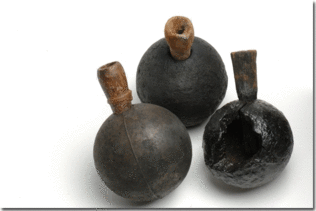
The bomb, a gunpowder-and-turpentine-filled grenade, failed to detonate, allowing Mather to die peacefully in his bed six years later. It also allowed him to read the note attached to the deadly billet-doux: "Cotton Mather, you dog, damn you, I'll inoculate you with this." Such sentiments remained common in Boston for some years thereafter. Former Bostonian Benjamin Franklin declined to inoculate his own offspring, later lamenting his decision when one died of smallpox in childhood. Military necessity obliged George Washington to inoculate the Continental Army in 1777. His soldiers might have disdained the procedure but their commander didn't allow them to vote on it. Even quarantine could provoke violence, as during riots in early 1774 against the inmates of a Boston smallpox hospital.
The notion of injecting oneself or one's children with a foreign substance, even through a very safe procedure like vaccination (inoculation with a dead or weakened microorganism), remained an uncomfortable one for many. Indeed, opposition to vaccination can be revived even in a more scientific age, and adults who religiously vaccinate their children still find the procedure creepy enough to ignore the needs of their own immune systems. How many of my readers get their flu shots every year?
*
Sources: Mark Peterson, "Life on the Margins: Boston's Anxieties of Influence in the Atlantic World," in Wim Klooster and Alfred Padula, eds., The Atlantic World: Essays on Slavery, Migration, and Imagination (Prentice Hall, 2005), 45-59, esp. 57-58; Pauline Maier, "Popular Uprisings and Civil Authority in Eighteenth-Century America," William and Mary Quarterly, Third Series, 27 (Jan. 1970): 3-35, esp. 5-6.
Showing posts with label Puritans. Show all posts
Monday, February 12, 2018
Monday, October 29, 2012
The Late Unpleasantness in Salem
While the colonial period of American history is full of drama and violence, public remembrances of the seventeenth and eighteenth centuries have generally bled all traces of excitement from the story. Our commemoration focuses instead on an arid narrative of pious pioneers building orderly towns on the edge of a wilderness, from which Indians occasionally emerged to skulk about and eat turkey. One well-known episode of public violence and madness interrupts this otherwise dreary story: the Salem witch trials of 1692, popularized in the twentieth century by Arthur Miller's play The Crucible. The bare outlines of this story - ten teenage girls in Salem afflicted with unexplained pains and spectral tormenters, snowballing accusations by locals against other suspected witches (including Salem Village's former minister), a special court which allowed "spectral evidence," over two hundred people accused of witchcraft, 150 of them imprisoned and 20 executed - are reasonably well known today. The causes of the crisis, however, remain a matter of controversy. To a nation with a short and shallow public history, and without much of a tradition of supernatural events, the Salem crisis necessarily remains weird and fascinating. In his recent overview of New England history, Saints and Strangers (2006, pages 121-130), Joseph Conforti performs the useful task of summarizing historians' theories about the origins of the Salem witchcraft trials. I am pleased to recount, with my own observations and glosses, some of his findings here:
I. It was a social forces/conflict/thingie: Forty years ago, in Salem Possessed, Paul Boyer and Stephen Nissenbaum observed that the initial accusers in the Salem cases and the people they accused lived on opposite sides of Salem Village, the inland community (now Danvers) where the witch craze began. There may have been an element of class conflict behind the accusations: the accusers lived in the poorer, western part of town, which the "witches" lived in the more commercial, eastern part of town, near Salem port and the Ipswich Road. Certainly there was social conflict within the village: westerners wanted to make Salem Village a separate town, independent of the port of Salem, while easterners preferred existing arrangements.
II. It was a gender conflict: About 80 percent of the people accused of witchcraft in Essex County were women. This was also characteristic of the smaller witchcraft trials held in Massachusetts and Connecticut earlier in the century, and of the much larger trials in sixteenth and seventeenth-century Europe. Puritan theology held that women were "weak vessels" prone to sin and vulnerable to corruption by the Devil, communion with whom was the essence of witchcraft. Gerald Klaits observes (Servants of Satan, 1987) that in early modern Europe, theologians commonly linked witchcraft to sexual congress with the Devil, and assumed that women, whom they believed more lustful than men, were particularly attracted to the prospect of Demonic Sexytime (TM). Puritan men tended to concur with this judgment, all the more worrying since woman had by the late seventeenth century become a majority of the communicants in Massachusetts's churches.
III. The Puritans really believed in witchcraft: The witchcraft trials reflected not only underlying material conflicts but a common, widespread Puritan belief in supernatural forces. David Hall, in Worlds of Wonder, Days of Judgment (1990), described the seventeenth-century Puritans as far more "Elizabethan" than modern in their religious beliefs. Those beliefs included the notion that God communicated with his People through meteorological signs, numerology, dreams, and unusual events (such as earthquakes and comets). The Puritan elite thus believed that one could ascribe strange occurrences to the supernatural. Since they also believed in a Devil, it is unsurprising that they attributed some of their misfortunes to him. In the case of witchcraft the Devil had to work through human agents, such as women, or Indians.
IV. It was the Indians' fault: Apart from the Pequot War, the Puritans had a fairly peaceful relationship with their Indian neighbors for half a century after the start of the Great Migration. Puritan land theft, legal discrimination, and other provocations progressively strained Puritan-Indian relations until finally, in 1675, Wampanoag sachem Philip led a confederacy of Indian warriors against the English colonists. "King Philip's War," which burned on in northern New England until 1678, killed seven thousand people and persuaded many second- and third-generation Puritans, like captive Mary Rowlandson, that Indians were not only barbarous but intrinsically devilish. The Abenaki Indians reinforced this view during King William's War (1689-97), when then raided several English settlements in Maine and New Hampshire. Refugees from those raids came south to Massachusetts, bearing frightful accounts of attacks on civilians. The residents of Salem, according to Mary Beth Norton, would have been primed to view the witchcraft outbreak in Salem and the Indian attacks on the Maine frontier as part of a single demonic conspiracy against New England. One of the accused witches at Salem, Abigail Hobbs, had recently moved to that town from Maine, where she confessed that the Devil persuaded her to recruit other witches; witchcraft accusations in Salem rose dramatically after she gave her testimony. Several of the "afflicted" girls in Salem were refugees from the Indian war in Maine, and some said they had seen a spectral "black man" whispering to some of the accused witches; New Englanders of the era assumed that this man was an Indian. (See Norton, In the Devil's Snare [2002].)
V. Good government could have prevented the crisis: When the Salem witch trials took place, Massachusetts Bay did not actually have a legitimate government. King Charles II had condemned the overly-independent colony's charter in 1684, and a year later his successor James II merged the New England colonies with New York. After the Glorious Revolution of 1688-89 Massachusetts's magistrates arrested James's unpopular governor, Edmund Andros, and sent him back to England. The province had no charter and only an interim government until 1693. If Massachusetts had had a legitimate governor and legislature, its government might have shown more restraint and confidence in dealing with the crisis in Essex County, instead of deferring to the judgments of a special court of oyer and terminer. When Massachusetts's new governor, William Phips, finally assumed office he was quick to dismiss the remaining 50 or so witchcraft cases still pending and free those still in jail.
In sum, historians can't fully explain what happened in Salem and the surrounding towns in 1692, but they can use the witchcraft crisis as an excuse to talk about other subjects that interest them more - and which may, in fact, be more important.
**
And, no, it wasn't ergot.
I. It was a social forces/conflict/thingie: Forty years ago, in Salem Possessed, Paul Boyer and Stephen Nissenbaum observed that the initial accusers in the Salem cases and the people they accused lived on opposite sides of Salem Village, the inland community (now Danvers) where the witch craze began. There may have been an element of class conflict behind the accusations: the accusers lived in the poorer, western part of town, which the "witches" lived in the more commercial, eastern part of town, near Salem port and the Ipswich Road. Certainly there was social conflict within the village: westerners wanted to make Salem Village a separate town, independent of the port of Salem, while easterners preferred existing arrangements.
II. It was a gender conflict: About 80 percent of the people accused of witchcraft in Essex County were women. This was also characteristic of the smaller witchcraft trials held in Massachusetts and Connecticut earlier in the century, and of the much larger trials in sixteenth and seventeenth-century Europe. Puritan theology held that women were "weak vessels" prone to sin and vulnerable to corruption by the Devil, communion with whom was the essence of witchcraft. Gerald Klaits observes (Servants of Satan, 1987) that in early modern Europe, theologians commonly linked witchcraft to sexual congress with the Devil, and assumed that women, whom they believed more lustful than men, were particularly attracted to the prospect of Demonic Sexytime (TM). Puritan men tended to concur with this judgment, all the more worrying since woman had by the late seventeenth century become a majority of the communicants in Massachusetts's churches.
III. The Puritans really believed in witchcraft: The witchcraft trials reflected not only underlying material conflicts but a common, widespread Puritan belief in supernatural forces. David Hall, in Worlds of Wonder, Days of Judgment (1990), described the seventeenth-century Puritans as far more "Elizabethan" than modern in their religious beliefs. Those beliefs included the notion that God communicated with his People through meteorological signs, numerology, dreams, and unusual events (such as earthquakes and comets). The Puritan elite thus believed that one could ascribe strange occurrences to the supernatural. Since they also believed in a Devil, it is unsurprising that they attributed some of their misfortunes to him. In the case of witchcraft the Devil had to work through human agents, such as women, or Indians.
IV. It was the Indians' fault: Apart from the Pequot War, the Puritans had a fairly peaceful relationship with their Indian neighbors for half a century after the start of the Great Migration. Puritan land theft, legal discrimination, and other provocations progressively strained Puritan-Indian relations until finally, in 1675, Wampanoag sachem Philip led a confederacy of Indian warriors against the English colonists. "King Philip's War," which burned on in northern New England until 1678, killed seven thousand people and persuaded many second- and third-generation Puritans, like captive Mary Rowlandson, that Indians were not only barbarous but intrinsically devilish. The Abenaki Indians reinforced this view during King William's War (1689-97), when then raided several English settlements in Maine and New Hampshire. Refugees from those raids came south to Massachusetts, bearing frightful accounts of attacks on civilians. The residents of Salem, according to Mary Beth Norton, would have been primed to view the witchcraft outbreak in Salem and the Indian attacks on the Maine frontier as part of a single demonic conspiracy against New England. One of the accused witches at Salem, Abigail Hobbs, had recently moved to that town from Maine, where she confessed that the Devil persuaded her to recruit other witches; witchcraft accusations in Salem rose dramatically after she gave her testimony. Several of the "afflicted" girls in Salem were refugees from the Indian war in Maine, and some said they had seen a spectral "black man" whispering to some of the accused witches; New Englanders of the era assumed that this man was an Indian. (See Norton, In the Devil's Snare [2002].)
V. Good government could have prevented the crisis: When the Salem witch trials took place, Massachusetts Bay did not actually have a legitimate government. King Charles II had condemned the overly-independent colony's charter in 1684, and a year later his successor James II merged the New England colonies with New York. After the Glorious Revolution of 1688-89 Massachusetts's magistrates arrested James's unpopular governor, Edmund Andros, and sent him back to England. The province had no charter and only an interim government until 1693. If Massachusetts had had a legitimate governor and legislature, its government might have shown more restraint and confidence in dealing with the crisis in Essex County, instead of deferring to the judgments of a special court of oyer and terminer. When Massachusetts's new governor, William Phips, finally assumed office he was quick to dismiss the remaining 50 or so witchcraft cases still pending and free those still in jail.
In sum, historians can't fully explain what happened in Salem and the surrounding towns in 1692, but they can use the witchcraft crisis as an excuse to talk about other subjects that interest them more - and which may, in fact, be more important.
**
And, no, it wasn't ergot.
Labels:
History As Such,
Native New Englanders,
Puritans
Wednesday, February 29, 2012
Happy Leap Year

Given its rare appearance on the calendar, it is unsurprising that February 29th was seldom a day of great moment in American history. However, there are two significant events that occurred on Leap Year during the colonial era, both involving Puritans and Indians. The first (1692) was the formal filing of a legal complaint by Thomas Preston, Joseph Hutchinson, and Thomas and Edward Putnam of Salem Village against three women whom they accused of injuring their daughters and servants by witchcraft. The accused were Sarah Good, a woman "previously suspected of witchcraft by her neighbors," Sarah Osborne, a middle-aged woman involved in a land dispute with the Putnam family, and Tituba, a Native American slave. The three women set the pattern for what would become known as the Salem Witchcraft Trials or the Essex County Witchcraft Crisis, a crisis originating with legal disputes in Salem Village, actual belief in witchcraft, and fears of "devilry" left over from the Indian wars of the 1670s and early '90s. Before they was over, the trials would implicate 185 defendants (mostly women) from 22 towns and result in deaths of 20 people - all so that Salem could become a happening place on Halloween thenceforward. (Mary Beth Norton, In the Devil's Snare [Vintage, 2002], 8, 21-23, quote 23; see also Joseph Conforti, Saints and Strangers: New England in British North America [Johns Hopkins, 2006], 124-127.)
The other noteworthy event which took place on Leap Year in colonial New England was the Deerfield Raid of 1704, wherein a war party of Abenakis, Hurons, and Caughnawagas attacked the Massachusetts town of Deerfield, killing 50 people and taking another 100 captive. The raid led to one of the most famous captivity narratives of the colonial era, The Redeemed Captive Returning to Zion (1707), written by the most prominent of the ransomed prisoners, Rev. John Williams. It also resulted in the decision by Williams' daughter Eunice to stay in Canada, convert to Catholicism, and marry a Mohawk man. Her grandson, Eleazar, led an equally famous life in the nineteenth century: educated by Congregationalists in New England, he went to Oneida country in 1816, successfully converted a number of Oneidas to Christianity, and became an advocate for voluntary removal of the Oneida nation to a new homeland in Wisconsin. Williams also asserted, later in his life, that he was the lost Dauphin of France, demonstrating that outrageous self-pronouncements were not merely the province of Anglo-Americans. (Conforti, 131-32; Karim Tiro, The People of the Standing Stone: The Oneida Nation from the Revolution through the Era of Removal [University of Massachusetts Press, 2011], 135-144.)
Labels:
Anniversaries,
Native New Englanders,
Puritans
Thursday, December 22, 2011
10 Centuries, 10 Links
1100s: Here's a recent Slate article on the 12th-century Lewis Chessmen. (The shield-chewing berserker rook is probably my favorite, with the pensive queen a close second.)
1200s: A blog entry, lavishly illustrated, on the geological and strategic importance of the town of Stirling during the wars of William Wallace. Look closely enough and you can see a tiny figure of Mel Gibson, mooning his adversaries.
1300s: The 14th-century Arab traveler, Ibn Battuta, who journeyed 75,000 miles during his lifetime, is being honored with a videogame. Apparently, there are zap guns.
1400s: While we're on the subject of guns, want to watch a short video demonstrating the use of the Hussites' early 15th-century handguns, the pistala (pipe gun) and hakovnice (hook gun)? Of course you do. (The clip is about halfway down the page).
1500s: Double-entry bookkeeping was first used in Europe in the 14th century, but the first popular text on the practice, Quaderno doppio col suo giornale, wasn't published until 1540. A webpage from the AMS follows the narrative of this 16th-()century textbook and finds that it is still a useful explanation of this accounting practice.
1600s: Sarah Underwood and Kathleen Brown try to guess what the 17th-century Pilgrims must have smelled like at the first Thanksgiving. Best not to read this one before dinner.*
1700s: Lynn Hunt, one of the world's experts on the 1789 French Revolution, recommends the five most influential books on the subject. Looks like I'm going to have to read R.R. Palmer's opus fairly soon.
1800s: The U.S. Mint will issue two coins in March 2012 honoring the bicentennial of the War of 1812. The coins will refer to the two images that most Americans associate with the war: the Star-Spangled Banner, and unnamed warships firing desultory broadsides at each other.
1900s: Did the French build a fake Paris during the First World War to fool German aerial bombers? Apparently so.
2000s: And Hungary has apparently decided that the best way to start the second decade of the 21st century is to slide back into fascism...
(Update, 12 July 2018: The Underwood and Brown piece is no longer available, but this more recent essay by Ruth Goodman suggests the Pilgrims didn't smell as bad as one might think.)
1200s: A blog entry, lavishly illustrated, on the geological and strategic importance of the town of Stirling during the wars of William Wallace. Look closely enough and you can see a tiny figure of Mel Gibson, mooning his adversaries.
1300s: The 14th-century Arab traveler, Ibn Battuta, who journeyed 75,000 miles during his lifetime, is being honored with a videogame. Apparently, there are zap guns.
1400s: While we're on the subject of guns, want to watch a short video demonstrating the use of the Hussites' early 15th-century handguns, the pistala (pipe gun) and hakovnice (hook gun)? Of course you do. (The clip is about halfway down the page).
1500s: Double-entry bookkeeping was first used in Europe in the 14th century, but the first popular text on the practice, Quaderno doppio col suo giornale, wasn't published until 1540. A webpage from the AMS follows the narrative of this 16th-()century textbook and finds that it is still a useful explanation of this accounting practice.
1600s: Sarah Underwood and Kathleen Brown try to guess what the 17th-century Pilgrims must have smelled like at the first Thanksgiving. Best not to read this one before dinner.*
1700s: Lynn Hunt, one of the world's experts on the 1789 French Revolution, recommends the five most influential books on the subject. Looks like I'm going to have to read R.R. Palmer's opus fairly soon.
1800s: The U.S. Mint will issue two coins in March 2012 honoring the bicentennial of the War of 1812. The coins will refer to the two images that most Americans associate with the war: the Star-Spangled Banner, and unnamed warships firing desultory broadsides at each other.
1900s: Did the French build a fake Paris during the First World War to fool German aerial bombers? Apparently so.
2000s: And Hungary has apparently decided that the best way to start the second decade of the 21st century is to slide back into fascism...
(Update, 12 July 2018: The Underwood and Brown piece is no longer available, but this more recent essay by Ruth Goodman suggests the Pilgrims didn't smell as bad as one might think.)
Labels:
Coins,
French Revolution,
Games,
Puritans,
War
Friday, March 18, 2011
Capitalism Defined, Part IV: You Say Ascetic, I Say Sociopath
Marx never doubted that capitalism was a social system, but he also argued that the material imperatives of capitalist societies were what really shaped their cultures and social institutions. Governments, laws, customs, and beliefs were all superstructures that the bourgeoisie built atop the foundation of a capitalist economy. Twenty years after Marx's death, however, another German social scientist, Max Weber, reversed this equation. Defining capitalists as seekers after "forever renewed profit by means of continuous, rational, capitalistic enterprise" (p. 18), and agreeing with Marx that capitalism could not exist without free labor (because one could not fully monetize and rationalize unfree labor), Weber diverged from his predecessor in asking whence these driven capitalists and their willing workers came, and in finding the answer not in their material circumstances but their cultural values. Capitalism, Weber argued, wasn't the product of commerce, mechanization, or corporate organization. It originated instead in a "social ethic" (54), the belief that one's earthly labor constituted a spiritual calling and that one had a religious duty to perform it well.
The capitalist, in Weber's view (expressed in his Protestant Ethic and the Spirit of Capitalism [Prentice-Hall, 1904/1977), revolutionized the world economy not with his techniques but with this ethos, which drove him to hard labor, "rigor[ous]...supervision" of his employees, and unrelenting maximization of output and profits (67-68). Weber tracked this ethic to the "Calvinistic diaspora" (43), particularly early modern Holland, England, and New England, the latter of which produced one of the world's first bourgeois ethicists, Benjamin Franklin, before it produced a capitalist economy. Calvinists, Weber observed, believed that mankind was depraved and helpless in God's eyes, and this belief endowed them with "a feeling of unprecedented inner loneliness" (104), unknown to Catholics and Lutherans. Unable to assuage this loneliness and anxiety through prayer or good works - neither of which Calvinists believed could help them achieve divine grace - Calvinists threw themselves instead into "intense worldly activity" (112). By the seventeenth century, Calvinist/Puritan theologians like Richard Baxter were arguing that constant labor was the Christian's primary duty, and that wasting time and losing opportunities to make profits were actually sinful, the former because it made one lose opportunities to advance God's work, the latter because it wasted the resources God wished to put into one's stewardship (157-58, 162-63).
The Calvinist's quest for self-perfection through work and material acquisition swiftly turned into a quest for continual and systematic increases in economic output, and the economies of nations with a large Calvinist population soon turned into productivity engines, emphasizing continual growth in profits and output at the expense of wages, consumption, or any of the ordinary pleasures of living. Indeed, since the Calvinist/Puritan's greatest earthly duty was to his work and "his possessions, to which he subordinate[d] himself as an obedient steward" (170), his work and wealth became more important, and one might say more holy, than any of the people who produced that wealth. The Protestant capitalist wasn't afraid of amassing possessions and growing rich; so long as he re-invested rather than consumed his wealth it would not block his entry into heaven. Nor was he opposed to inequalities of wealth, since these were ordained by God. Nor did he feel any obligation to pay his employees a decent wage, since if they were fellow Calvinists they would feel their work was its own reward, and if they weren't then they were sinners who would only work if goaded to it by the threat of starvation.
To me, and I suspect to some of Weber's other readers, these seem like the personality traits of a borderline sociopath: ridden by anxiety, unable to feel contentment, and uninterested in the fate of others. Weber had no wish to condemn early capitalists for these traits, but his plumbing of the capitalist psyche revealed a type not terribly different from the bourgeois "eunuchs" found in Marx's early essays. There was, however, one feature of Protestant capitalism that could meliorate its more pathological features: the concept of stewardship. The religious capitalist who believed that he held his property and profits in trust for the Almighty was theoretically less likely to consider them his personal reward for his efforts and more likely to view them as communal assets that he should spend for a greater good - reinvesting them in the economy or spending them on charitable and educational enterprises. This was the attitude of Andrew Carnegie, who while treating his workers like dogs spent millions of dollars on ways to "help the aspiring to rise" libraries, museums, parks, and educational endowments. The robber baron who, after years of cutting throats and sweating his employees, finally curled up on his accumulated treasures like Smaug the Dragon, had no place in this moral scheme, though one suspects Ayn Rand and her followers would regard him as a laudable human being, Carnegie as a moralizing sap, and Weber as a bore.
The capitalist, in Weber's view (expressed in his Protestant Ethic and the Spirit of Capitalism [Prentice-Hall, 1904/1977), revolutionized the world economy not with his techniques but with this ethos, which drove him to hard labor, "rigor[ous]...supervision" of his employees, and unrelenting maximization of output and profits (67-68). Weber tracked this ethic to the "Calvinistic diaspora" (43), particularly early modern Holland, England, and New England, the latter of which produced one of the world's first bourgeois ethicists, Benjamin Franklin, before it produced a capitalist economy. Calvinists, Weber observed, believed that mankind was depraved and helpless in God's eyes, and this belief endowed them with "a feeling of unprecedented inner loneliness" (104), unknown to Catholics and Lutherans. Unable to assuage this loneliness and anxiety through prayer or good works - neither of which Calvinists believed could help them achieve divine grace - Calvinists threw themselves instead into "intense worldly activity" (112). By the seventeenth century, Calvinist/Puritan theologians like Richard Baxter were arguing that constant labor was the Christian's primary duty, and that wasting time and losing opportunities to make profits were actually sinful, the former because it made one lose opportunities to advance God's work, the latter because it wasted the resources God wished to put into one's stewardship (157-58, 162-63).
The Calvinist's quest for self-perfection through work and material acquisition swiftly turned into a quest for continual and systematic increases in economic output, and the economies of nations with a large Calvinist population soon turned into productivity engines, emphasizing continual growth in profits and output at the expense of wages, consumption, or any of the ordinary pleasures of living. Indeed, since the Calvinist/Puritan's greatest earthly duty was to his work and "his possessions, to which he subordinate[d] himself as an obedient steward" (170), his work and wealth became more important, and one might say more holy, than any of the people who produced that wealth. The Protestant capitalist wasn't afraid of amassing possessions and growing rich; so long as he re-invested rather than consumed his wealth it would not block his entry into heaven. Nor was he opposed to inequalities of wealth, since these were ordained by God. Nor did he feel any obligation to pay his employees a decent wage, since if they were fellow Calvinists they would feel their work was its own reward, and if they weren't then they were sinners who would only work if goaded to it by the threat of starvation.
To me, and I suspect to some of Weber's other readers, these seem like the personality traits of a borderline sociopath: ridden by anxiety, unable to feel contentment, and uninterested in the fate of others. Weber had no wish to condemn early capitalists for these traits, but his plumbing of the capitalist psyche revealed a type not terribly different from the bourgeois "eunuchs" found in Marx's early essays. There was, however, one feature of Protestant capitalism that could meliorate its more pathological features: the concept of stewardship. The religious capitalist who believed that he held his property and profits in trust for the Almighty was theoretically less likely to consider them his personal reward for his efforts and more likely to view them as communal assets that he should spend for a greater good - reinvesting them in the economy or spending them on charitable and educational enterprises. This was the attitude of Andrew Carnegie, who while treating his workers like dogs spent millions of dollars on ways to "help the aspiring to rise" libraries, museums, parks, and educational endowments. The robber baron who, after years of cutting throats and sweating his employees, finally curled up on his accumulated treasures like Smaug the Dragon, had no place in this moral scheme, though one suspects Ayn Rand and her followers would regard him as a laudable human being, Carnegie as a moralizing sap, and Weber as a bore.
Sunday, October 24, 2010
Nourishment Spiritual and Temporal
While we're on the subject of Mary Rowlandson:
I recently asked my U.S. History survey classes to read most of Rowlandson's captivity narrative, and to check whether any of them had actually done the reading, I asked which book of the Bible Rowlandson most frequently cited in her memoir. (Mrs. Rowlandson wrote that one of her captors gave her a Bible he'd plundered from an English settlement, and that it provided her with much solace during her ordeal.) The correct answer was Psalms - 15 citations in all. In the process of determining the answer, I calculated that there were 42 direct quotes or paraphrases of Judeo-Christian scripture in "The Sovereignty and Goodness of God," as follows:
Psalms: 15
Isaiah: 5
Deuteronomy, Jeremiah, Job, Luke, Micah, I Samuel: 2 each
Corinthians, Exodus, Genesis, Hebrews, Hezekiah, Judges, II Kings, Proverbs, II Samuel, II Thessalonians: 1 each
That most of Rowlandson's citations (all but five, by my count) were from the Old Testament need not surprise us. Quite apart from its length relative to the New Testament, the first part of the Bible impressed the Puritans because they saw themselves as the new Children of Israel, to the extent that they described their relationship with God as a covenant, viewed their American settlements as a new Zion, and modeled their first law code after passages from Exodus.
While noting Mary Rowlandson's dependence on the Bible for spiritual sustenance, I suspect my students were more impressed with, or at least moved by, her description of the earthly foodstuffs she and her half-starved Indian captors choked down. These included tree bark broth, horse liver, peas, cornmeal mush, acorns, horse's guts, chestnuts, bear meat, biscuits, and horse's leg broth. "Many times," Rowlandson wrote in her memoir, "they would eat that that a hog or a dog would hardly touch," and she herself recalled that "now that was savory to me that one would think...[would] turn the stomach of a brute creature." Hunger is the best sauce.
I recently asked my U.S. History survey classes to read most of Rowlandson's captivity narrative, and to check whether any of them had actually done the reading, I asked which book of the Bible Rowlandson most frequently cited in her memoir. (Mrs. Rowlandson wrote that one of her captors gave her a Bible he'd plundered from an English settlement, and that it provided her with much solace during her ordeal.) The correct answer was Psalms - 15 citations in all. In the process of determining the answer, I calculated that there were 42 direct quotes or paraphrases of Judeo-Christian scripture in "The Sovereignty and Goodness of God," as follows:
Psalms: 15
Isaiah: 5
Deuteronomy, Jeremiah, Job, Luke, Micah, I Samuel: 2 each
Corinthians, Exodus, Genesis, Hebrews, Hezekiah, Judges, II Kings, Proverbs, II Samuel, II Thessalonians: 1 each
That most of Rowlandson's citations (all but five, by my count) were from the Old Testament need not surprise us. Quite apart from its length relative to the New Testament, the first part of the Bible impressed the Puritans because they saw themselves as the new Children of Israel, to the extent that they described their relationship with God as a covenant, viewed their American settlements as a new Zion, and modeled their first law code after passages from Exodus.
While noting Mary Rowlandson's dependence on the Bible for spiritual sustenance, I suspect my students were more impressed with, or at least moved by, her description of the earthly foodstuffs she and her half-starved Indian captors choked down. These included tree bark broth, horse liver, peas, cornmeal mush, acorns, horse's guts, chestnuts, bear meat, biscuits, and horse's leg broth. "Many times," Rowlandson wrote in her memoir, "they would eat that that a hog or a dog would hardly touch," and she herself recalled that "now that was savory to me that one would think...[would] turn the stomach of a brute creature." Hunger is the best sauce.
Labels:
Food Glorious Food,
Native New Englanders,
Puritans
Tuesday, December 22, 2009
The Indian College Discovered?
Via the History News Network: archaeologists have discovered the probable location of Harvard's Indian College, the first school for Native Americans in British North America. The specific find was a trench containing brick, tile, and stone, likely the foundation of one of the school's walls. The trench also contained ceramic remains and some pieces of type from Massachusetts Bay's first printing press, also housed at the College - perhaps the same press used to print John Eliot's Wampanoag translation of the Bible.
As Harvard's own webpage on the Indian College makes clear, the institution was (like Dartmouth College a century later) a fundraising device designed to pry money out of the evangelizing New England Company. The principal residents of the brick College building were white students, and only a few of the seven Algonquian Indians who attended Harvard in the seventeenth century resided there. Most of these students, incidentally, came to bad ends: three died before graduating and one, John Sassamon, was murdered in 1675, setting off the chain of events that led to King Philip's War.
Labels:
Higher Education,
Native New Englanders,
Puritans
Thursday, November 26, 2009
The Pilgrims' Menu

As someone not fond of turkey I am attracted to the story that the Plymouth Separatists (a.k.a. Pilgrims) did not consume turkey during their first thanksgiving feast. However, after a little source reading I'm inclined to think they probably did. William Bradford, in Of Plymouth Plantation, said nothing about the "first Thanksgiving," but noted that after their first harvest (Fall, 1621) the Plymouth settlers had a "good store" of cod and other fish, ample wild water fowl, a fair amount of cornmeal, and "great store of wild Turkies." So, yes, the Pilgrims probably did eat turkey at their first harvest feast, along with duck, cod, and cornbread.
There was no cranberry sauce, though - they didn't know cranberries were edible. It would have been handy if they did, since so many of them had died of scurvy the previous winter.
For more Thanksgiving myth-debunking, see this classic article from the History News Network.
(My thanks to Elena O'Malley for asking me this question several months ago, thus inspiring me to do the research well in advance of the holiday.)
Tuesday, September 29, 2009
What Cheer!
I've begun reading Susan Moore's 2007 book Pilgrims: New World Settlers and the Call of Home, a study of 600 Puritan colonists who left New England in the mid-seventeenth century and returned to old England. I've come across two anecdotes of personal interest:
1) Many of the returnees were drawn back to England by the lack of economic opportunities in Massachusetts, whose economy stagnated in the 1640s and '50s, creating a shortage of work for those in specialized trades. This included Harvard graduates, who after completing their training for the ministry found a distinct shortage of open posts in the colony. Nearly half of the college's students left for England after graduation, including seven of the nine members of the first graduating class (56, 70). (One of these students, George Downing, fought with Cromwell in the English Civil War, changed sides in 1660, became a baronet, and is now remembered as the namesake of Downing Street in London.) The Puritans and their nineteenth-century descendants were quite smug about establishing the first college in British North America, but apparently they opened it a few decades too soon.
2) To illustrate the "alien and mysterious character" of early Massachusetts, Moore tells the story of John Dane, who while walking from Roxbury to Ipswich (north of Salem) encountered a party of 40-50 Indians (probably Wampanoags). Startled, Dane "stuttered out" the old English greeting "What cheer." The Indians thought this was hilarious. "What cheer! What cheer!" they repeated, until "the woods rang with the noise" (p. 45). I think I may experiment with this greeting myself.
1) Many of the returnees were drawn back to England by the lack of economic opportunities in Massachusetts, whose economy stagnated in the 1640s and '50s, creating a shortage of work for those in specialized trades. This included Harvard graduates, who after completing their training for the ministry found a distinct shortage of open posts in the colony. Nearly half of the college's students left for England after graduation, including seven of the nine members of the first graduating class (56, 70). (One of these students, George Downing, fought with Cromwell in the English Civil War, changed sides in 1660, became a baronet, and is now remembered as the namesake of Downing Street in London.) The Puritans and their nineteenth-century descendants were quite smug about establishing the first college in British North America, but apparently they opened it a few decades too soon.
2) To illustrate the "alien and mysterious character" of early Massachusetts, Moore tells the story of John Dane, who while walking from Roxbury to Ipswich (north of Salem) encountered a party of 40-50 Indians (probably Wampanoags). Startled, Dane "stuttered out" the old English greeting "What cheer." The Indians thought this was hilarious. "What cheer! What cheer!" they repeated, until "the woods rang with the noise" (p. 45). I think I may experiment with this greeting myself.
Labels:
Higher Education,
Native New Englanders,
Puritans
Friday, June 09, 2006
Pine Trees and Sovereignty
June 10th marks the anniversary of the issuance of the Pine Tree Shilling (1652), the first coin minted by English-speaking settlers in North America. Those who might regard this as mere numismatic trivia are invited to read Mark Peterson's fascinating essay in the April 2006 issue of Common Place, "Big Money Comes to Boston." In it, Peterson notes the difference between what he calls "big money" (gold and silver coins issued by sovereign states) and "little money" (informal currencies like cowrie shells) in the 17th-century Atlantic world, and identifies the minting of the Pine Tree Shilling as the moment when Bostonians formally shifted to a big-money economy. He also explains how Bostonians' efforts to establish first a little-money economy, based on wampum, and then a big-money economy based on precious metals reflected the colony's ambitious territorial and commercial aspirations, linking coinage to the fur trade, the Pequot War, the silver mines of Potosi, and the West Indies. Finally, he describes the amusing -- and, for a long time, successful -- efforts of colonial officials to convince Charles II that they had not usurped his royal prerogative. (I particularly liked Sir Thomas Temple's insistence that the pine tree engraving was actually the Royal Oak, in which Charles II had hidden after losing the Battle of Worcester [1651], and that the coin was therefore a hidden tribute to the exiled king.) Charles' brother James was not taken in by such arguments and put an end to the new coinage when he became king, but this was merely a temporary setback for New England officials, who in the eighteenth century found a new way to produce money: by printing it.
(Image above is from the National Museum of American History, Washington, DC, via http://amhistory.si.edu/coins/printable/coin.cfm?coincode=1_00. Added 11 June 2018.)
Subscribe to:
Posts (Atom)


