Showing posts with label Coins. Show all posts

Wednesday, June 06, 2018

Sometimes Imperialism Wears an Expensive Fur Hat


The Manchus, whose soldiers conquered China in the 1640s and whose Qing dynasty ruled it for 270 years, shared with other northern Eurasian peoples a love of fur. In the cold northern provinces of the Qing Empire, ermine, sable, and otter adorned the hats and outer garments of Manchu elites and their wealthier Han subjects. Of all these adornments the thick and lustrous pelts of Pacific sea otters were probably most prized. European observers claimed that Han merchants would buy otter fur for its weight in silver. This made sea otter pelts very valuable to Europeans, for China had much that Europe wanted - tea and fine silks, in particular - and Europe had nothing China wanted, except for silver itself. Hard cash being ever in short supply in the backward and barbarous West, China-bound merchants saw the luxury fur market as their salvation. Here at last was a commodity the sophisticated Han would willingly buy.*
Russia pioneered the Chinese luxury-fur trade, selling high-value pelts at the Qing entrepot of Kyakta on the Amur River. Once Russian traders (promyshlenniki) discovered the value of sea otter pelts, they began buying or seizing them from northern Pacific indigenes. From the Kamchatka Peninsula the adventurers expanded their range into the Aleutian Islands, thence to southern and southeastern Alaska. The 100 or so Russian trading expeditions to Alaska between 1740 and 1800 brought home up to 4,000 otter pelts each, and collectively sold eight million rubles’ worth** of otter in northern China. Many paid little or nothing to their Native American suppliers, forcing Aleut hunters (for instance) into their service by taking Aleut families hostage. Some indigenes proved harder to coerce: the Tlingits destroyed several Russian outposts rather than submit to serfdom, and the Russian-American Company decided that peaceful commerce would cost less than the conquest of so large a nation. Russians bought the Tlingits’ furs with European and Chinese trade goods. Tlingit chiefs displayed the wealth they derived from the tripartite Pacific trade by wearing vests adorned with one of their new imports: Chinese coins. Three continents’ peoples were now joined not only by commerce but by the exotic clothing, the bright silks and sleek furs and formidable vests, that their elites showed off in public.

Russia could not long enjoy a monopoly of northern Pacific commerce. Other European powers with strong mercantile fleets soon inserted themselves into the Sino-American otter trade. Britain got in early, after James Cook learned (1778) that the Nootka people would sell the furs of “sea beavers” (as he called otters) for a relative pittance. The fractious but intrepid Americans soon followed. After American independence New Englanders began sailing round the Horn to the north Pacific, stopping near the Columbia River to swap beads and nails for Chinook hunters’ furs, then continuing on to Canton with their “soft gold.” By 1820, 400 British and American trading ships had called at the Columbia, Puget Sound, and Vancouver Island. Sea otter pelts from the Pacific Northwest drew lower prices than their Alaskan equivalents, but Alaska lay under a Russian claim, and otter remained easier for Americans (or Brits) to obtain in quantity than their other China-market export, ginseng.
Fairly early on, wealthy British and American merchants, and the government officials with whom they enjoyed a more-than-cordial relationship, realized that a land-based otter trade could probably operate more cheaply and effectively than a maritime one. Coastal trading posts could attract trading partners from greater distances, as Native American hunters would presumably more readily undertake long journeys to a permanently staffed storehouse than to an ephemeral landing site. Also, such posts might prove easier to supply by land than by sea. Using an oceanic route, the Pacific Northwest lay half a planet away from London and Boston, but a continental riverine route might make it more accessible from the eastern United States and Canada.

Britain’s Northwest Company, one of the two largest trading firms in eighteenth-century Canada, made an early attempt to develop an overland route to the western sea. In 1792-93 NWC employee Alexander McKenzie, with substantial assistance from Native American guides, crossed the northern Rockies to the Pacific. The path he followed proved too rough and difficult for sustained long-distance commerce. Nonetheless, it stoked the anxieties of American officials when Mackenzie published an account of his travels in London a decade later. President Thomas Jefferson worried that the British would soon discover a cheap and easy overland route to the Pacific, use it to establish trading posts in the Northwest, and thereby dominate the region’s sea-otter trade. Hoping that the United States could beat Britain to the punch, Jefferson directed the Corps of Discovery (which departed one year after the release of Mackenzie’s book) to chart a route for water traffic from the center of North America to the western shore, and to plant the American flag on the north Pacific coast. Meriwether Lewis and William Clark weren’t engaged in an early act of Manifest Destiny, blazing a trail for brave pioneer settlers*** - they were securing American access to the complex and valuable China trade. Gumption and bravery these explorers doubtless had, but what set them on their course were silk and silver, Manchu fur hats and Native American coin vests, and plain old-fashioned imperialism.

Sources:

James Gibson, Otter Skins, British Ships, and China Goods: The Maritime Fur Trade of the Northwest Coast (McGill-Queens UP, 1992), 12-15

Claudio Saunt, West of the Revolution: An Uncommon History of 1776 (W.W. Norton, 2014), Chapter 1

Jonathan Schlesinger, “China’s Tangled Environmental History,” The Diplomat, 5 November 2016

Alan Taylor, “Continental Crossings,” Journal of the Early Republic, 24 (Summer 2004): 182-188

Jason Wordie, “Pelt and Road: How Trade with China was Smoothed with Furs from British Columbia,” South China Morning Post, 7 March 2018


* Before the British introduced opium, the only other European imports saleable in China were French clocks and printed cotton cloth, the latter of which Chinese traders bought only reluctantly.

** About 240-480 million modern U.S. dollars, based on the equivalent exchange values between each currency and gold.

*** The Oregon Trail followed a different route than Lewis and Clark’s path, in any case, a route pioneered by the first American fur-trading company to set up shop in the Pacific Northwest.

Wednesday, September 27, 2017

Flush Times in Mississippi (and Terre Haute)

Your humble narrator spent much of the past month preparing and giving research presentations to several regional audiences: to students and faculty at the University of Mississippi, to the attendees of the Chickasaw Days celebration in Holly Springs, MS; and to the invitees of Indiana State University's Center for Global Engagement in Terre Haute. The three talks concerned, respectively, the Chickasaw Indians' perception of coinage and currency, the adoption of commercial agriculture by the same nation in the early nineteenth century, and the history and culture of the Great Lakes Indians from the Mississippian era (had to work Mississippi in there somewhere!) to the Relocation program of the mid-twentieth century.

The currency talk, which Robbie Ethridge kindly invited me to give, observed that the Chickasaws first acquired coinage, diplomatic medals, and silver jewelry at more or less the same time (between ca. 1765 and 1790). I argued that they probably saw these three novelties as commensurable objects, as diplomatic tokens and prestige symbols. Chickasaw men and women knew how Europeans used money, and were glad to acquire it, but they appear to have either hoarded it or only to have exchanged it for other "prestige goods" until the 1820s.

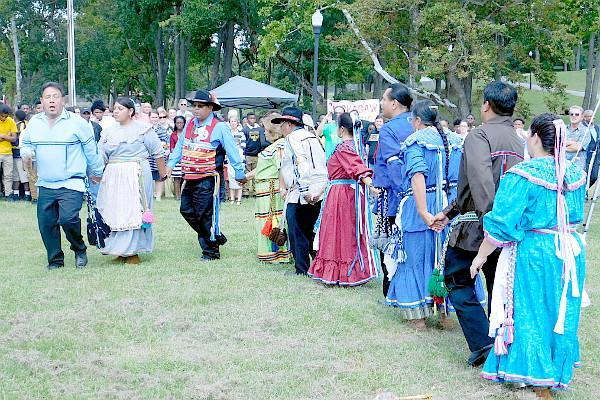
My address to the Chickasaw Days festival, "Stock and Trade," discussed the nation's similarly conservative approach to stock-raising and cotton cultivation, activities they adapted to their own gendered division of labor and desire not to abandon other traditional enterprises (like hunting and maize horticulture). I adapted the talk from a similar address I gave at the Ittafama Ithana conference on Chickasaw History last February, an address that I assumed most history enthusiasts in northern Mississippi had missed.* Most, but not all: some of the Chickasaw Nation Dance Troupe, ten of whom performed in Holly Springs, had been in my audience in Oklahoma.

I had formed the idea that Holly Springs was just a wide spot in the road. Actually, it is a fairly large courthouse town with several museums - including the birthplace of famed anti-lynching activist Ida Wells - and at least one restaurant serving first-rate fried pickles. It is a majority-black community, and the Chickasaw Days event drew a predominantly white crowd. Perhaps the region's Native American history doesn't appeal as much to an African-American audience. The nineteenth-century Chickasaws were slave-owners, after all, and later made a strenuous effort to exclude their freedmen from citizenship. Perhaps the town's black families were preoccupied with the huge homecoming-day parade which took place around the main square the same day as the festival, and in which many African-American children and teenagers were featured participants. I rather hope the latter interpretation is the more accurate one.


* My conference talk has since been reprinted in the Journal of Chickasaw History and Culture, Spring 2017 issue.

Friday, October 03, 2014

Giving Currency to Native American Women


Indian Country Today has proposed removing Andrew Jackson from the 20-dollar bill, on the grounds that Americans should not so honor an Indian hater and genocidaire, and recommends replacing him with a Native American leader. Though I believe many other people deserve the blame for Indian Removal, I have no brief for Jackson and no problem finding new heroes for our national currency. I do, however, find ICT's list of suggested replacements a bit dispiriting, even stereotypical: ten Indian men, mostly from the West, nearly all of them war leaders. Perhaps the authors were looking for well-known people and figured most readers could not identify Native women or civil leaders, but there is something to be said for using currency to popularize less well-known leaders who nonetheless reflect useful virtues: endurance, business acumen, organizational ability, political activism, and artistic virtuosity. To this end, let me propose the following substitutes:

Matoaka, alias Rebecca Rolfe, alias Pocahontas. Powhatan chief's daughter, endured captivity under the English, converted to Christianity, and became a diplomat and traveler – one of the first Native Virginians to visit London.

Weetamoo, or Wettimore, Wampanoag sachem, wife of sachem Quannopin, co-leader of the insurgency known as King Phillip's War (1675-77). Captive Mary Rowlandson described her as haughty but a snappy dresser, which, given Rowlandson's Puritan worldview, is probably an exaggeration.

Nonhelema, or Catherine Grenadio, Shawnee businesswoman who provided intelligence to the Americans during the Revolutionary War, sold cattle to the Continental Army, and attended the Fort McIntosh (1785) treaty council.

Gertrude Bonnin, alias Zitkala-Sa, Sioux activist who attended Earlham College, taught at Carlisle Industrial Training School, later proponent of cultural preservation and organizer of the National Council of American Indians.

Maria Martinez, Pueblo ceramicist who rediscovered the thin-walled, shiny black pottery-making technique for which Pueblo potters would become famous.

Wilma Mankiller, author, Alcatraz occupier, and first female principal chief of the western Cherokee Nation.

Mildred Loving, Rappahannock woman, identified as black under Virginia law, who became one of the plaintiffs in the Supreme Court case Loving versus Virginia (1967), legalizing interracial marriage. Putting her on American currency would cause Sean Hannity's head to explode.

Tuesday, January 08, 2013

An Utterance of Superfluous Coin

Earlier this month economist Paul Krugman proposed that President Obama adopt an unorthodox solution to the interminable debt-ceiling crisis: rather than default on the national debt or cave in to Republican lawmakers' demands, the president could use his statutory authority to mint platinum coins to issue a single one-trillion-dollar coin, deposit it with the Federal Reserve, and "thereby avoid...the need to issue debt" to pay the federal government's bills. This sounds like a crackpot idea, but it is less cracked than threatening a sovereign default to force the Democrats to dismantle what's left of the American social safety-net. The main defects in Krugman's plan, it seems to me, are twofold: 1) he only proposes minting one coin in one very high denomination, eliminating the possibility of selling a few slightly smaller high-denomination coins to eccentric billionaires, and 2) he doesn't indicate whose image(s) these coins should display. Politically, it might be wise for the president to exploit Republicans' obsession with Ronald Reagan by stamping his image on the anti-debt-ceiling coins.  But that's no fun. Coins, after all, provide an opportunity for nation-states to express their values and celebrate their people's achievements, and there are an awful lot of obscure American leaders, artists, and heroes one could take this opportunity to celebrate.

My own proposal for new high-value platinum coin denominations, and whose visages they should display, follows.  Feel free to propose your own, bearing in mind that U.S. coins should display persons who are a) more or less American, and b) more or less deceased.

$1 million: Emily Dickinson, poet (1)
$5 million: Eugene Debs, presidential candidate
$10 million: Mercy Otis Warren, historian
$20 million: Percy Julian, inventor (2)
$50 million: Jeannette Rankin, pacifist Congresswoman
$100 million: Duke Ellington, musician and composer
$1 billion: Jane Addams, social activist
$5 billion: Carl Sagan, astronomer (3)
$10 billion: Wilma Mankiller, Cherokee principal chief
$20 billion: William S. Burroughs, author (4)
$50 billion:Victoria Woodhull, activist, presidential candidate
$100 billion: Herman Husband, populist and pacifist
$1 trillion: Lori Ann Piestewa, soldier

(1) Obverse: something with feathers.
(2) Of synthetic steroids.
(3) For obvious reasons, given the denomination.
(4) Warning: coin may contain heroin.

Thursday, December 22, 2011

10 Centuries, 10 Links

1100s: Here's a recent Slate article on the 12th-century Lewis Chessmen. (The shield-chewing berserker rook is probably my favorite, with the pensive queen a close second.)

1200s: A blog entry, lavishly illustrated, on the geological and strategic importance of the town of Stirling during the wars of William Wallace. Look closely enough and you can see a tiny figure of Mel Gibson, mooning his adversaries.

1300s: The 14th-century Arab traveler, Ibn Battuta, who journeyed 75,000 miles during his lifetime, is being honored with a videogame. Apparently, there are zap guns.

1400s: While we're on the subject of guns, want to watch a short video demonstrating the use of the Hussites' early 15th-century handguns, the pistala (pipe gun) and hakovnice (hook gun)? Of course you do. (The clip is about halfway down the page).

1500s: Double-entry bookkeeping was first used in Europe in the 14th century, but the first popular text on the practice, Quaderno doppio col suo giornale, wasn't published until 1540. A webpage from the AMS follows the narrative of this 16th-()century textbook and finds that it is still a useful explanation of this accounting practice.

1600s: Sarah Underwood and Kathleen Brown try to guess what the 17th-century Pilgrims must have smelled like at the first Thanksgiving. Best not to read this one before dinner.*

1700s: Lynn Hunt, one of the world's experts on the 1789 French Revolution, recommends the five most influential books on the subject. Looks like I'm going to have to read R.R. Palmer's opus fairly soon.

1800s: The U.S. Mint will issue two coins in March 2012 honoring the bicentennial of the War of 1812. The coins will refer to the two images that most Americans associate with the war: the Star-Spangled Banner, and unnamed warships firing desultory broadsides at each other.

1900s: Did the French build a fake Paris during the First World War to fool German aerial bombers? Apparently so.

2000s: And Hungary has apparently decided that the best way to start the second decade of the 21st century is to slide back into fascism...


(Update, 12 July 2018: The Underwood and Brown piece is no longer available, but this more recent essay by Ruth Goodman suggests the Pilgrims didn't smell as bad as one might think.)

Thursday, November 30, 2006

Pine Trees and Penobscots

In my post of June 9th, I discussed Mark Peterson's article on the Pine Tree shilling, the first coin minted by an American colonial government, and its significance as a symbol of Massachusetts's imperial ambitions. A couple of weeks ago I discovered another historical use of the Pine Tree shilling: as an ad hoc medal given to Indians to display (and to secure) their friendship to the colony.

In January 1714 General Francis Nicholson held a peace conference (most likely in Nova Scotia, of which he was the governor) with 5 sachems of the Penobscot, Norridgewock, and Kennetuck divisions of Abenakis. The general presented each man with two Pine Tree shillings, placing one in the recipient's hand and the other in his mouth, that he might never act or speak against the English Crown or its subjects. He declared that the pine tree on the coins symbolized the unity of the English and Abenakis - "they and the English should be like that tree - but one root tho' several branches" - and noted that it was always green, symbolizing truth. (James Baxter, ed., Documentary History of the State of Maine [23 volumes; Portland, ME, 1869-1916], Vol. 23, pp. 53-54.)

Nicholson did not record the Abenakis' reaction, but it's likely that they understood what they were receiving - the Woodland Indians were sufficiently familiar with coins by the early 18th century that some were learning how to counterfeit them. (Colin Calloway, New Worlds for All [Baltimore, 1997], pp. 47-48.) It also seems likely that the sachems were unimpressed with the display: shillings were not valuable coins and Nicholson's metaphors were ersatz.

Friday, June 09, 2006

Pine Trees and Sovereignty

June 10th marks the anniversary of the issuance of the Pine Tree Shilling (1652), the first coin minted by English-speaking settlers in North America. Those who might regard this as mere numismatic trivia are invited to read Mark Peterson's fascinating essay in the April 2006 issue of Common Place, "Big Money Comes to Boston." In it, Peterson notes the difference between what he calls "big money" (gold and silver coins issued by sovereign states) and "little money" (informal currencies like cowrie shells) in the 17th-century Atlantic world, and identifies the minting of the Pine Tree Shilling as the moment when Bostonians formally shifted to a big-money economy. He also explains how Bostonians' efforts to establish first a little-money economy, based on wampum, and then a big-money economy based on precious metals reflected the colony's ambitious territorial and commercial aspirations, linking coinage to the fur trade, the Pequot War, the silver mines of Potosi, and the West Indies. Finally, he describes the amusing -- and, for a long time, successful -- efforts of colonial officials to convince Charles II that they had not usurped his royal prerogative. (I particularly liked Sir Thomas Temple's insistence that the pine tree engraving was actually the Royal Oak, in which Charles II had hidden after losing the Battle of Worcester [1651], and that the coin was therefore a hidden tribute to the exiled king.) Charles' brother James was not taken in by such arguments and put an end to the new coinage when he became king, but this was merely a temporary setback for New England officials, who in the eighteenth century found a new way to produce money: by printing it.

(Image above is from the National Museum of American History, Washington, DC, via http://amhistory.si.edu/coins/printable/coin.cfm?coincode=1_00. Added 11 June 2018.)