
Via the History News Network: archaeologists have discovered the probable location of Harvard's Indian College, the first school for Native Americans in British North America. The specific find was a trench containing brick, tile, and stone, likely the foundation of one of the school's walls. The trench also contained ceramic remains and some pieces of type from Massachusetts Bay's first printing press, also housed at the College - perhaps the same press used to print John Eliot's Wampanoag translation of the Bible.
As Harvard's own webpage on the Indian College makes clear, the institution was (like Dartmouth College a century later) a fundraising device designed to pry money out of the evangelizing New England Company. The principal residents of the brick College building were white students, and only a few of the seven Algonquian Indians who attended Harvard in the seventeenth century resided there. Most of these students, incidentally, came to bad ends: three died before graduating and one, John Sassamon, was murdered in 1675, setting off the chain of events that led to King Philip's War.
Tuesday, December 22, 2009

Thursday, November 26, 2009
The Pilgrims' Menu

As someone not fond of turkey I am attracted to the story that the Plymouth Separatists (a.k.a. Pilgrims) did not consume turkey during their first thanksgiving feast. However, after a little source reading I'm inclined to think they probably did. William Bradford, in Of Plymouth Plantation, said nothing about the "first Thanksgiving," but noted that after their first harvest (Fall, 1621) the Plymouth settlers had a "good store" of cod and other fish, ample wild water fowl, a fair amount of cornmeal, and "great store of wild Turkies." So, yes, the Pilgrims probably did eat turkey at their first harvest feast, along with duck, cod, and cornbread.
There was no cranberry sauce, though - they didn't know cranberries were edible. It would have been handy if they did, since so many of them had died of scurvy the previous winter.
For more Thanksgiving myth-debunking, see this classic article from the History News Network.
(My thanks to Elena O'Malley for asking me this question several months ago, thus inspiring me to do the research well in advance of the holiday.)
Sunday, November 15, 2009
The Killing Ground

Perhaps the most interesting, if grimmest, historical essay I've read online this year is Timothy Snyder's "Holocaust: The Ignored Reality," which appeared in the July 16 issue of the New York Review of Books. Snyder reminds his readers of an often-overlooked aspect of the Holocaust: its victims were primarily Eastern European. About 70 percent of the Jews killed by the Nazis came from Poland, the Ukraine, Belarus and the Baltic states; most of the rest came from Romania, Hungary, and Czechoslovakia. As Hannah Arendt once noted, national identity was supremely important for European Jews in the Nazi empire; if one was German or Polish one's chances of survival were close to zero, while French and Danish Jews had survival rates in the 75-100% range.
The Holocaust, Snyder argues, wasn't just an ethnic and religious genocide: it was also a regional crime, conducted in the chaotic and disgoverned eastern European borderland between two of the twentieth century's greatest tyrannies, Nazi Germany and Stalinist Russia. Moreover, it was only the largest and most efficient of the mass-murder operations that these two totalitarian states conducted in the region. "When one considers the total number of European civilians killed by totalitarian powers in the middle of the twentieth century," he writes "one should have in mind three groups of roughly equal* size: Jews killed by Germans, non-Jews killed by Germans, and Soviet citizens killed by the Soviet state." Referring to the second group as "civilian" is a stretch: most of its constituents were captured Red Army soldiers whom the Nazis deliberately starved to death in POW camps. The rest were Soviet civilians who died in the siege of Leningrad, or guerrillas and innocent bystanders killed in anti-partisan actions in Belarus and Yugoslavia. It's clear, though, that the Nazis fully intended to kill the Soviet citizens whom they starved to death, and that they planned to murder far more in this fashion - about 50 million Slavs, actually - as part of their Generalplan Ost for the colonization of the conquered Soviet Union.
Hunger wasn't merely used as a weapon by the Nazis; Stalinist Russia used planned famines to kill three million Ukrainians in the early 1930s, and may have deliberately starved another one million Kazakhs. In addition, the Soviet security police (NKVD) executed another 700,000 Soviet citizens during the purges of 1937-38, most of them well-to-do peasants (kulaks) or members of suspect national minorities. Most of these killings shared a feature in common with the Nazis' mass murders: the Soviet government undertook them in pursuit of economic goals, in their case the collectivization of agriculture (whereas the Nazis' economic goal was the creation of an agrarian colony in eastern Europe). "Both regimes were aiming for economic autarky in a large empire, in which both sought to control Eastern Europe...What is crucial is that the ideology that legitimated mass death was also a vision of economic development. In a world of scarcity, particularly of food supplies, both regimes integrated mass murder with economic planning." Such schemes of development through mass killing, Snyder concludes, are inevitable whenever human beings are treated as means to an end, rather than individual ends in themselves.
One needs to add a strong caveat here, which is that the Nazis' mass murder of the Jews proceeded without such an obvious economic motive. While many non-Jewish Germans benefited from the Third Reich's confiscation and redistribution of murdered Jews' property (see Goertz Aly's Hitler's Beneficiaries for details), this was an afterthought; the fundamental purpose of the Holocaust was to destroy an entire people, without regard for economic consequences. One of my professors in college characterized the Holocaust as sui generis, noting that efforts to compare it to other genocides only underscored its unique qualities. I'm not entirely convinced that's true, but it's clear to me that despite the intellectual attractions of Snyder's linkage of political economy with mass murder, his thesis is one of many that can't adequately explain the Nazis' war on European Jews.
* Very roughly. The Nazis killed six million Jews and five million non-Jewish civilians; the Soviet government killed (excluding, as Snyder does, prisoners who died in the gulags) four million Europeans and one million Kazakhs.
Tuesday, November 03, 2009
The Prince and the Plenipotentiary
Anna Berkes, at "A Summary View," writes about the first high-level contact between the American and Vietnamese governments: a 1787 meeting in France between U.S. minister plenipotentiary Thomas Jefferson and Nguyen Phuc Canh, the 7-year-old heir to the royal throne of Vietnam. Prince Canh was in France to help secure a treaty of alliance, which the French Crown approved later that year (and under which France supplied Canh's father with arms, warships, and military advisors). Jefferson's goal in meeting the prince was more pacific: he sought samples of Cochin-Chinese upland rice, which he had read were the best in the world. Prince Canh said he would send the American minister these samples, but Jefferson apparently never got them.
Saturday, October 24, 2009
Guest Star

While the massive July 1054 supernova which produced the Crab Nebula was visible throughout the world (one could see it in the daytime for three weeks), it made little impression on the written records left by observers in the Eastern Hemisphere, apart from an entry by an astronomer in Song China. However, according to Timothy Pauketat's new book on Cahokia (pp. 20-21), Native North Americans left ample non-written records of the event in this hemisphere. Indians in Missouri and New Mexico represented the supernova in pottery, petroglyphs, and rock paintings, sometimes placing it near a crescent moon or an image of a rabbit (which some identified with the moon). The Chaco Canyon culture, also known as the Anasazi, identified the supernova in a painted star map and may have built of their largest underground temples, or kivas, in its honor. Pauketat believes the founders of Cahokia may have begun constructing their ambitious new city shortly after - and in consequence of - the supernova. If true, Cahokia would be the largest "record" of the astronomical event this side of the Crab Nebula.
Sunday, October 18, 2009
Things That Make Me Feel Old
Ampersand, the magazine of the University of Kentucky's College of Arts and Sciences, reports in its Fall 2009 issue on the recent graduation of Kelsey Ladt '09, summa cum laude in biology. As an undergraduate Ms. Ladt studied the impact of cyclooxygenase-2 on spinal cord injuries, and she will be spending 2009-10 on a post-graduate research fellowship at the National Institute of Neurological Disorders and Stroke. She then plans to pursue a joint Ph.D./M.D., preparatory to a career as a medical researcher. Ladt is fourteen years old.
Tuesday, September 29, 2009
What Cheer!
I've begun reading Susan Moore's 2007 book Pilgrims: New World Settlers and the Call of Home, a study of 600 Puritan colonists who left New England in the mid-seventeenth century and returned to old England. I've come across two anecdotes of personal interest:
1) Many of the returnees were drawn back to England by the lack of economic opportunities in Massachusetts, whose economy stagnated in the 1640s and '50s, creating a shortage of work for those in specialized trades. This included Harvard graduates, who after completing their training for the ministry found a distinct shortage of open posts in the colony. Nearly half of the college's students left for England after graduation, including seven of the nine members of the first graduating class (56, 70). (One of these students, George Downing, fought with Cromwell in the English Civil War, changed sides in 1660, became a baronet, and is now remembered as the namesake of Downing Street in London.) The Puritans and their nineteenth-century descendants were quite smug about establishing the first college in British North America, but apparently they opened it a few decades too soon.
2) To illustrate the "alien and mysterious character" of early Massachusetts, Moore tells the story of John Dane, who while walking from Roxbury to Ipswich (north of Salem) encountered a party of 40-50 Indians (probably Wampanoags). Startled, Dane "stuttered out" the old English greeting "What cheer." The Indians thought this was hilarious. "What cheer! What cheer!" they repeated, until "the woods rang with the noise" (p. 45). I think I may experiment with this greeting myself.
1) Many of the returnees were drawn back to England by the lack of economic opportunities in Massachusetts, whose economy stagnated in the 1640s and '50s, creating a shortage of work for those in specialized trades. This included Harvard graduates, who after completing their training for the ministry found a distinct shortage of open posts in the colony. Nearly half of the college's students left for England after graduation, including seven of the nine members of the first graduating class (56, 70). (One of these students, George Downing, fought with Cromwell in the English Civil War, changed sides in 1660, became a baronet, and is now remembered as the namesake of Downing Street in London.) The Puritans and their nineteenth-century descendants were quite smug about establishing the first college in British North America, but apparently they opened it a few decades too soon.
2) To illustrate the "alien and mysterious character" of early Massachusetts, Moore tells the story of John Dane, who while walking from Roxbury to Ipswich (north of Salem) encountered a party of 40-50 Indians (probably Wampanoags). Startled, Dane "stuttered out" the old English greeting "What cheer." The Indians thought this was hilarious. "What cheer! What cheer!" they repeated, until "the woods rang with the noise" (p. 45). I think I may experiment with this greeting myself.
Friday, September 18, 2009
Northeast Passages
 It appears that in the race to develop a viable commercial route through the increasingly-ice-free Arctic Ocean, the Northeast Passage - along the northern coast of Siberia and through the Bering Strait - has pulled ahead of the Northwest Passage. Here's a story to that effect from the Associated Press (11 September 2009):
"The merchant ships MV Beluga Fraternity and MV Beluga Foresight arrived this week in Yamburg, Siberia, their owner Beluga Shipping GmbH said Friday. They traveled from Ulsan, South Korea, in late July to Siberia by way of the Northeast Passage, a sea lane that, in years past, was avoided because of its heavy ice floes."
The two 12,000-ton ships were carrying cargo for a Russian power plant and construction parts to Rotterdam, their final destination. They will, once they complete their voyage, become the first Western European commercial ships successfully to navigate the Northeast Passage from East Asia. While it is only ice-free for part of the year now, the Arctic shortcut is potentially a profitable trade route because it is 3,500 miles shorter than the lower-latitude route through the Suez Canal, saving both time and fuel. Explorers who attempted to traverse the Northeast Passage in colder times, like Henry Hudson, would probably feel vindicated. (Either that, or envious of the Russian nuclear icebreakers that Beluga Shipping hired to help their freighters break through drift ice.)
Update: both ships passed Novaya Zemlya on September 16.
Second Update: Beluga Foresight docked in Arkhangel, in northwestern Russia, on 19 September.
Monday, September 07, 2009
Read the Founders!

Apropos of President Obama's forthcoming speech to America's schoolchildren, Tim Rutten writes in the Los Angeles Times that one conservative group "is urging parents to demand that their children be excused from watching the president and be sent instead to the library to read the Founding Fathers." I think this is a fine idea, and as a historian of early national America, I would like to offer the following reading suggestions:
* Benjamin Franklin, "Advice to a Young Friend on Finding a Mistress," a 1745 letter observing that the proper remedy for "the violent natural inclinations" of youth is marriage, but that taking a mistress is an acceptable substitute, as long as she is an older woman.
* Thomas Paine (or, as we call him here in the early 21st century, "Glenn Beck"), "Agrarian Justice." Argues in favor of the creation of a guaranteed income for all, funded by a tax on estates. "It is not charity but a right, not bounty but justice, that I am pleading for."
* Thomas Jefferson, "Notes on the State of Virginia," Chapter 17. The future third president's reflections on the separation of church and state: "It does me no injury for my neighbour to say there are twenty gods, or no god. It neither picks my pocket nor breaks my leg."
No offense to the current occupant of 1600 Pennsylvania Avenue intended, but any of these essays would be more edifying and stimulating than an address on the importance of doing well in school.
Sunday, August 30, 2009
The Corporate State
Fred Clark, a Delaware-based journalist, has recently written an essay explaining why his home state, the first to ratify the Constitution and the last to outlaw flogging,* is the headquarters of 63% of the United States' Fortune 500 companies. State leaders credit Delaware's Chancery Court, which they describe as a font of wisdom on corporate law. More cynical observers, like Jonathan Chait in The New Republic (whose 2002 article Clark cross-references in his essay), instead give credit to Delaware's highly permissive general-incorporation laws and its lack of usury laws. Thanks to corporations' legal personhood and the Privileges and Immunities Clause of the U.S. Constitution, a company chartered in Delaware can operate elsewhere in the United States without having to worry about other states' more restrictive regulations. In return, Delaware derives a third of its budget from corporate charter fees - and the rest, I assume, from the state's tollbooth on I-95.
*Thus earning it a brief but favorable mention in Robert Heinlein's political science-fiction novel Starship Troopers (1959). Delaware outlawed flogging in 1971.
*Thus earning it a brief but favorable mention in Robert Heinlein's political science-fiction novel Starship Troopers (1959). Delaware outlawed flogging in 1971.
Monday, August 24, 2009
Things I Learned at the SHEAR (2009)
The annual meeting of the Society for Historians of the Early American Republic (SHEAR) is one I've taken care not to miss. It differs from other professional conferences in that A) it occurs in the summer, B) there is no job registry, and C) it has a single chronological and national focus (the United States, 1776-1861). Consequently, the convention primarily attracts people who want to attend panels and talk about history, as opposed to the American Historical Association and OAH conventions, which are full of anxious job-seekers and junior professors trying to shmooze. The SHEAR is one of the few conventions devoted almost exclusively to its attendees' intellectual development. Well, that and founder James Broussard's nickel-ante poker games, at which I've lost about $50 since 2002.
This year's SHEAR conference took place in Springfield, Illinois from July 16th through 19th. Given the location, it's not surprising there were several panels devoted to my academic specialties, the early American frontier and early U.S. - Indian relations. For me, it was a productive meeting. Herewith, some of the things wot I learned:
Robert Owens ("A Tale of Two Treaties"), comparing the 1768 and 1784 treaties of Fort Stanwix, asserted that U.S. Indian policy after the Revolution was "more evolutionary than revolutionary," a point with which I am inclined to agree.
Susan Gaunt ("Markets and Liberal Rhetoric in Post-Revolutionary Kentucky") noted that American boatmen taken prisoner by Spanish patrols on the Mississippi River were put to work building fortifications for Spain. This both demonstrated American weakness in the 1780s - the U.S. government couldn't protect its citizens' presumptive right to navigate the Mississippi - and Spain's fear of the United States' future power (hence the fortifications).
Kristopher Maulden ("They Want to Do You Justice") argued that the Federalists' war against the Northwest Indians in the 1790s was too destructive to be considered just - the War Department deliberately targeted cornfields and villages in order to starve Indians into submission. He observed that the Federalists were less interested in frontier justice than in state-building, which they could only accomplish by creating a monopoly of violence.*
Gregory Nobles ("Looking Back at the Backcountry") reminded his audience of what Patrick Griffin called a "frontier commonwealth ideal," in his 2006 book American Leviathan, which I guess I'll have to re-read.**
Patrick Bollinger ("Prophetic Tools") observed that Miami Indian leaders who opposed Tecumseh and Tenskwatawa's prophetic movement nonetheless used it to their advantage, warning American officials that their young men would "go to Prophetstown" unless the U.S. increased gift payments and moderated its demands for land.
Brad Jarvis ("Our Father in Detroit") described an unusual way of recording the terms of treaties: Ottawa chief Aulieauneay requested from Governor William Hull (of Michigan Territory) a silver gorget inscribed with the words "The Ottawa nation is entitled to $800 a year forever by the Treaty of Detroit." Jarvis also noted that the Ottawa nation had its own problems with the Shawnee Prophet, and that many wanted to destroy Prophetstown because 160 Ottawas visiting the town had died of influenza.
Rowena McClinton ("Demanding and Preserving Nationhood") observed that the Cherokees' efforts to preserve their tribal government persisted during the actual process of Removal (1838-39) - the Cherokee Light Horse Police made an effort to discipline Cherokees who became drunk and disorderly on the Trail of Tears.
And, finally, David Konig, in his comments on a panel on "women's legal troubles," argued that the law didn't just create winners and losers - it was also, like diplomacy and trade, a process of accommodation that reinforced social ties. I suspect it would be hard to convince anyone who's lost a lawsuit of that point, but it sounded good to me.
* Andrew Cayton noted in his comments, however, that Federalist state-building in the Old Northwest was rather minimally violent when one compares it to, for example, revolutionary state-building in contemporary France.
** Update, 18 June 2018: Annnnnnnny day now...
This year's SHEAR conference took place in Springfield, Illinois from July 16th through 19th. Given the location, it's not surprising there were several panels devoted to my academic specialties, the early American frontier and early U.S. - Indian relations. For me, it was a productive meeting. Herewith, some of the things wot I learned:
Robert Owens ("A Tale of Two Treaties"), comparing the 1768 and 1784 treaties of Fort Stanwix, asserted that U.S. Indian policy after the Revolution was "more evolutionary than revolutionary," a point with which I am inclined to agree.
Susan Gaunt ("Markets and Liberal Rhetoric in Post-Revolutionary Kentucky") noted that American boatmen taken prisoner by Spanish patrols on the Mississippi River were put to work building fortifications for Spain. This both demonstrated American weakness in the 1780s - the U.S. government couldn't protect its citizens' presumptive right to navigate the Mississippi - and Spain's fear of the United States' future power (hence the fortifications).
Kristopher Maulden ("They Want to Do You Justice") argued that the Federalists' war against the Northwest Indians in the 1790s was too destructive to be considered just - the War Department deliberately targeted cornfields and villages in order to starve Indians into submission. He observed that the Federalists were less interested in frontier justice than in state-building, which they could only accomplish by creating a monopoly of violence.*
Gregory Nobles ("Looking Back at the Backcountry") reminded his audience of what Patrick Griffin called a "frontier commonwealth ideal," in his 2006 book American Leviathan, which I guess I'll have to re-read.**
Patrick Bollinger ("Prophetic Tools") observed that Miami Indian leaders who opposed Tecumseh and Tenskwatawa's prophetic movement nonetheless used it to their advantage, warning American officials that their young men would "go to Prophetstown" unless the U.S. increased gift payments and moderated its demands for land.
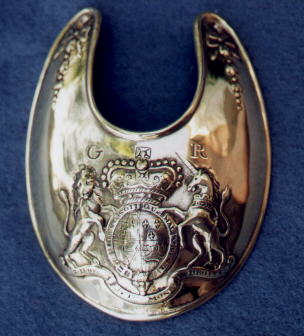
Brad Jarvis ("Our Father in Detroit") described an unusual way of recording the terms of treaties: Ottawa chief Aulieauneay requested from Governor William Hull (of Michigan Territory) a silver gorget inscribed with the words "The Ottawa nation is entitled to $800 a year forever by the Treaty of Detroit." Jarvis also noted that the Ottawa nation had its own problems with the Shawnee Prophet, and that many wanted to destroy Prophetstown because 160 Ottawas visiting the town had died of influenza.
Rowena McClinton ("Demanding and Preserving Nationhood") observed that the Cherokees' efforts to preserve their tribal government persisted during the actual process of Removal (1838-39) - the Cherokee Light Horse Police made an effort to discipline Cherokees who became drunk and disorderly on the Trail of Tears.
And, finally, David Konig, in his comments on a panel on "women's legal troubles," argued that the law didn't just create winners and losers - it was also, like diplomacy and trade, a process of accommodation that reinforced social ties. I suspect it would be hard to convince anyone who's lost a lawsuit of that point, but it sounded good to me.
* Andrew Cayton noted in his comments, however, that Federalist state-building in the Old Northwest was rather minimally violent when one compares it to, for example, revolutionary state-building in contemporary France.
** Update, 18 June 2018: Annnnnnnny day now...
Wednesday, August 12, 2009
The News from Cahokia

In Salon.com, Andrew O'Hehir reviews, at length, Cahokia: Ancient America's Great City on the Mississippi, Timothy Pauketat's new book about the largest pre-Columbian city in North America. Cahokia was the largest of a group of Native American city-states which flourished in the greater Mississippi Valley between 900 and 1300 CE, then rapidly declined, leaving behind enormous earthen temple mounds and immense archaeological remains. Pauketat's book makes at least three observations about the enigmatic metropolis that I hadn't read before. First, rather than growing slowly over time, Cahokia appeared quite rapidly: its founders built it around 1050 CE on the (razed) remains of a previous agricultural village. Second, the Cahokian priesthood and nobility practiced mass human sacrifice: excavations of Mound 72 in the late 1960s revealed the remains of more than 80 young men and women who were all killed at approximately the same time and buried with two high-status men, probably members of the nobility. Third, the sacrifices were probably linked to massive public feasts: another excavation in the 1960s uncovered a 900-year-old midden, so deeply buried that the contents were still decomposing (one can only imagine the smell), filled with the remains of several thousand deer, various plant foods, and millions of tobacco seeds. The feasts that generated this garbage probably consisted of several days of communal gorging and smoking, and helped prop up Cahokia's civic morale – and palliated the hunger and hardship that otherwise were the lot of most of the city's residents. In sum, these excavations help explain why so many Indian "commoners," even those not held in slavery, were willing to live in a setting that must (given the Cahokians' lack of running water and concomitant problems with sanitation) have been unpleasant for them: it was a place of "pomp and pageantry," drama, excitement, and periodic excess, just like any other big city.
Sunday, August 09, 2009
War Toys
Via the Orwell Diaries weblog, a two-page newspaper illustration from July 19, 1939, displaying the entire British battle fleet, from destroyers to aircraft carriers. It's a very impressive panorama - too bad Hitler didn't read the Daily Telegraph.

Friday, August 07, 2009
Your Monthly Apocalypse: Late Paleocene Collision Edition
A follow up to last summer's Death from Above entry: a group of researchers has discovered a layer of "shocked"* microscopic diamonds, dating to 12,900 years ago (10,900 BCE), on Santa Rosa Island off California. The crystals, properly known as Lonsdaleite, are only formed on Earth under extreme conditions, like those of a "cosmic collision." Based on the discovery of other "shock-synthesized minerals" and soot at other American sites dating to the same period, Douglas Kennett (of the University of Oregon) has hypothesized that a large comet or meteor exploded over North America about 13,000 years ago, leading to a 1,000-year cooling period that may have wiped out mammoths and other mega-fauna on the continent.
This hypothesis remains controversial, because the megafaunal species in question had just survived several Ice Ages without incident. It still seems likelier, at least to this educated layman, that newly-arrived human hunters bore primary responsibility for the North American extinctions. An old but serviceable computer model, created by Paul Martin and James Moisimann, demonstrated that a very small initial population of Paleo-Indian hunters could have exterminated every large (450-plus kilogram) herbivorous mammal species north of Mexico within 1,000 years of their arrival in America. (Alfred Crosby, Throwing Fire [Cambridge UP, 2002], 57, 60-66.) Indeed, the cometary explosion discovered by Kinnett et al. may have given some large mammal species additional breathing room, by temporarily reversing the warming trend that had been shrinking the mid-continent "mammoth steppes" and leaving mammoths and other large herbivores more vulnerable to human predation. Still, this is an important story, and reminds historians and anthropologists to Keep Watching the Skies.
* I was going to call this entry "Shocked, I Say," but I've already used that title.
This hypothesis remains controversial, because the megafaunal species in question had just survived several Ice Ages without incident. It still seems likelier, at least to this educated layman, that newly-arrived human hunters bore primary responsibility for the North American extinctions. An old but serviceable computer model, created by Paul Martin and James Moisimann, demonstrated that a very small initial population of Paleo-Indian hunters could have exterminated every large (450-plus kilogram) herbivorous mammal species north of Mexico within 1,000 years of their arrival in America. (Alfred Crosby, Throwing Fire [Cambridge UP, 2002], 57, 60-66.) Indeed, the cometary explosion discovered by Kinnett et al. may have given some large mammal species additional breathing room, by temporarily reversing the warming trend that had been shrinking the mid-continent "mammoth steppes" and leaving mammoths and other large herbivores more vulnerable to human predation. Still, this is an important story, and reminds historians and anthropologists to Keep Watching the Skies.
* I was going to call this entry "Shocked, I Say," but I've already used that title.
Wednesday, August 05, 2009
Oh, Those Wacky Enlightenment Types
From Richard Holmes' new book The Age of Wonder (reviewed in TIME Magazine, 3 Aug. 2009), this account of Humphrey Davy's early experiences with nitrous oxide, which he took in the company of friends Robert Southey and Samuel Taylor Coleridge:
"I seemed to be a sublime being, newly created and superior to other mortals. I was indignant at what they said of me and stalked majestically out of the laboratory to inform Dr. Kinglake privately that nothing existed but thoughts."
I'm sure Kinglake appreciated the insight.
Davy, incidentally, was the inventor of the Davy safety lamp, which was of great use to nineteenth-century miners. Perhaps it shouldn't surprise us that his experiments with laughing gas would prove to be of more lasting utility, at least to dentists and college students.
"I seemed to be a sublime being, newly created and superior to other mortals. I was indignant at what they said of me and stalked majestically out of the laboratory to inform Dr. Kinglake privately that nothing existed but thoughts."
I'm sure Kinglake appreciated the insight.
Davy, incidentally, was the inventor of the Davy safety lamp, which was of great use to nineteenth-century miners. Perhaps it shouldn't surprise us that his experiments with laughing gas would prove to be of more lasting utility, at least to dentists and college students.
Monday, July 13, 2009
Bad Library Books
The new "Awful Library Books" weblog reminds us that while nothing ages faster than modernity, some aspects of the modern world - computers, celebrity biographies, youth fashions, and conventional wisdom regarding gender roles, for example - age faster than others.
Some of the books featured on this site will be of great interest to cultural historians in another 75 years. At the moment, though, none of them is particularly useful, except for a few cheap laughs.
Some of the books featured on this site will be of great interest to cultural historians in another 75 years. At the moment, though, none of them is particularly useful, except for a few cheap laughs.
Tuesday, July 07, 2009
How Empires Die

I've written before in these pages about the fall of the Soviet Union, and referred to Yegor Gaidar's provocative thesis about the long-term economic causes of Soviet decline. This year marks the twentieth anniversary of the collapse of communist power in Eastern Europe, and one of the most significant, if more obscure, episodes in that narrative of collapse occurred twenty years ago today.
As Michael Meyer recounts in his Slate Magazine article "The Wink That Changed the World," by the summer of 1989 the communist regime in Hungary had pursued more far-reaching reforms than any of its neighbors, drafting a new liberal constitution and planning multi-party elections. (The party also gave Imre Nagy, leader of Hungary's 1956 revolution, a formal reinterment and state funeral, and began cutting down the border fence with non-communist Austria.) Alarmed and outraged, the party bosses of the other Warsaw Pact nations scheduled an emergency summit in Bucharest, where they angrily denounced the Hungarian premier, a 40-year-old economist named Miklos Nemeth, as a traitor to the socialist cause.
Fearing a repeat of the Russian invasion that destroyed Hungary's 1956 revolution, Nemeth turned to look at the man who held everyone's leash, Mikhail Gorbachev. To his surprise, Gorbachev seemed ready to laugh out loud at his blustering satraps. He and Nemeth, Gorbachev's expressions implied, were on the same page, and old-guard communists like Erich Honneker were not. Realizing that the Soviet Union had no intention of intervening in Hungary's internal affairs (not that it could afford to do so), Nemeth went home and doubled down on his party's radical reforms. Hungary removed the hammer and sickle from its flag, and on September 10th fully opened the border with Austria, which allowed East Germans - who could travel freely to Hungary - to escape to the West. The Berlin Wall, which the Hungarian government's decision rendered obsolete, fell less than two months later. (See also Patrick Brogan, The Captive Nations [New York, 1990], 140-142.)
Sunday, July 05, 2009
Are There College Professors on the Moon?
Apparently so! Consider the following excerpt from a radio transmission by the esteemed Mr. Cavor, describing the various social castes among his Selenite hosts:
The erudite [class] for the most part are rapt in an impervious and apoplectic complacency, from which only a denial of their erudition can rouse them... [moreover] some of the profounder scholars are altogether too great for locomotion, and are carried from place to place in a sort of sedan tub, wabbling jellies of knowledge that enlist my respectful astonishment.
Apparently, there are graduate students as well:
I have already mentioned the retinues that accompany most of the intellectuals: ushers, bearers, valets, extraneous tentacles and muscles, as it were, to replace the abortive physical powers of these hypertrophied minds. Porters almost invariably accompany them. There are also extremely swift messengers with spider-like legs and 'hands'...and attendants with vocal organs that could well nigh wake the dead. Apart from their controlling intelligence these subordinates are as inert and helpless as umbrellas in a stand.
(From H.G. Wells, First Men in the Moon [1901], Chapter 24.)
The erudite [class] for the most part are rapt in an impervious and apoplectic complacency, from which only a denial of their erudition can rouse them... [moreover] some of the profounder scholars are altogether too great for locomotion, and are carried from place to place in a sort of sedan tub, wabbling jellies of knowledge that enlist my respectful astonishment.
Apparently, there are graduate students as well:
I have already mentioned the retinues that accompany most of the intellectuals: ushers, bearers, valets, extraneous tentacles and muscles, as it were, to replace the abortive physical powers of these hypertrophied minds. Porters almost invariably accompany them. There are also extremely swift messengers with spider-like legs and 'hands'...and attendants with vocal organs that could well nigh wake the dead. Apart from their controlling intelligence these subordinates are as inert and helpless as umbrellas in a stand.
(From H.G. Wells, First Men in the Moon [1901], Chapter 24.)
Friday, July 03, 2009
Your Monthly Apocalypse: Famine
We've had a respite this year from the high food prices that led to widespread hunger and riots in 2008, but that reprieve (if you can call it that, since some of its causes are economic depression and deflation) may be about to end. In "A 'Time Bomb' for the World Wheat Crop," the Los Angeles Times (14 June 2009) reports on the Ug99 stem rust fungus, a potent strain of wheat rust which originated in Uganda in 1999 (hence the name) and has since spread throughout eastern Africa and the Middle East. One Mexican crop-research institute estimates that about 20% of the world's wheat crop is now in "imminent" danger from the fungus, and since the spores are airborne it will eventually spread around the world. Agronomists are trying to breed wheat strains resistant to Ug99, but this could take a decade, by which time the blight could destroy 80% of the world's wheat crop.
And if you were thinking "Well, that may be it for bread, cakes, and cereals, but at least we'll always have fish and chips," consider a recent report in the Idaho Mountain Press which suggests that the world's fisheries are perilously close to 100% depletion. While the world fish supply isn't absolutely doomed - fish populations can, after all, replace themselves, as oil and other minerals cannot - it is certainly troubling that advanced fishing fleets have been able to wipe out 90% of the world's large fish (tuna, cod, marlin) since 1950.
Neither of these articles portends global famine, but neither is good news for the developing world. Those of us in the richer countries will just have to learn to get by on corn dogs and Spam.
And if you were thinking "Well, that may be it for bread, cakes, and cereals, but at least we'll always have fish and chips," consider a recent report in the Idaho Mountain Press which suggests that the world's fisheries are perilously close to 100% depletion. While the world fish supply isn't absolutely doomed - fish populations can, after all, replace themselves, as oil and other minerals cannot - it is certainly troubling that advanced fishing fleets have been able to wipe out 90% of the world's large fish (tuna, cod, marlin) since 1950.
Neither of these articles portends global famine, but neither is good news for the developing world. Those of us in the richer countries will just have to learn to get by on corn dogs and Spam.
Saturday, June 27, 2009
Perfidious Albion
 A curious feature of the late insurgency in Iran has been the tendency of Iranian officials to blame the popular uprising not on the United States or Israel, but Great Britain. Foreign Minister Manochehr Mottaki, for instance, claimed that the British government instigated the demonstrations in Teheran and other cities by sending 747s full of security agents to Iran. It appears that Iranian cultural and religious leaders have long viewed Perfidious Albion as the great puppet-master responsible for their nation's political and economic ills. In 1951 the nationalist Iranian prime minister, Mohammed Mossadegh, told Averall Harriman to beware of the British: "You don't know how crafty they are. You don't know how evil they are." Almost thirty years later, the Shah and his followers charged Britain - in particular, the BBC, which had given airtime to the Ayatollah Khomenei - with starting the 1979 revolution in order to drive up the price of oil, which would increase the profitability of North Sea Oil. (William Shawcross, The Shah's Last Ride [New York, 1988], 64 [quote], 227, 343.) Since the revolution, Christopher Hitchens recently noted, the theocracy's staged demonstrations against foreign powers have inevitably included denunciations of Britain. A member of the state's Guardian Council even claimed a few years ago that the British government had organized the London terror bombings of 7/7/05.
Some of the historical causes of Iranian Anglophobia are obvious: Britain spent a good part of the nineteenth and twentieth centuries meddling in Iran's domestic affairs. British firms secured substantial economic concessions in Persia under the Qajar dynasty, including control of the kingdom's banking and oil industries. Britain also joined Russia in invading and occupying Iran during World War Two, to prevent the nation from becoming a German ally, and in 1953 MI6 joined the CIA in a covert operation that toppled Mossadegh and made the Shah an absolute monarch. The intensity of the Iranian government's anti-British sentiment, however, is hard to fathom given that the regime has two more dangerous and well-armed foreign adversaries, namely America and Israel. Perhaps the sentiment is a byproduct of a historical dynamic mentioned by Ali Ansari: Iran first entered formal diplomatic relations with Britain at a time when Persian power was declining and British power was increasing. Iranian political and cultural leaders might well have drawn the conclusion that this shift in power was due to British conspiracies - and their historical experience of British exploitation and intervention could only have confirmed the hypothesis.
Subscribe to:
Posts (Atom)