
In the annals of failed military expeditions, the voyage of Imperial Russia's Baltic Fleet to the Pacific during the Russo-Japanese War (1904-05) has few peers. As Gavin Wrightman recounts in The Industrial Revolutionaries (New York, 2007), the fleet got off to a uniquely bad start when several of the ships therein mistook English fishing boats in the North Sea for Japanese torpedo boats (no, I'm not making that up) and opened fire, killing two people and wounding six. Russian diplomats agreed to pay reparations to the British government, but the Baltic Fleet's fortunes did not subsequently improve. Both Britain and France refused to supply the ships with fuel (which they had to obtain from German collier vessels en route), one of the ships severed a French submarine telegraph cable in Tangier, a number of crewmen died of heatstroke while loading coal off the African coast, and storms battered one squadron as it rounded the Cape of Good Hope. To lighten the gloomy mood, some of the Russians took shore leave during stops in Africa and "acquired a menagerie of exotic animals including a boa constrictor which apparently developed a taste for vodka" (p. 349). Russian sailors' interest in exotic pets was one they shared with naval officers in the contemporary British Navy, whose shipboard companions included baboons and at least one elephant.
Finally, after seven months of struggle, the Russian fleet reached the Straits of Tsushima, a few days' sailing from Vladivostok. There in the Straits, on 27 May 1905, the exhausted officers and crew ran into a Japanese fleet under Admiral Heihachiro Togo, and suffered one of the most decisive defeats in naval history. Togo enjoyed several advantages over his opponents: his men were rested, his ships had a functional wireless telegraph system, and his fleet included several dozen deadly torpedo boats, which he deployed to good effect. In just 24 hours of fighting the Japanese navy virtually annihilated the Baltic Fleet, sinking or disabling 34 of 48 ships and inflicting over 10,000 casualties on the Russians. Alas, Weightman is silent on the fate of the boa constrictor. I fear the worst.
Monday, August 23, 2010

Friday, August 06, 2010
Founderbrau
While Scottish and German brewers fight to see who can produce the most potent beer in the world, a microbrewery in Philadelphia is reviving some of the gentler, but still distinctive, potables of the American past. Yards Brewing Company has launched its series of "Ales of the Revolution" with George Washington's Tavern Porter, a 14-proof brew inspired by one of Washington's own recipes. The Washington Post described the beverage as a mixture of "sharper, coffeelike flavors" and "residual sweetness," the latter flavor resulting from the molasses infused into each barrel.
Beer, of course, has been an important drink since the development of agriculture 11,000 years ago, but in late-colonial British North America it usually took a back seat to harder alcoholic beverages. The Anglophone elite preferred imported heavy wines, like port and Madeira, while farmers and laborers enjoyed hard cider and spiritous liquors, particularly rum distilled from West Indies molasses. David McCullough noted in 1776 that the early Continental Army consumed a prodigious amount of ordinary rum, plus cherry rum and flip (a "mixture of liquor, beer, and sugar" [29-30]), while their commander purchased "cider, brandy, and rum by the gallon" (42). I suspect, though, that if they'd had access to 110-proof beer they would have consumed it by preference, whether or not the bottles were stuffed into the carcasses of squirrels and stoats.
Beer, of course, has been an important drink since the development of agriculture 11,000 years ago, but in late-colonial British North America it usually took a back seat to harder alcoholic beverages. The Anglophone elite preferred imported heavy wines, like port and Madeira, while farmers and laborers enjoyed hard cider and spiritous liquors, particularly rum distilled from West Indies molasses. David McCullough noted in 1776 that the early Continental Army consumed a prodigious amount of ordinary rum, plus cherry rum and flip (a "mixture of liquor, beer, and sugar" [29-30]), while their commander purchased "cider, brandy, and rum by the gallon" (42). I suspect, though, that if they'd had access to 110-proof beer they would have consumed it by preference, whether or not the bottles were stuffed into the carcasses of squirrels and stoats.
Monday, August 02, 2010
What I Saw of the SHEAR Convention (2010)
This year's meeting of the Society for Historians of the Early American Republic attracted 400 people, about 40% of the society's membership – a remarkable achievement, given the economic slump and the meeting's isolated location (Rochester, NY). I did some agreeable socializing at the conference, and attended a baker's dozen of papers, of which some of the highlights follow:
Michael Oberg, in "The Many Worlds of Eleazer Williams" (read by Daniel Richter), briefly recounted the life of Reverend Williams, a grandson of Indian captive Eunice Williams who became an Episcopal missionary to the Oneidas. Of particular interest was Williams' "discovery," in the 1840s, that he was the dauphin – the long-lost son of Louis XVI of France, supposedly spirited away to Canada in infancy to protect him from the Jacobins. Of equal interest was the investigation of Williams' claim by two Philadelphia phrenologists, who concluded that Williams was actually an Indian (despite his white ancestry) and couldn't be the Bourbon heir.
The United States' early relations with East Asia received considerable attention this year. Kim Todt, in "'Merchants Have No Country:' The Early Republic and the Importance of its Dutch Trading Partners," observed that the governor of Dutch Batavia (modern Jakarta) actively promoted American trade with the Dutch East Indies, and that the U.S. Navy was sending frigates there by the 1820s. SHEAR President Rosemarie Zagarri, in her presidential address ("The Significance of the 'Global Turn' for the Early American Republic"), pointed out that the British East India Company welcomed U.S. merchants to India in the 1780s, even before Jay's Treaty allowed them to operate there legally. There were forty American ships in the India trade by 1789, and Jacob Crowinshield of Salem brought the first elephant to the United States shortly thereafter. Dale Norwood noted, in "Fear of a British Planet: American Anxiety about British Hegemony and the First U.S. Mission to China," that Americans took an active interest in the First Opium War, a conflict described in American newspaper editorials, church magazines, even children's magazines. One of the latter featured a fictitious child asking her father if the evil British would kill Americans if they didn't buy British opium.
At the last session of the conference, Rob Harper (in "The Powerful Weakness of the Frontier State: Manipulative Mobilization and the 1786 Clark-Logan Expedition") told a great deal about the Logan expedition of 1786 that I didn't know, mentioning the raid's unpopularity among Kentuckians (who were reluctant to contribute supplies and manpower) and noting that its chief purpose was not revenge but the seizure of Indian hostages who could be traded for white captives. In the same session Robert Owens showed his good sense and taste by mentioning recent scholarship by yours truly in his paper "Vigilante for Peace: James Robertson and the Curious Case of Lame Will."
Finally, I enjoyed the privilege of having breakfast with past SHEAR president Alan Taylor, and learned from him of his forthcoming book, The Civil War of 1812, which ought to prove thought-provoking reading on the eve of that conflict's bicentennial.
Michael Oberg, in "The Many Worlds of Eleazer Williams" (read by Daniel Richter), briefly recounted the life of Reverend Williams, a grandson of Indian captive Eunice Williams who became an Episcopal missionary to the Oneidas. Of particular interest was Williams' "discovery," in the 1840s, that he was the dauphin – the long-lost son of Louis XVI of France, supposedly spirited away to Canada in infancy to protect him from the Jacobins. Of equal interest was the investigation of Williams' claim by two Philadelphia phrenologists, who concluded that Williams was actually an Indian (despite his white ancestry) and couldn't be the Bourbon heir.
The United States' early relations with East Asia received considerable attention this year. Kim Todt, in "'Merchants Have No Country:' The Early Republic and the Importance of its Dutch Trading Partners," observed that the governor of Dutch Batavia (modern Jakarta) actively promoted American trade with the Dutch East Indies, and that the U.S. Navy was sending frigates there by the 1820s. SHEAR President Rosemarie Zagarri, in her presidential address ("The Significance of the 'Global Turn' for the Early American Republic"), pointed out that the British East India Company welcomed U.S. merchants to India in the 1780s, even before Jay's Treaty allowed them to operate there legally. There were forty American ships in the India trade by 1789, and Jacob Crowinshield of Salem brought the first elephant to the United States shortly thereafter. Dale Norwood noted, in "Fear of a British Planet: American Anxiety about British Hegemony and the First U.S. Mission to China," that Americans took an active interest in the First Opium War, a conflict described in American newspaper editorials, church magazines, even children's magazines. One of the latter featured a fictitious child asking her father if the evil British would kill Americans if they didn't buy British opium.
At the last session of the conference, Rob Harper (in "The Powerful Weakness of the Frontier State: Manipulative Mobilization and the 1786 Clark-Logan Expedition") told a great deal about the Logan expedition of 1786 that I didn't know, mentioning the raid's unpopularity among Kentuckians (who were reluctant to contribute supplies and manpower) and noting that its chief purpose was not revenge but the seizure of Indian hostages who could be traded for white captives. In the same session Robert Owens showed his good sense and taste by mentioning recent scholarship by yours truly in his paper "Vigilante for Peace: James Robertson and the Curious Case of Lame Will."
Finally, I enjoyed the privilege of having breakfast with past SHEAR president Alan Taylor, and learned from him of his forthcoming book, The Civil War of 1812, which ought to prove thought-provoking reading on the eve of that conflict's bicentennial.
Wednesday, July 07, 2010
Noble Ideas and Petty Grievances

For those of us who think the Declaration of Independence is just a tad too long (that includes nearly anyone who's read more than a few of Jefferson's obscure, nit-picky indictments of George III), Slate Magazine is pleased to offer several translations of the founding American document into Twitter form. The winning entry in their contest was "Bye, George, we've got it" (just 25 characters, you'll note), but I will confess I preferred their third runner-up:
We seek independence based on noble and universal ideas combined with petty and one-sided grievances
and their first runner-up:
Our Rights from Creator (h/t @JLocke). Life, Liberty, PoH FTW! Your transgressions = FAIL. GTFO, @GeorgeIII. -HANCOCK et al.
Sunday, July 04, 2010
Reflections on the Fourth of July
For those of you who missed it last year, here is a thought-provoking Independence-Day editorial, "Life, Liberty, and Benign Monarchy" (New York Times, 2 July 2009), by Professor Kathleen DuVal of the University of North Carolina, reflecting on Native American political authority and the attractiveness of Spanish paternalism to American settlers and slaves.
Happy Fourth of July, everyone.
Happy Fourth of July, everyone.
Wednesday, June 30, 2010
No Mustard with Them Taters
It is rare, in my research, to encounter primary narratives that evoke a visceral reaction, and such occasions are all the more memorable for it. I still recall the discomfort I felt twelve years ago when I read a letter by Northwest Territorial Governor Arthur St. Clair, explaining that he could not attend an Indian council because he had fallen hard on the pommel of his saddle and "ruptured [his] private parts most dreadfully." I had a similarly immediate, though more muted, response to an entry I read a few months ago in British fur trader George Nelson's memoirs. While traveling to an Indian hunting camp on the Kettle River, in northern Minnesota, Nelson and his partners joined an Ojibwa party for a meal. One of the Ojibwas was a woman whose young child was suffering from loose bowels. "The little black devil was running about the lodge squettering out yellow stuff like mustard; she [the mother] scolded and laying the brat on her lap opened the cheeks & with the back of her knife scraped off the stuff." She then released the child, washed her hands in the cooking kettle, wiped off the knife, and resumed cutting meat with it. After that Nelson found he didn't have much of an appetite. (My First Years in the Fur Trade: The Journals of 1802-1804, ed. Laura Peers and Theresa Schenck [Saint Paul, 2002], 65-66.)
Nelson later recorded this anecdote to illustrate, I think, the "savage" Indians' tolerance for filth and disease. In reflecting on it, I have come to the conclusion that the Ojibwa mother in Nelson's story was instead expressing a rather common maternal belief - that her child's exudations couldn't really harm anyone, since they hadn't harmed her - coupled with sufficient exhaustion to wear down any scruples she have about her guests' dining experience. The tired and overworked cooks in George Orwell's Down and Out in Paris and London, one might well note, prepared food in even more squalid conditions than Nelson's hosts, and received greater compensation for it.
Also, "squettering" is an awesome word.
Nelson later recorded this anecdote to illustrate, I think, the "savage" Indians' tolerance for filth and disease. In reflecting on it, I have come to the conclusion that the Ojibwa mother in Nelson's story was instead expressing a rather common maternal belief - that her child's exudations couldn't really harm anyone, since they hadn't harmed her - coupled with sufficient exhaustion to wear down any scruples she have about her guests' dining experience. The tired and overworked cooks in George Orwell's Down and Out in Paris and London, one might well note, prepared food in even more squalid conditions than Nelson's hosts, and received greater compensation for it.
Also, "squettering" is an awesome word.
Sunday, June 06, 2010
Retrospective Review: Pox Americana (Part Two)
(Continued from earlier post:)
The epidemic in the east, for all its gruesome qualities, was mild in comparison to the outbreak that appeared in Mexico City in August 1779 and spread throughout the hemisphere. Fenn doesn't speculate whether there was a connection between the Mexican smallpox epidemic and the British North American one, though New Orleans, where there were a number of American rebels trading throughout the war and where smallpox broke out in late 1778, may have been a junction between the two. What is certain is that "arrival in Mexico City was key to [the virus's subsequent] success" (142). From thence it could be spread by a large transient population of workers, farmers, and other travelers, down to the coasts and up the caminos reals, throughout Spanish America and into the trading networks of its aboriginal neighbors.
 Expanding northward from Mexico City, smallpox reached the Spanish borderland colonies of New Mexico and Texas by early 1781. The disease claimed 46,000 lives within the boundaries of modern Mexico, and killed at least 5,000 mission Indians in New Mexico and Texas. Sometime in 1780 or '81, smallpox broke out among the horse-mounted expansionists of the vast Comanche nation, who probably contracted it from the mission-dwelling Lipan Apaches of western Texas. The Comanches then spread the disease throughout the Great Plains, where it had a particularly fatal impact on the agricultural nations of the Upper Missouri River.
The most geographically significant victims of the smallpox were the Shoshones, who carried the variola virus into Canada – and thus into the trading network of the Hudson Bay Company, thereby killing thousands of Cree and Chipewyans – and down the Columbia River to the Pacific Northwest. While exact numbers are impossible to come by, Fenn thinks smallpox killed about 60,000 Native Americans north of Mexico.
Altogether, 130,000 North Americans died of smallpox between 1775 and 1782. Only 10% of them, however, were Anglo-Americans, which helps explain why this episode remains obscure in U.S. historiography, preoccupied as U.S. historians are with the American Revolution. Beyond the limits of the Thirteen Colonies, however, the epidemic was vastly important: it led to a marked decline in marriage ages in New Spain (as Mexicans tried to replace their population losses), compelled the now-diminished Comanche "empire" to make peace with Spain, and allowed the Sioux to supplant the Mandans and the Blackfeet the Shoshones as the premier hunters and traders of their respective homelands. Throughout Indian country, Fenn concludes, smallpox was a "virus of empire" (275).
One point that Fenn does not make as pointedly as she might, and which is particularly useful to students of colonial America, is that the pattern of variola's spread reveals a great deal about transportation and trade in early America. In British North America, smallpox moved by water from seaport to seaport, then spread slowly inland – except in the case of Canada, where the disease moved fairly quickly up the Saint Lawrence River to the Great Lakes. In Spanish America, smallpox spread rapidly north and south from Mexico City, and was carried almost to the Arctic Circle by horse-borne Indian nomads and their trading partners. Fenn's book thus helps confirm and extend April Hatfield's observation (in Atlantic Virginia [2004]) that the British American colonies were more like an archipelago of outposts than a continuous area of settlement, and that the most extensive networks of human contact within the continent were Native American ones. It also reminds us that epidemic disease was - and remains today - one of the most unfortunate side-effects of improvements in trade and communications; the parts of North America that had the best roads or the most mobile populations were also the regions most susceptible to smallpox, while the more isolated settlements of British North America were most effectively able to control the disease.
The epidemic in the east, for all its gruesome qualities, was mild in comparison to the outbreak that appeared in Mexico City in August 1779 and spread throughout the hemisphere. Fenn doesn't speculate whether there was a connection between the Mexican smallpox epidemic and the British North American one, though New Orleans, where there were a number of American rebels trading throughout the war and where smallpox broke out in late 1778, may have been a junction between the two. What is certain is that "arrival in Mexico City was key to [the virus's subsequent] success" (142). From thence it could be spread by a large transient population of workers, farmers, and other travelers, down to the coasts and up the caminos reals, throughout Spanish America and into the trading networks of its aboriginal neighbors.
The most geographically significant victims of the smallpox were the Shoshones, who carried the variola virus into Canada – and thus into the trading network of the Hudson Bay Company, thereby killing thousands of Cree and Chipewyans – and down the Columbia River to the Pacific Northwest. While exact numbers are impossible to come by, Fenn thinks smallpox killed about 60,000 Native Americans north of Mexico.
Altogether, 130,000 North Americans died of smallpox between 1775 and 1782. Only 10% of them, however, were Anglo-Americans, which helps explain why this episode remains obscure in U.S. historiography, preoccupied as U.S. historians are with the American Revolution. Beyond the limits of the Thirteen Colonies, however, the epidemic was vastly important: it led to a marked decline in marriage ages in New Spain (as Mexicans tried to replace their population losses), compelled the now-diminished Comanche "empire" to make peace with Spain, and allowed the Sioux to supplant the Mandans and the Blackfeet the Shoshones as the premier hunters and traders of their respective homelands. Throughout Indian country, Fenn concludes, smallpox was a "virus of empire" (275).
One point that Fenn does not make as pointedly as she might, and which is particularly useful to students of colonial America, is that the pattern of variola's spread reveals a great deal about transportation and trade in early America. In British North America, smallpox moved by water from seaport to seaport, then spread slowly inland – except in the case of Canada, where the disease moved fairly quickly up the Saint Lawrence River to the Great Lakes. In Spanish America, smallpox spread rapidly north and south from Mexico City, and was carried almost to the Arctic Circle by horse-borne Indian nomads and their trading partners. Fenn's book thus helps confirm and extend April Hatfield's observation (in Atlantic Virginia [2004]) that the British American colonies were more like an archipelago of outposts than a continuous area of settlement, and that the most extensive networks of human contact within the continent were Native American ones. It also reminds us that epidemic disease was - and remains today - one of the most unfortunate side-effects of improvements in trade and communications; the parts of North America that had the best roads or the most mobile populations were also the regions most susceptible to smallpox, while the more isolated settlements of British North America were most effectively able to control the disease.
Thursday, June 03, 2010
Retrospective Review: Pox Americana (Part One)

The American smallpox epidemic of 1775-82, one of the most widespread outbreaks of that disease in recorded history, remained an obscure episode for more than two centuries after its subsidence. In 2001, Elizabeth Fenn, then of George Washington University (now at Duke), finally brought this event to a large readership with her deeply-researched, engagingly-written book Pox Americana. Dr. Fenn's book received much publicity when it was published, owing to its appearance in the immediate aftermath of September 11th and the October 2001 anthrax scare. I recently reread Pox Americana, to see how well it holds up now that the initial publicity has faded - and in light of nearly ten years of subsequent scholarship. The short answer is that it's even better than I remembered the first time. Over the next entry or two, I'll be reviewing Pox Americana, analyzing its findings, and suggesting why the plague at the center of Fenn's book, which spread from Hudson Bay to Peru and killed over 100,000 people, remained obscure for so many years.
Smallpox was a relentless and terrifying killer in the early modern period, and one which apparently grew in virulence between 1500 and 1800. It was particularly dangerous to isolated rural populations - like most of the white settlers in North America - and to populations with homogeneous immune systems, like American Indians. In the disease's early stages, those infected with smallpox suffered from aches, fever, and anxiety; as the disease progressed, its victims broke out in hundreds of oozing sores concentrated on the hands, feet, and face. The sores could lead to dehydration (if they appeared in the throat) or blindness; if they flowed together, they doubled the victim's chances of dying; and they almost invariably left disfiguring scars, whose only benefit was that they branded the survivor as permanently immune. There was no way to cure smallpox in the eighteenth century, and only two ways to fight its spread: quarantine and inoculation. Since inoculation actually gave inoculees a mild version of the disease and rendered them temporarily infectious, it was a controversial procedure and usually only available to the wealthy.
When the epidemic of Fenn's subtitle first broke out in the Atlantic seaboard cities of Boston, Montreal, Philadelphia, and Charleston (1775-79), Americans' first impulse was to quarantine the infected areas through controls on public movement, particularly the movement of soldiers. This proved impossible, given the cycling of volunteers in and out of the Continental Army and the movement of refugees to or from areas under rebel control. As a result the disease spread from its coastal enclaves into the hinterland, though it raged with greatest virulence on the coast, on British prison ships and in encampments of black Loyalist refugees - runaway slaves who sought freedom with British but often (in about 5,500 cases, Fenn estimates) found death instead.
As the smallpox death toll slowly grew, some white Americans came to believe that the British Army was using the disease as a weapon of war, dispatching sick Loyalist refugees to infect rebel-controlled areas. Fenn thinks this accusation was true; she presents evidence that at least one British commander, late in the war, sent infected slaves into rebel lines to spread the disease to his enemies. That smallpox posed so great a threat to American military effectiveness that the British tried to use it as a weapon helps explain George Washington's crucial decision of 1777 to inoculate all soldiers in the Continental Army against the disease (92-98). Fenn argued that this was "among [Washington's] most important decisions of the war" (134) and helped secure the rebels' eventual victory.
(To be continued...)
Saturday, May 29, 2010
Living in the Valley of Death
The lurid title of this post refers not to my own status, but rather to the conference presentation I've spent a good part of the past few weeks researching, writing, and delivering. For the benefit of those of my readers who could not attend the Filson Historical Society's public history conference on Native American history earlier this month, and to hear my lecture on "Native American Subsistence and Commerce in the Revolutionary Ohio Valley," I've posted my lecture notes on Google Documents. Comments, criticism, or unadulterated praise are all welcome.
Friday, April 30, 2010
Founders Round-Up
It seems that Thomas Jefferson has catalogued his personal library on LibraryThing, complete with 'reviews' extracted from his correspondence.
There's a hip-hop video on YouTube (actually from WhiteHouse.gov, but YouTube is trendier) on the early life of Alexander Hamilton - about a year old now, but still worth watching.
John Quincy Adams has a Twitter feed, derived from his diary entries for 1810.
And there's a new strategy game in the works, Founding Fathers, about the Constitutional Convention of 1787.
Once known primarily as political wonks, the Founders are fast becoming Web 2.0 and boardgame geeks.
There's a hip-hop video on YouTube (actually from WhiteHouse.gov, but YouTube is trendier) on the early life of Alexander Hamilton - about a year old now, but still worth watching.
John Quincy Adams has a Twitter feed, derived from his diary entries for 1810.
And there's a new strategy game in the works, Founding Fathers, about the Constitutional Convention of 1787.
Once known primarily as political wonks, the Founders are fast becoming Web 2.0 and boardgame geeks.
Friday, April 16, 2010
You Mean They Ate Each Other Up?
Probably not, Danny! An archaeological team investigating the winter camp of the Donner Party subjected the bones that the settlers discarded to intense microscopic scrutiny and determined that none of them were from human beings. Instead, the survivors ate cattle which died of starvation, horses brought by one of the relief parties, deer (which they were able to hunt despite 30 feet of snow), and one family's pet dog. They also tried to preserve "civilized" decorum during the winter; their midden includes pieces of slate, used for children's school lessons, and of chinaware, used for their meager meals of boot-and-bone soup. The survivors themselves denied that they had resorted to cannibalism, and no-one was ever able to prove the charge. The conventional story of the Donner Party, however appealing it may be (even to the extent of inspiring an excellent Western/horror movie), appears, like so much of the West's history, to have been a myth.
Wednesday, April 07, 2010
Historical Humor: A Small Example
For a change of pace I decided to wear my Declaration of Independence tie - a red silk tie bearing the facsimile signatures of the members of the Continental Congress - to school today. In my upper-level Colonial History class, one of my students, after asking me what was on my tie, said - completely deadpan - "It must have taken you a while to collect all those signatures." I'm not used to my students making good jokes, but it's a pleasant surprise when they do.
Wednesday, March 24, 2010
The Return of Fred the Sheep
A follow-up, courtesy of my friend Carl Anderson, to a story I mentioned last year: working from a proposal by Professor Michael Drout, engineers at Northwestern University have developed a prototype machine capable of extracting sheep DNA from medieval parchment. If researchers then succeed in developing a chemical process that allows them to analyze and classify the extracted genetic material, it will be possible to identify the date and perhaps also the geographical provenance of undated medieval manuscripts.
Northwestern engineering students are also working on a super-hard "dragonslayer" sword, which should make it easier for the school to deal with Chicago's persistent dragon problem.
Northwestern engineering students are also working on a super-hard "dragonslayer" sword, which should make it easier for the school to deal with Chicago's persistent dragon problem.
Thursday, March 18, 2010
Statecraft as Mortal Combat
On December 30, 1800, Emperor Paul of Russia made the following announcement in his court's official newspaper: "His Majesty . . . perceiving that the European powers cannot come to an accommodation, and wishing to put an end to the war which has raged fourteen years*, has conceived the idea of appointing a place to which he will invite the other potentates to engage together with himself in single combat on lists which shall be marked at; for which purpose they shall bring with them, to act as their esquires, umpires, and heralds, their most enlightened ministers and able generals, as Thugut, Pitt, and Bernstorff."
Quoted in Edward Emerson's History of the Nineteenth Century (New York, 1902), p. 79. Emerson views this invitation as evidence that Paul's mind had come unhinged, a conclusion also reached by the emperor's inner circle, whose members assassinated him early the following year. From our perspective in the early twenty-first century, though, the idea of resolving international disputes through "single combat" between state leaders, rather than through bloody wars with millions of casualties, seems rather more sane. I suspect it would have been amusing, at least, to view a joust or duel between Tallyrand and Pitt the Younger.
* Paul was doubtless mashing together the Wars of the First and Second Coalitions (1792-1802) with the Russo-Turkish War of 1787-89.
Quoted in Edward Emerson's History of the Nineteenth Century (New York, 1902), p. 79. Emerson views this invitation as evidence that Paul's mind had come unhinged, a conclusion also reached by the emperor's inner circle, whose members assassinated him early the following year. From our perspective in the early twenty-first century, though, the idea of resolving international disputes through "single combat" between state leaders, rather than through bloody wars with millions of casualties, seems rather more sane. I suspect it would have been amusing, at least, to view a joust or duel between Tallyrand and Pitt the Younger.
* Paul was doubtless mashing together the Wars of the First and Second Coalitions (1792-1802) with the Russo-Turkish War of 1787-89.
Wednesday, March 10, 2010
Chickasaw Archery
I'm in the early stages of researching a book on the economic history of the Chickasaws, a small but strategically-important southeastern Indian nation that in the nineteenth century would become one of the Five Civilized Tribes. In the course of re-reading Charles Hudson's description of the sixteenth -century Chicazas (the principal ancestors of the Chickasaws) in his book Knights of Spain, Warriors of the Sun (U. of Georgia Press, 1997), I came across this account of Chickasaw archers' military prowess: when the Chicazas attacked De Soto's men in the winter of 1541, they succeeded in killing nearly 60 horses, twelve of which they shot through the heart. The horse of hidalgo Juan Diaz was supposedly killed by an arrow that entered its shoulder, went through the entire body, and "protrud[ed] on the opposite side the length of four fingers" (p. 269). Another died after two arrows entered its heart from two different directions.
Hudson bases this chapter on contemporary accounts of the Soto expedition, chiefly the narrative of the Gentleman of Elvas. I must say I find this account of Chickasaw archers' virtuosity somewhat difficult to believe - their arrows would have had to have been of the same strength as medieval longbowmen's arrows in order to have that degree of penetrating power. It doesn't surprise me, though, that they would consider the Spaniards' animals important targets, since horses gave Europeans a military advantage nearly as important as that provided by their firearms and steel weapons.
Hudson bases this chapter on contemporary accounts of the Soto expedition, chiefly the narrative of the Gentleman of Elvas. I must say I find this account of Chickasaw archers' virtuosity somewhat difficult to believe - their arrows would have had to have been of the same strength as medieval longbowmen's arrows in order to have that degree of penetrating power. It doesn't surprise me, though, that they would consider the Spaniards' animals important targets, since horses gave Europeans a military advantage nearly as important as that provided by their firearms and steel weapons.
Saturday, February 20, 2010
Enemies Foreign and Domestic

I didn't mean to turn February into Adam Zamoyski month here at Stranger Things Have Happened, but I wanted to share one last anecdote from his very entertaining (and thought-provoking) book on the Congress of Vienna, Rites of Peace (NY, 2007):
When Napoleon Bonaparte died on St. Helena, in May 1821, the nation which had fought hardest to defeat and exile him, Great Britain, was preoccupied with the coronation of King George IV and his struggle to exclude his estranged wife Caroline from the ceremony. Supposedly, when a messenger brought George the news that "Your greatest enemy [i.e., Napoleon] is dead," he replied "No! By God! Is she?" (p. 561)
I guess that's funnier if you've watched A Royal Scandal.
Sunday, February 14, 2010
A Hard World for Little Republics
It's not easy being a small nation in a world of aggressive Great Powers. Consider the experience of diplomats from the short-lived Italian republic of Lucca, who in the spring of 1814 petitioned Emperor Francis of Austria for "the restoration of their independence." Francis replied - in Italian, graciously enough - "Tutti hanno fame, anch'io voglio mangiare, emmeglio che io vi mangi che se fosse un altro," which translates as "Everyone is hungry, and I need to eat too, and it is better I should eat you than another." (Adam Zamoyski, The Rites of Peace [New York, 2007], 234.)
I'll have to remember that line the next time I play Diplomacy.
I'll have to remember that line the next time I play Diplomacy.
Friday, February 05, 2010
If I Were the Emperor Napoleon
"In his place, I would take ship, and I would go to seek fortune in America and I would live there very peacefully in the forests and the deserts. The fruit of the coconut tree would nourish me, and water clearer than crystal would refresh my burning blood and my burnt-out brain. I would hunt monkeys in the woods, I would reflect on my past greatness and would try to console myself for my present misfortune as best I could. That is what I would do if I were the Emperor Napoleon." Marie Metternich, in a letter to her father, 27 January 1814, quoted in Adam Zamoyski, The Rites of Peace (HarperCollins, 2007), p. 151.
Wednesday, January 20, 2010
Town versus Gown
Thanks to riotous students, expansionist campus developers, and professors mowing their lawns at 11:30 on Tuesday mornings, relations between modern American universities and their host communities are rarely tranquil. Things have been worse in earlier days and other lands, of course. At the Historiann weblog, commenter Indyanna recalls an "early modern town-gown ruckus" in Oxford, England, in 1717, caused by George I's decision to garrison a regiment of soldiers in that town. "When the probably-mainly-Jacobite students refused to illuminate their windows to celebrate the King’s birthday, some tipsy soldiers smashed the windows in question. Next thing, the whole town was in arms and on fire. The House of Lords had to intervene to sort things out, the regiment got sent to Minorca, and its aging Colonel was packed off back to Dublin in retirement." Bad news for the colonel and the town, but perhaps not such bad consequences for the window-smashing soldiers - Minorca doesn't sound like a hardship post.
(ETA, 28 June 2018: The Oxford riot apparently took place in 1716, according to OU sources.)
(ETA, 28 June 2018: The Oxford riot apparently took place in 1716, according to OU sources.)
Tuesday, December 22, 2009
The Indian College Discovered?
Via the History News Network: archaeologists have discovered the probable location of Harvard's Indian College, the first school for Native Americans in British North America. The specific find was a trench containing brick, tile, and stone, likely the foundation of one of the school's walls. The trench also contained ceramic remains and some pieces of type from Massachusetts Bay's first printing press, also housed at the College - perhaps the same press used to print John Eliot's Wampanoag translation of the Bible.
As Harvard's own webpage on the Indian College makes clear, the institution was (like Dartmouth College a century later) a fundraising device designed to pry money out of the evangelizing New England Company. The principal residents of the brick College building were white students, and only a few of the seven Algonquian Indians who attended Harvard in the seventeenth century resided there. Most of these students, incidentally, came to bad ends: three died before graduating and one, John Sassamon, was murdered in 1675, setting off the chain of events that led to King Philip's War.
As Harvard's own webpage on the Indian College makes clear, the institution was (like Dartmouth College a century later) a fundraising device designed to pry money out of the evangelizing New England Company. The principal residents of the brick College building were white students, and only a few of the seven Algonquian Indians who attended Harvard in the seventeenth century resided there. Most of these students, incidentally, came to bad ends: three died before graduating and one, John Sassamon, was murdered in 1675, setting off the chain of events that led to King Philip's War.
Thursday, November 26, 2009
The Pilgrims' Menu

As someone not fond of turkey I am attracted to the story that the Plymouth Separatists (a.k.a. Pilgrims) did not consume turkey during their first thanksgiving feast. However, after a little source reading I'm inclined to think they probably did. William Bradford, in Of Plymouth Plantation, said nothing about the "first Thanksgiving," but noted that after their first harvest (Fall, 1621) the Plymouth settlers had a "good store" of cod and other fish, ample wild water fowl, a fair amount of cornmeal, and "great store of wild Turkies." So, yes, the Pilgrims probably did eat turkey at their first harvest feast, along with duck, cod, and cornbread.
There was no cranberry sauce, though - they didn't know cranberries were edible. It would have been handy if they did, since so many of them had died of scurvy the previous winter.
For more Thanksgiving myth-debunking, see this classic article from the History News Network.
(My thanks to Elena O'Malley for asking me this question several months ago, thus inspiring me to do the research well in advance of the holiday.)
Sunday, November 15, 2009
The Killing Ground

Perhaps the most interesting, if grimmest, historical essay I've read online this year is Timothy Snyder's "Holocaust: The Ignored Reality," which appeared in the July 16 issue of the New York Review of Books. Snyder reminds his readers of an often-overlooked aspect of the Holocaust: its victims were primarily Eastern European. About 70 percent of the Jews killed by the Nazis came from Poland, the Ukraine, Belarus and the Baltic states; most of the rest came from Romania, Hungary, and Czechoslovakia. As Hannah Arendt once noted, national identity was supremely important for European Jews in the Nazi empire; if one was German or Polish one's chances of survival were close to zero, while French and Danish Jews had survival rates in the 75-100% range.
The Holocaust, Snyder argues, wasn't just an ethnic and religious genocide: it was also a regional crime, conducted in the chaotic and disgoverned eastern European borderland between two of the twentieth century's greatest tyrannies, Nazi Germany and Stalinist Russia. Moreover, it was only the largest and most efficient of the mass-murder operations that these two totalitarian states conducted in the region. "When one considers the total number of European civilians killed by totalitarian powers in the middle of the twentieth century," he writes "one should have in mind three groups of roughly equal* size: Jews killed by Germans, non-Jews killed by Germans, and Soviet citizens killed by the Soviet state." Referring to the second group as "civilian" is a stretch: most of its constituents were captured Red Army soldiers whom the Nazis deliberately starved to death in POW camps. The rest were Soviet civilians who died in the siege of Leningrad, or guerrillas and innocent bystanders killed in anti-partisan actions in Belarus and Yugoslavia. It's clear, though, that the Nazis fully intended to kill the Soviet citizens whom they starved to death, and that they planned to murder far more in this fashion - about 50 million Slavs, actually - as part of their Generalplan Ost for the colonization of the conquered Soviet Union.
Hunger wasn't merely used as a weapon by the Nazis; Stalinist Russia used planned famines to kill three million Ukrainians in the early 1930s, and may have deliberately starved another one million Kazakhs. In addition, the Soviet security police (NKVD) executed another 700,000 Soviet citizens during the purges of 1937-38, most of them well-to-do peasants (kulaks) or members of suspect national minorities. Most of these killings shared a feature in common with the Nazis' mass murders: the Soviet government undertook them in pursuit of economic goals, in their case the collectivization of agriculture (whereas the Nazis' economic goal was the creation of an agrarian colony in eastern Europe). "Both regimes were aiming for economic autarky in a large empire, in which both sought to control Eastern Europe...What is crucial is that the ideology that legitimated mass death was also a vision of economic development. In a world of scarcity, particularly of food supplies, both regimes integrated mass murder with economic planning." Such schemes of development through mass killing, Snyder concludes, are inevitable whenever human beings are treated as means to an end, rather than individual ends in themselves.
One needs to add a strong caveat here, which is that the Nazis' mass murder of the Jews proceeded without such an obvious economic motive. While many non-Jewish Germans benefited from the Third Reich's confiscation and redistribution of murdered Jews' property (see Goertz Aly's Hitler's Beneficiaries for details), this was an afterthought; the fundamental purpose of the Holocaust was to destroy an entire people, without regard for economic consequences. One of my professors in college characterized the Holocaust as sui generis, noting that efforts to compare it to other genocides only underscored its unique qualities. I'm not entirely convinced that's true, but it's clear to me that despite the intellectual attractions of Snyder's linkage of political economy with mass murder, his thesis is one of many that can't adequately explain the Nazis' war on European Jews.
* Very roughly. The Nazis killed six million Jews and five million non-Jewish civilians; the Soviet government killed (excluding, as Snyder does, prisoners who died in the gulags) four million Europeans and one million Kazakhs.
Tuesday, November 03, 2009
The Prince and the Plenipotentiary
Anna Berkes, at "A Summary View," writes about the first high-level contact between the American and Vietnamese governments: a 1787 meeting in France between U.S. minister plenipotentiary Thomas Jefferson and Nguyen Phuc Canh, the 7-year-old heir to the royal throne of Vietnam. Prince Canh was in France to help secure a treaty of alliance, which the French Crown approved later that year (and under which France supplied Canh's father with arms, warships, and military advisors). Jefferson's goal in meeting the prince was more pacific: he sought samples of Cochin-Chinese upland rice, which he had read were the best in the world. Prince Canh said he would send the American minister these samples, but Jefferson apparently never got them.
Saturday, October 24, 2009
Guest Star

While the massive July 1054 supernova which produced the Crab Nebula was visible throughout the world (one could see it in the daytime for three weeks), it made little impression on the written records left by observers in the Eastern Hemisphere, apart from an entry by an astronomer in Song China. However, according to Timothy Pauketat's new book on Cahokia (pp. 20-21), Native North Americans left ample non-written records of the event in this hemisphere. Indians in Missouri and New Mexico represented the supernova in pottery, petroglyphs, and rock paintings, sometimes placing it near a crescent moon or an image of a rabbit (which some identified with the moon). The Chaco Canyon culture, also known as the Anasazi, identified the supernova in a painted star map and may have built of their largest underground temples, or kivas, in its honor. Pauketat believes the founders of Cahokia may have begun constructing their ambitious new city shortly after - and in consequence of - the supernova. If true, Cahokia would be the largest "record" of the astronomical event this side of the Crab Nebula.
Sunday, October 18, 2009
Things That Make Me Feel Old
Ampersand, the magazine of the University of Kentucky's College of Arts and Sciences, reports in its Fall 2009 issue on the recent graduation of Kelsey Ladt '09, summa cum laude in biology. As an undergraduate Ms. Ladt studied the impact of cyclooxygenase-2 on spinal cord injuries, and she will be spending 2009-10 on a post-graduate research fellowship at the National Institute of Neurological Disorders and Stroke. She then plans to pursue a joint Ph.D./M.D., preparatory to a career as a medical researcher. Ladt is fourteen years old.
Tuesday, September 29, 2009
What Cheer!
I've begun reading Susan Moore's 2007 book Pilgrims: New World Settlers and the Call of Home, a study of 600 Puritan colonists who left New England in the mid-seventeenth century and returned to old England. I've come across two anecdotes of personal interest:
1) Many of the returnees were drawn back to England by the lack of economic opportunities in Massachusetts, whose economy stagnated in the 1640s and '50s, creating a shortage of work for those in specialized trades. This included Harvard graduates, who after completing their training for the ministry found a distinct shortage of open posts in the colony. Nearly half of the college's students left for England after graduation, including seven of the nine members of the first graduating class (56, 70). (One of these students, George Downing, fought with Cromwell in the English Civil War, changed sides in 1660, became a baronet, and is now remembered as the namesake of Downing Street in London.) The Puritans and their nineteenth-century descendants were quite smug about establishing the first college in British North America, but apparently they opened it a few decades too soon.
2) To illustrate the "alien and mysterious character" of early Massachusetts, Moore tells the story of John Dane, who while walking from Roxbury to Ipswich (north of Salem) encountered a party of 40-50 Indians (probably Wampanoags). Startled, Dane "stuttered out" the old English greeting "What cheer." The Indians thought this was hilarious. "What cheer! What cheer!" they repeated, until "the woods rang with the noise" (p. 45). I think I may experiment with this greeting myself.
1) Many of the returnees were drawn back to England by the lack of economic opportunities in Massachusetts, whose economy stagnated in the 1640s and '50s, creating a shortage of work for those in specialized trades. This included Harvard graduates, who after completing their training for the ministry found a distinct shortage of open posts in the colony. Nearly half of the college's students left for England after graduation, including seven of the nine members of the first graduating class (56, 70). (One of these students, George Downing, fought with Cromwell in the English Civil War, changed sides in 1660, became a baronet, and is now remembered as the namesake of Downing Street in London.) The Puritans and their nineteenth-century descendants were quite smug about establishing the first college in British North America, but apparently they opened it a few decades too soon.
2) To illustrate the "alien and mysterious character" of early Massachusetts, Moore tells the story of John Dane, who while walking from Roxbury to Ipswich (north of Salem) encountered a party of 40-50 Indians (probably Wampanoags). Startled, Dane "stuttered out" the old English greeting "What cheer." The Indians thought this was hilarious. "What cheer! What cheer!" they repeated, until "the woods rang with the noise" (p. 45). I think I may experiment with this greeting myself.
Friday, September 18, 2009
Northeast Passages
 It appears that in the race to develop a viable commercial route through the increasingly-ice-free Arctic Ocean, the Northeast Passage - along the northern coast of Siberia and through the Bering Strait - has pulled ahead of the Northwest Passage. Here's a story to that effect from the Associated Press (11 September 2009):
"The merchant ships MV Beluga Fraternity and MV Beluga Foresight arrived this week in Yamburg, Siberia, their owner Beluga Shipping GmbH said Friday. They traveled from Ulsan, South Korea, in late July to Siberia by way of the Northeast Passage, a sea lane that, in years past, was avoided because of its heavy ice floes."
The two 12,000-ton ships were carrying cargo for a Russian power plant and construction parts to Rotterdam, their final destination. They will, once they complete their voyage, become the first Western European commercial ships successfully to navigate the Northeast Passage from East Asia. While it is only ice-free for part of the year now, the Arctic shortcut is potentially a profitable trade route because it is 3,500 miles shorter than the lower-latitude route through the Suez Canal, saving both time and fuel. Explorers who attempted to traverse the Northeast Passage in colder times, like Henry Hudson, would probably feel vindicated. (Either that, or envious of the Russian nuclear icebreakers that Beluga Shipping hired to help their freighters break through drift ice.)
Update: both ships passed Novaya Zemlya on September 16.
Second Update: Beluga Foresight docked in Arkhangel, in northwestern Russia, on 19 September.
Monday, September 07, 2009
Read the Founders!

Apropos of President Obama's forthcoming speech to America's schoolchildren, Tim Rutten writes in the Los Angeles Times that one conservative group "is urging parents to demand that their children be excused from watching the president and be sent instead to the library to read the Founding Fathers." I think this is a fine idea, and as a historian of early national America, I would like to offer the following reading suggestions:
* Benjamin Franklin, "Advice to a Young Friend on Finding a Mistress," a 1745 letter observing that the proper remedy for "the violent natural inclinations" of youth is marriage, but that taking a mistress is an acceptable substitute, as long as she is an older woman.
* Thomas Paine (or, as we call him here in the early 21st century, "Glenn Beck"), "Agrarian Justice." Argues in favor of the creation of a guaranteed income for all, funded by a tax on estates. "It is not charity but a right, not bounty but justice, that I am pleading for."
* Thomas Jefferson, "Notes on the State of Virginia," Chapter 17. The future third president's reflections on the separation of church and state: "It does me no injury for my neighbour to say there are twenty gods, or no god. It neither picks my pocket nor breaks my leg."
No offense to the current occupant of 1600 Pennsylvania Avenue intended, but any of these essays would be more edifying and stimulating than an address on the importance of doing well in school.
Sunday, August 30, 2009
The Corporate State
Fred Clark, a Delaware-based journalist, has recently written an essay explaining why his home state, the first to ratify the Constitution and the last to outlaw flogging,* is the headquarters of 63% of the United States' Fortune 500 companies. State leaders credit Delaware's Chancery Court, which they describe as a font of wisdom on corporate law. More cynical observers, like Jonathan Chait in The New Republic (whose 2002 article Clark cross-references in his essay), instead give credit to Delaware's highly permissive general-incorporation laws and its lack of usury laws. Thanks to corporations' legal personhood and the Privileges and Immunities Clause of the U.S. Constitution, a company chartered in Delaware can operate elsewhere in the United States without having to worry about other states' more restrictive regulations. In return, Delaware derives a third of its budget from corporate charter fees - and the rest, I assume, from the state's tollbooth on I-95.
*Thus earning it a brief but favorable mention in Robert Heinlein's political science-fiction novel Starship Troopers (1959). Delaware outlawed flogging in 1971.
*Thus earning it a brief but favorable mention in Robert Heinlein's political science-fiction novel Starship Troopers (1959). Delaware outlawed flogging in 1971.
Monday, August 24, 2009
Things I Learned at the SHEAR (2009)
The annual meeting of the Society for Historians of the Early American Republic (SHEAR) is one I've taken care not to miss. It differs from other professional conferences in that A) it occurs in the summer, B) there is no job registry, and C) it has a single chronological and national focus (the United States, 1776-1861). Consequently, the convention primarily attracts people who want to attend panels and talk about history, as opposed to the American Historical Association and OAH conventions, which are full of anxious job-seekers and junior professors trying to shmooze. The SHEAR is one of the few conventions devoted almost exclusively to its attendees' intellectual development. Well, that and founder James Broussard's nickel-ante poker games, at which I've lost about $50 since 2002.
This year's SHEAR conference took place in Springfield, Illinois from July 16th through 19th. Given the location, it's not surprising there were several panels devoted to my academic specialties, the early American frontier and early U.S. - Indian relations. For me, it was a productive meeting. Herewith, some of the things wot I learned:
Robert Owens ("A Tale of Two Treaties"), comparing the 1768 and 1784 treaties of Fort Stanwix, asserted that U.S. Indian policy after the Revolution was "more evolutionary than revolutionary," a point with which I am inclined to agree.
Susan Gaunt ("Markets and Liberal Rhetoric in Post-Revolutionary Kentucky") noted that American boatmen taken prisoner by Spanish patrols on the Mississippi River were put to work building fortifications for Spain. This both demonstrated American weakness in the 1780s - the U.S. government couldn't protect its citizens' presumptive right to navigate the Mississippi - and Spain's fear of the United States' future power (hence the fortifications).
Kristopher Maulden ("They Want to Do You Justice") argued that the Federalists' war against the Northwest Indians in the 1790s was too destructive to be considered just - the War Department deliberately targeted cornfields and villages in order to starve Indians into submission. He observed that the Federalists were less interested in frontier justice than in state-building, which they could only accomplish by creating a monopoly of violence.*
Gregory Nobles ("Looking Back at the Backcountry") reminded his audience of what Patrick Griffin called a "frontier commonwealth ideal," in his 2006 book American Leviathan, which I guess I'll have to re-read.**
Patrick Bollinger ("Prophetic Tools") observed that Miami Indian leaders who opposed Tecumseh and Tenskwatawa's prophetic movement nonetheless used it to their advantage, warning American officials that their young men would "go to Prophetstown" unless the U.S. increased gift payments and moderated its demands for land.
Brad Jarvis ("Our Father in Detroit") described an unusual way of recording the terms of treaties: Ottawa chief Aulieauneay requested from Governor William Hull (of Michigan Territory) a silver gorget inscribed with the words "The Ottawa nation is entitled to $800 a year forever by the Treaty of Detroit." Jarvis also noted that the Ottawa nation had its own problems with the Shawnee Prophet, and that many wanted to destroy Prophetstown because 160 Ottawas visiting the town had died of influenza.
Rowena McClinton ("Demanding and Preserving Nationhood") observed that the Cherokees' efforts to preserve their tribal government persisted during the actual process of Removal (1838-39) - the Cherokee Light Horse Police made an effort to discipline Cherokees who became drunk and disorderly on the Trail of Tears.
And, finally, David Konig, in his comments on a panel on "women's legal troubles," argued that the law didn't just create winners and losers - it was also, like diplomacy and trade, a process of accommodation that reinforced social ties. I suspect it would be hard to convince anyone who's lost a lawsuit of that point, but it sounded good to me.
* Andrew Cayton noted in his comments, however, that Federalist state-building in the Old Northwest was rather minimally violent when one compares it to, for example, revolutionary state-building in contemporary France.
** Update, 18 June 2018: Annnnnnnny day now...
This year's SHEAR conference took place in Springfield, Illinois from July 16th through 19th. Given the location, it's not surprising there were several panels devoted to my academic specialties, the early American frontier and early U.S. - Indian relations. For me, it was a productive meeting. Herewith, some of the things wot I learned:
Robert Owens ("A Tale of Two Treaties"), comparing the 1768 and 1784 treaties of Fort Stanwix, asserted that U.S. Indian policy after the Revolution was "more evolutionary than revolutionary," a point with which I am inclined to agree.
Susan Gaunt ("Markets and Liberal Rhetoric in Post-Revolutionary Kentucky") noted that American boatmen taken prisoner by Spanish patrols on the Mississippi River were put to work building fortifications for Spain. This both demonstrated American weakness in the 1780s - the U.S. government couldn't protect its citizens' presumptive right to navigate the Mississippi - and Spain's fear of the United States' future power (hence the fortifications).
Kristopher Maulden ("They Want to Do You Justice") argued that the Federalists' war against the Northwest Indians in the 1790s was too destructive to be considered just - the War Department deliberately targeted cornfields and villages in order to starve Indians into submission. He observed that the Federalists were less interested in frontier justice than in state-building, which they could only accomplish by creating a monopoly of violence.*
Gregory Nobles ("Looking Back at the Backcountry") reminded his audience of what Patrick Griffin called a "frontier commonwealth ideal," in his 2006 book American Leviathan, which I guess I'll have to re-read.**
Patrick Bollinger ("Prophetic Tools") observed that Miami Indian leaders who opposed Tecumseh and Tenskwatawa's prophetic movement nonetheless used it to their advantage, warning American officials that their young men would "go to Prophetstown" unless the U.S. increased gift payments and moderated its demands for land.
Brad Jarvis ("Our Father in Detroit") described an unusual way of recording the terms of treaties: Ottawa chief Aulieauneay requested from Governor William Hull (of Michigan Territory) a silver gorget inscribed with the words "The Ottawa nation is entitled to $800 a year forever by the Treaty of Detroit." Jarvis also noted that the Ottawa nation had its own problems with the Shawnee Prophet, and that many wanted to destroy Prophetstown because 160 Ottawas visiting the town had died of influenza.
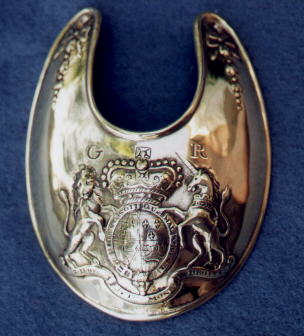
Rowena McClinton ("Demanding and Preserving Nationhood") observed that the Cherokees' efforts to preserve their tribal government persisted during the actual process of Removal (1838-39) - the Cherokee Light Horse Police made an effort to discipline Cherokees who became drunk and disorderly on the Trail of Tears.
And, finally, David Konig, in his comments on a panel on "women's legal troubles," argued that the law didn't just create winners and losers - it was also, like diplomacy and trade, a process of accommodation that reinforced social ties. I suspect it would be hard to convince anyone who's lost a lawsuit of that point, but it sounded good to me.
* Andrew Cayton noted in his comments, however, that Federalist state-building in the Old Northwest was rather minimally violent when one compares it to, for example, revolutionary state-building in contemporary France.
** Update, 18 June 2018: Annnnnnnny day now...
Wednesday, August 12, 2009
The News from Cahokia

In Salon.com, Andrew O'Hehir reviews, at length, Cahokia: Ancient America's Great City on the Mississippi, Timothy Pauketat's new book about the largest pre-Columbian city in North America. Cahokia was the largest of a group of Native American city-states which flourished in the greater Mississippi Valley between 900 and 1300 CE, then rapidly declined, leaving behind enormous earthen temple mounds and immense archaeological remains. Pauketat's book makes at least three observations about the enigmatic metropolis that I hadn't read before. First, rather than growing slowly over time, Cahokia appeared quite rapidly: its founders built it around 1050 CE on the (razed) remains of a previous agricultural village. Second, the Cahokian priesthood and nobility practiced mass human sacrifice: excavations of Mound 72 in the late 1960s revealed the remains of more than 80 young men and women who were all killed at approximately the same time and buried with two high-status men, probably members of the nobility. Third, the sacrifices were probably linked to massive public feasts: another excavation in the 1960s uncovered a 900-year-old midden, so deeply buried that the contents were still decomposing (one can only imagine the smell), filled with the remains of several thousand deer, various plant foods, and millions of tobacco seeds. The feasts that generated this garbage probably consisted of several days of communal gorging and smoking, and helped prop up Cahokia's civic morale – and palliated the hunger and hardship that otherwise were the lot of most of the city's residents. In sum, these excavations help explain why so many Indian "commoners," even those not held in slavery, were willing to live in a setting that must (given the Cahokians' lack of running water and concomitant problems with sanitation) have been unpleasant for them: it was a place of "pomp and pageantry," drama, excitement, and periodic excess, just like any other big city.
Sunday, August 09, 2009
War Toys
Via the Orwell Diaries weblog, a two-page newspaper illustration from July 19, 1939, displaying the entire British battle fleet, from destroyers to aircraft carriers. It's a very impressive panorama - too bad Hitler didn't read the Daily Telegraph.

Friday, August 07, 2009
Your Monthly Apocalypse: Late Paleocene Collision Edition
A follow up to last summer's Death from Above entry: a group of researchers has discovered a layer of "shocked"* microscopic diamonds, dating to 12,900 years ago (10,900 BCE), on Santa Rosa Island off California. The crystals, properly known as Lonsdaleite, are only formed on Earth under extreme conditions, like those of a "cosmic collision." Based on the discovery of other "shock-synthesized minerals" and soot at other American sites dating to the same period, Douglas Kennett (of the University of Oregon) has hypothesized that a large comet or meteor exploded over North America about 13,000 years ago, leading to a 1,000-year cooling period that may have wiped out mammoths and other mega-fauna on the continent.
This hypothesis remains controversial, because the megafaunal species in question had just survived several Ice Ages without incident. It still seems likelier, at least to this educated layman, that newly-arrived human hunters bore primary responsibility for the North American extinctions. An old but serviceable computer model, created by Paul Martin and James Moisimann, demonstrated that a very small initial population of Paleo-Indian hunters could have exterminated every large (450-plus kilogram) herbivorous mammal species north of Mexico within 1,000 years of their arrival in America. (Alfred Crosby, Throwing Fire [Cambridge UP, 2002], 57, 60-66.) Indeed, the cometary explosion discovered by Kinnett et al. may have given some large mammal species additional breathing room, by temporarily reversing the warming trend that had been shrinking the mid-continent "mammoth steppes" and leaving mammoths and other large herbivores more vulnerable to human predation. Still, this is an important story, and reminds historians and anthropologists to Keep Watching the Skies.
* I was going to call this entry "Shocked, I Say," but I've already used that title.
This hypothesis remains controversial, because the megafaunal species in question had just survived several Ice Ages without incident. It still seems likelier, at least to this educated layman, that newly-arrived human hunters bore primary responsibility for the North American extinctions. An old but serviceable computer model, created by Paul Martin and James Moisimann, demonstrated that a very small initial population of Paleo-Indian hunters could have exterminated every large (450-plus kilogram) herbivorous mammal species north of Mexico within 1,000 years of their arrival in America. (Alfred Crosby, Throwing Fire [Cambridge UP, 2002], 57, 60-66.) Indeed, the cometary explosion discovered by Kinnett et al. may have given some large mammal species additional breathing room, by temporarily reversing the warming trend that had been shrinking the mid-continent "mammoth steppes" and leaving mammoths and other large herbivores more vulnerable to human predation. Still, this is an important story, and reminds historians and anthropologists to Keep Watching the Skies.
* I was going to call this entry "Shocked, I Say," but I've already used that title.
Wednesday, August 05, 2009
Oh, Those Wacky Enlightenment Types
From Richard Holmes' new book The Age of Wonder (reviewed in TIME Magazine, 3 Aug. 2009), this account of Humphrey Davy's early experiences with nitrous oxide, which he took in the company of friends Robert Southey and Samuel Taylor Coleridge:
"I seemed to be a sublime being, newly created and superior to other mortals. I was indignant at what they said of me and stalked majestically out of the laboratory to inform Dr. Kinglake privately that nothing existed but thoughts."
I'm sure Kinglake appreciated the insight.
Davy, incidentally, was the inventor of the Davy safety lamp, which was of great use to nineteenth-century miners. Perhaps it shouldn't surprise us that his experiments with laughing gas would prove to be of more lasting utility, at least to dentists and college students.
"I seemed to be a sublime being, newly created and superior to other mortals. I was indignant at what they said of me and stalked majestically out of the laboratory to inform Dr. Kinglake privately that nothing existed but thoughts."
I'm sure Kinglake appreciated the insight.
Davy, incidentally, was the inventor of the Davy safety lamp, which was of great use to nineteenth-century miners. Perhaps it shouldn't surprise us that his experiments with laughing gas would prove to be of more lasting utility, at least to dentists and college students.
Monday, July 13, 2009
Bad Library Books
The new "Awful Library Books" weblog reminds us that while nothing ages faster than modernity, some aspects of the modern world - computers, celebrity biographies, youth fashions, and conventional wisdom regarding gender roles, for example - age faster than others.
Some of the books featured on this site will be of great interest to cultural historians in another 75 years. At the moment, though, none of them is particularly useful, except for a few cheap laughs.
Some of the books featured on this site will be of great interest to cultural historians in another 75 years. At the moment, though, none of them is particularly useful, except for a few cheap laughs.
Tuesday, July 07, 2009
How Empires Die

I've written before in these pages about the fall of the Soviet Union, and referred to Yegor Gaidar's provocative thesis about the long-term economic causes of Soviet decline. This year marks the twentieth anniversary of the collapse of communist power in Eastern Europe, and one of the most significant, if more obscure, episodes in that narrative of collapse occurred twenty years ago today.
As Michael Meyer recounts in his Slate Magazine article "The Wink That Changed the World," by the summer of 1989 the communist regime in Hungary had pursued more far-reaching reforms than any of its neighbors, drafting a new liberal constitution and planning multi-party elections. (The party also gave Imre Nagy, leader of Hungary's 1956 revolution, a formal reinterment and state funeral, and began cutting down the border fence with non-communist Austria.) Alarmed and outraged, the party bosses of the other Warsaw Pact nations scheduled an emergency summit in Bucharest, where they angrily denounced the Hungarian premier, a 40-year-old economist named Miklos Nemeth, as a traitor to the socialist cause.
Fearing a repeat of the Russian invasion that destroyed Hungary's 1956 revolution, Nemeth turned to look at the man who held everyone's leash, Mikhail Gorbachev. To his surprise, Gorbachev seemed ready to laugh out loud at his blustering satraps. He and Nemeth, Gorbachev's expressions implied, were on the same page, and old-guard communists like Erich Honneker were not. Realizing that the Soviet Union had no intention of intervening in Hungary's internal affairs (not that it could afford to do so), Nemeth went home and doubled down on his party's radical reforms. Hungary removed the hammer and sickle from its flag, and on September 10th fully opened the border with Austria, which allowed East Germans - who could travel freely to Hungary - to escape to the West. The Berlin Wall, which the Hungarian government's decision rendered obsolete, fell less than two months later. (See also Patrick Brogan, The Captive Nations [New York, 1990], 140-142.)
Sunday, July 05, 2009
Are There College Professors on the Moon?
Apparently so! Consider the following excerpt from a radio transmission by the esteemed Mr. Cavor, describing the various social castes among his Selenite hosts:
The erudite [class] for the most part are rapt in an impervious and apoplectic complacency, from which only a denial of their erudition can rouse them... [moreover] some of the profounder scholars are altogether too great for locomotion, and are carried from place to place in a sort of sedan tub, wabbling jellies of knowledge that enlist my respectful astonishment.
Apparently, there are graduate students as well:
I have already mentioned the retinues that accompany most of the intellectuals: ushers, bearers, valets, extraneous tentacles and muscles, as it were, to replace the abortive physical powers of these hypertrophied minds. Porters almost invariably accompany them. There are also extremely swift messengers with spider-like legs and 'hands'...and attendants with vocal organs that could well nigh wake the dead. Apart from their controlling intelligence these subordinates are as inert and helpless as umbrellas in a stand.
(From H.G. Wells, First Men in the Moon [1901], Chapter 24.)
The erudite [class] for the most part are rapt in an impervious and apoplectic complacency, from which only a denial of their erudition can rouse them... [moreover] some of the profounder scholars are altogether too great for locomotion, and are carried from place to place in a sort of sedan tub, wabbling jellies of knowledge that enlist my respectful astonishment.
Apparently, there are graduate students as well:
I have already mentioned the retinues that accompany most of the intellectuals: ushers, bearers, valets, extraneous tentacles and muscles, as it were, to replace the abortive physical powers of these hypertrophied minds. Porters almost invariably accompany them. There are also extremely swift messengers with spider-like legs and 'hands'...and attendants with vocal organs that could well nigh wake the dead. Apart from their controlling intelligence these subordinates are as inert and helpless as umbrellas in a stand.
(From H.G. Wells, First Men in the Moon [1901], Chapter 24.)
Friday, July 03, 2009
Your Monthly Apocalypse: Famine
We've had a respite this year from the high food prices that led to widespread hunger and riots in 2008, but that reprieve (if you can call it that, since some of its causes are economic depression and deflation) may be about to end. In "A 'Time Bomb' for the World Wheat Crop," the Los Angeles Times (14 June 2009) reports on the Ug99 stem rust fungus, a potent strain of wheat rust which originated in Uganda in 1999 (hence the name) and has since spread throughout eastern Africa and the Middle East. One Mexican crop-research institute estimates that about 20% of the world's wheat crop is now in "imminent" danger from the fungus, and since the spores are airborne it will eventually spread around the world. Agronomists are trying to breed wheat strains resistant to Ug99, but this could take a decade, by which time the blight could destroy 80% of the world's wheat crop.
And if you were thinking "Well, that may be it for bread, cakes, and cereals, but at least we'll always have fish and chips," consider a recent report in the Idaho Mountain Press which suggests that the world's fisheries are perilously close to 100% depletion. While the world fish supply isn't absolutely doomed - fish populations can, after all, replace themselves, as oil and other minerals cannot - it is certainly troubling that advanced fishing fleets have been able to wipe out 90% of the world's large fish (tuna, cod, marlin) since 1950.
Neither of these articles portends global famine, but neither is good news for the developing world. Those of us in the richer countries will just have to learn to get by on corn dogs and Spam.
And if you were thinking "Well, that may be it for bread, cakes, and cereals, but at least we'll always have fish and chips," consider a recent report in the Idaho Mountain Press which suggests that the world's fisheries are perilously close to 100% depletion. While the world fish supply isn't absolutely doomed - fish populations can, after all, replace themselves, as oil and other minerals cannot - it is certainly troubling that advanced fishing fleets have been able to wipe out 90% of the world's large fish (tuna, cod, marlin) since 1950.
Neither of these articles portends global famine, but neither is good news for the developing world. Those of us in the richer countries will just have to learn to get by on corn dogs and Spam.
Saturday, June 27, 2009
Perfidious Albion
 A curious feature of the late insurgency in Iran has been the tendency of Iranian officials to blame the popular uprising not on the United States or Israel, but Great Britain. Foreign Minister Manochehr Mottaki, for instance, claimed that the British government instigated the demonstrations in Teheran and other cities by sending 747s full of security agents to Iran. It appears that Iranian cultural and religious leaders have long viewed Perfidious Albion as the great puppet-master responsible for their nation's political and economic ills. In 1951 the nationalist Iranian prime minister, Mohammed Mossadegh, told Averall Harriman to beware of the British: "You don't know how crafty they are. You don't know how evil they are." Almost thirty years later, the Shah and his followers charged Britain - in particular, the BBC, which had given airtime to the Ayatollah Khomenei - with starting the 1979 revolution in order to drive up the price of oil, which would increase the profitability of North Sea Oil. (William Shawcross, The Shah's Last Ride [New York, 1988], 64 [quote], 227, 343.) Since the revolution, Christopher Hitchens recently noted, the theocracy's staged demonstrations against foreign powers have inevitably included denunciations of Britain. A member of the state's Guardian Council even claimed a few years ago that the British government had organized the London terror bombings of 7/7/05.
Some of the historical causes of Iranian Anglophobia are obvious: Britain spent a good part of the nineteenth and twentieth centuries meddling in Iran's domestic affairs. British firms secured substantial economic concessions in Persia under the Qajar dynasty, including control of the kingdom's banking and oil industries. Britain also joined Russia in invading and occupying Iran during World War Two, to prevent the nation from becoming a German ally, and in 1953 MI6 joined the CIA in a covert operation that toppled Mossadegh and made the Shah an absolute monarch. The intensity of the Iranian government's anti-British sentiment, however, is hard to fathom given that the regime has two more dangerous and well-armed foreign adversaries, namely America and Israel. Perhaps the sentiment is a byproduct of a historical dynamic mentioned by Ali Ansari: Iran first entered formal diplomatic relations with Britain at a time when Persian power was declining and British power was increasing. Iranian political and cultural leaders might well have drawn the conclusion that this shift in power was due to British conspiracies - and their historical experience of British exploitation and intervention could only have confirmed the hypothesis.
Tuesday, June 23, 2009
Scholarship That Sparkles in the Sun
Yes, it's true: there is a forthcoming anthology about the relationship between history (as a scholarly discipline) and America's favorite series of young-adult novels about chastely attractive Mormon vampires. The editor, Prof. Nancy Reagin of Pace University, is "looking for essays that historicize Stephanie Meyer's Twilight series...or analyz[e] how popular historical understandings inform the series." Her suggested list of topics includes:
* "Masculine honor and gender roles in Edward’s world and Bella’s"
* "Marriage and courtship in Edward’s youth"
* Essays that connect characters in the novels to the Indians of the Pacific Northwest and South America, and
* "The Volturi, art patronage, and politics in Italian history." (A.K.A. "Jacob Burkhardt Wants To Drink Your Blood.")
I don't have much to add, except to note that Prof. Reagin is, perhaps, being a bit too charitable toward the TWILIGHT novels, whose plots and characterization are, by some accounts, crudely and even violently misogynistic. (See this summary of the series if you don't believe me.) A more daring or subversive cultural critic might instead ask whether the views of courtship, marriage, and child-bearing that Prof. Meyer is trying to impress upon her readers, who are mostly impressionable teenage girls, are conservative, reactionary, or batshit insane. But then, we historians are often too impressed with celebrity to take any risks criticizing it. We leave that to young people.
* "Masculine honor and gender roles in Edward’s world and Bella’s"
* "Marriage and courtship in Edward’s youth"
* Essays that connect characters in the novels to the Indians of the Pacific Northwest and South America, and
* "The Volturi, art patronage, and politics in Italian history." (A.K.A. "Jacob Burkhardt Wants To Drink Your Blood.")
I don't have much to add, except to note that Prof. Reagin is, perhaps, being a bit too charitable toward the TWILIGHT novels, whose plots and characterization are, by some accounts, crudely and even violently misogynistic. (See this summary of the series if you don't believe me.) A more daring or subversive cultural critic might instead ask whether the views of courtship, marriage, and child-bearing that Prof. Meyer is trying to impress upon her readers, who are mostly impressionable teenage girls, are conservative, reactionary, or batshit insane. But then, we historians are often too impressed with celebrity to take any risks criticizing it. We leave that to young people.
Tuesday, June 16, 2009
A Federalist-Themed Windfall
This afternoon, Heritage Auction Galleries will auction in Dallas, for a current minimum bid of $30,000, a 1788 first edition of Volume One of The Federalist Papers. The book is the property of Nathan Harlan, a National Guard captain from Granger, Indiana, who purchased it in 1990 (while he was in high school) for seven dollars. In recognition of Capt. Harlan's forthcoming deployment to Iraq, the auction house has waived its usual commission, so Harlan will make a significant profit on the sale: about $770 for each of the 39 essays in that volume.
Update, 10 PM EDT: The final selling price was $80,000 - so make that $2,051 per essay.
Update, 10 PM EDT: The final selling price was $80,000 - so make that $2,051 per essay.
Monday, June 08, 2009
Ograbme, Part III
When Congress ended the Embargo in 1809, it replaced it with a law temporarily banning all American trade with Britain and France. American port inspectors were then surprised by the number of vessels heading for such obscure ports-of-call as Tonningen, Saint Bartholomew island, and Fayal, in the Azores. Herbert Heaton suggests that these captains were bending the truth a little: they may indeed have intended briefly to stop in their declared destinations, but their final destinations were more lucrative ports in Europe and the West Indies. (Heaton, "Non-Importation," 192.) The new - and easily evaded - non-intercourse act lasted for a year before Congress replaced it with the more flexible (but ultimately unworkable) Macon's Bill No. 2, then with a straightforward ban on British imports, which lasted until Congress declared war on Britain.
Jefferson and his colleagues had hoped the Embargo would inaugurate a new era of "peaceable coercion" in international relations - a "republican alternative" to war. The limited resources of the early American state, however, combined with the ancient ingenuity of American merchants, almost by themselves guaranteed that the experiment would fail.*
* Well, more or less. The British government did finally repeal its trade restrictions in 1812, but Congress didn't receive this news until after it had declared war on Britain.
Jefferson and his colleagues had hoped the Embargo would inaugurate a new era of "peaceable coercion" in international relations - a "republican alternative" to war. The limited resources of the early American state, however, combined with the ancient ingenuity of American merchants, almost by themselves guaranteed that the experiment would fail.*
* Well, more or less. The British government did finally repeal its trade restrictions in 1812, but Congress didn't receive this news until after it had declared war on Britain.
Tuesday, June 02, 2009
Ograbme, Part II
Herbert Heaton, in his old but well-researched (and wryly humorous) article "Non-Importation, 1806-1812," observed that even during the Embargo, when American trade with foreign nations was illegal, an enormous quantity of British goods entered the United States - 3.9 million pounds sterling worth in 1808 alone. This was half as much merchandise as Britain exported to the U.S. in 1807, but the figure should have been zero. Heaton suspects that most of these goods were carried in American ships that had cleared port and headed across the Atlantic before the Embargo took effect. Some may have left after that date: at least one port inspector, in New Orleans, didn't enforce the Embargo for six weeks after he learned of it. (Journal of Economic History 1 [November 1941]: 183, 189-191.)
To the extent that most American merchants complied with the Embargo, they did so because they could exploit legal loopholes like these - or because they expected it to last no more than a year. At the end of 1808, as the anniversary of the Embargo Act approached, merchant ships traveled up and down the Atlantic seaboard, loading American produce (wheat, tobacco, etc.) in the expectation that they would be able to put to sea in the new year. When Congress instead passed a new law tightening the Embargo (Jan. 1809), many captains set sail in defiance of the law, knowing that the customs service and the navy lacked sufficient vessels to stop them. At least 100 Embargo-breakers reached Britain and Europe by the time Congress finally killed the "Ograbme" in March 1809.
To the extent that most American merchants complied with the Embargo, they did so because they could exploit legal loopholes like these - or because they expected it to last no more than a year. At the end of 1808, as the anniversary of the Embargo Act approached, merchant ships traveled up and down the Atlantic seaboard, loading American produce (wheat, tobacco, etc.) in the expectation that they would be able to put to sea in the new year. When Congress instead passed a new law tightening the Embargo (Jan. 1809), many captains set sail in defiance of the law, knowing that the customs service and the navy lacked sufficient vessels to stop them. At least 100 Embargo-breakers reached Britain and Europe by the time Congress finally killed the "Ograbme" in March 1809.
Tuesday, May 12, 2009
Ograbme, Part I

Some of my readers are familiar with my current book project, "Engines of Diplomacy," a study of the trading posts that the U.S. government operated in Indian country between 1796 and 1822. As part of my research for the book, I've been reading about early nineteenth-century federal trade policy, particularly the restrictions that the U.S. government imposed on trade with Britain in retaliation for Britain's curtailment (through the 1806-07 Orders in Council, which allowed the seizure of American ships trading with Europe) of American commercial rights. The American trade restrictions included the Embargo of 1807-09, a total stoppage of trade with the rest of the world (one of its critics called the policy the "Cursed Ograbme"); a non-intercourse act directed against Britain and France; and finally an anti-British non-importation act (1811-12) which ended when Congress finally tired of playing the economic sanctions game and declared war on Britain.
What particularly interested me about all of these trade restrictions, and what I thought might interest my readers, were the various means by which resourceful American merchants tried to evade them - usually by exploiting loopholes in the law. My next few posts will describe some of the more creative evaders.
For instance, the 1807 Embargo law allowed the president to authorize diplomatic voyages to foreign ports. Under color of this exception, the wealthy fur trader John Jacob Astor received permission to take "Punqua Wingchong," a Chinese official, back to Canton, along with that eminent officer's personal property. The ostensible mandarin was actually a merchant, who had come to New England in 1807 and become stranded by the Embargo, and his "personal property" consisted mainly of trade goods and bullion to the amount of $50,000, which Astor sent to Canton in Wingchong's ship and exchanged for $200,000 worth of Chinese imports. Thus, Astor was able to continue making profits in the China trade while his competitors were denied permission to leave port. (Kenneth Porter, John Jacob Astor [Cambridge, Mass., 1931], 1:142-150.)
Monday, May 04, 2009
Gaming by Wire

Via the Cliopatria weblog, a New Scientist article on the first chess game played by telegraph. This match took place in England just one year after the invention of the electromagnetic telegraph, and while it ended in a draw it also started a fashion; intercity telegraphic chess games spread as quickly as the telegraph lines that carried them. By the early twentieth century there were even some clubs that held telegraphic bowling and billiards matches. The article does not mention, however, whether or not there were any Victorian-era equivalents of World of Warcraft addiction.
Friday, April 17, 2009
David Hume, Action Hero
Given that one does not usually associate philosophers with wartime military service, and given that one especially does not associate the vita activa with the reclusive and sanguine philosopher David Hume, I was somewhat surprised to come across this passage in the editor's notes to Hume's Essays Moral, Political, and Literary:
"In 1746, Hume accompanied an expeditionary force under General James St. Clair in an attack on the French coast. Hume describes the expedition, for which he received a commission as Judge-Advocate, in a manuscript known as the 'Descent on the Coast of Brittany.' See Mossner, The Life of David Hume (Edinburgh: Nelson, 1954), pp. 187-204."
The expedition in question formed a minor military episode in the War of the Austrian Succession (1740-48), a conflict which was important enough at the time but obscure today. Hume's manuscript describing the landing can be found in the 1889 edition of his Essays (available through Google Books). Seeking to aid Britain's allies in Flanders, General St. Clair took 4,500 men from a cancelled expedition against Canada and threw them into a diversionary attack on the French coast. However, the organizers of the campaign were, according to Hume, dithering and clueless - the general didn't even have a map of Brittany. When the soldiers finally landed they made an abortive attempt to attack the city of L'Orient, then withdrew a few weeks later, with the loss of twenty men and nothing at all to show for their pains - except a few sardonic remarks in an unfinished essay by one of Europe's great skeptics. It's the kind of story that Hume's contemporary, Voltaire, would have enjoyed.
"In 1746, Hume accompanied an expeditionary force under General James St. Clair in an attack on the French coast. Hume describes the expedition, for which he received a commission as Judge-Advocate, in a manuscript known as the 'Descent on the Coast of Brittany.' See Mossner, The Life of David Hume (Edinburgh: Nelson, 1954), pp. 187-204."
The expedition in question formed a minor military episode in the War of the Austrian Succession (1740-48), a conflict which was important enough at the time but obscure today. Hume's manuscript describing the landing can be found in the 1889 edition of his Essays (available through Google Books). Seeking to aid Britain's allies in Flanders, General St. Clair took 4,500 men from a cancelled expedition against Canada and threw them into a diversionary attack on the French coast. However, the organizers of the campaign were, according to Hume, dithering and clueless - the general didn't even have a map of Brittany. When the soldiers finally landed they made an abortive attempt to attack the city of L'Orient, then withdrew a few weeks later, with the loss of twenty men and nothing at all to show for their pains - except a few sardonic remarks in an unfinished essay by one of Europe's great skeptics. It's the kind of story that Hume's contemporary, Voltaire, would have enjoyed.
Friday, April 03, 2009
OAH Convention Summary, Part the Second
In addition to attending a reception or two and browsing at the book exhibit, my main activity at this year's Organization of American Historians conference was attending two professional panels, one titled "Teaching American History as if the Pacific Mattered" (March 27), the other a "State of the Profession" panel on Native American History (March 28). The Pacific History panel featured presentations by Iris Engstrand, who presented some of her work on 18th-century explorers in the North Pacific; Thomas Osborne, who called for the creation of a Pacific History institute similar to Harvard's Atlantic World symposium; and Elliott Barkan, who observed ruefully that most American historians' consciousness stops at the Mississippi River. While the presentations were interesting, the session as a whole was an extended bout of question-begging, the question being "Is there really such a thing as 'Pacific History'? and if so, does anyone care?" I have my doubts. The panelists themselves seemed unsure, inasmuch as they frequently conflated Pacific History with the history of the American West, a related but not synonymous subfield.
The second panel was graced with some professional heavy-hitters - R. David Edmunds, Peter Iverson, Brenda Child, and Laurence Hauptman - but the panelists talked little about the actual "state of the field" (e.g. how many Native Americanist historians there now are, how many monographs we're producing, what questions we're now asking and interpretive devices are we using). Most instead spent their time telling a few good stories and anecdotes, and admonishing their peers to engage in more fieldwork - more direct contact with actual Native Americans - and to acknowledge the emotional depth of their field of study. I concur with the first admonition but not the second; the emotions most commonly associated with American Indian history are pity and rage, neither of which usefully contributes to historians' efforts to emphasize Native American agency and move them to the center of the historical narrative.
Dave Edmunds also informed the audience of a forthcoming American Experience miniseries on Native American history titled We Shall Remain, which premieres on April 13th. The five episodes cover 17th-century New England, Tecumseh, the Trail of Tears, Geronimo, and the Wounded Knee confrontation of 1973. A bit selective and dramatic, to be sure, but the producers wanted to make sure they could hold their audience's attention, which is a bit hard to do when you're discussing the High Plains smallpox epidemic or the Indian Reorganization Act.
Finally, here is a more thorough account of the OAH convention from the standpoint of another early Americanist (Ann Little of Colorado State University), who seems to have had a few problems with the local cuisine...
The second panel was graced with some professional heavy-hitters - R. David Edmunds, Peter Iverson, Brenda Child, and Laurence Hauptman - but the panelists talked little about the actual "state of the field" (e.g. how many Native Americanist historians there now are, how many monographs we're producing, what questions we're now asking and interpretive devices are we using). Most instead spent their time telling a few good stories and anecdotes, and admonishing their peers to engage in more fieldwork - more direct contact with actual Native Americans - and to acknowledge the emotional depth of their field of study. I concur with the first admonition but not the second; the emotions most commonly associated with American Indian history are pity and rage, neither of which usefully contributes to historians' efforts to emphasize Native American agency and move them to the center of the historical narrative.
Dave Edmunds also informed the audience of a forthcoming American Experience miniseries on Native American history titled We Shall Remain, which premieres on April 13th. The five episodes cover 17th-century New England, Tecumseh, the Trail of Tears, Geronimo, and the Wounded Knee confrontation of 1973. A bit selective and dramatic, to be sure, but the producers wanted to make sure they could hold their audience's attention, which is a bit hard to do when you're discussing the High Plains smallpox epidemic or the Indian Reorganization Act.
Finally, here is a more thorough account of the OAH convention from the standpoint of another early Americanist (Ann Little of Colorado State University), who seems to have had a few problems with the local cuisine...
Monday, March 30, 2009
OAH Report

Herewith, at the request of one of my grad-school friends, an update on the annual meeting of the Organization of American Historians (OAH), which I attended this past weekend:
The OAH met in Seattle this year, and the siting of its annual conference on the less-heavily-populated West Coast, combined with the austerities of the current recession, made for a lightly attended and somewhat bare-bones meeting. Slightly more than 1,800 people registered for the convention, down from the 2,600 who attended the 2008 meeting in New York. The book exhibit, the heart of any professional historians' convention, had 38 fewer exhibitors than last year, and those publishers who attended sold few books. The halls at the Seattle Convention and Trade Center were relatively uncrowded; one might have thought that most of the attendees were out sightseeing, were it not for the less-than-optimal weather (mid-40s, rainy) that put a damper on outdoor activities. The presidential address, by Pete Daniel, drew less than 200 people, and I heard of no panels or other conference sessions with more than 50 people in the audience.
The History News Network has further bad news on the Organization's finances, for those who are interested in such things. Not mentioned, but well-known to American historians, is the self-inflicted nature of some of the OAH's financial wounds: the Organization's officers have cancelled two contracts and moved two conventions in the last decade due to labor actions against the host hotels, at a cost to the OAH of $600,000. I don't believe the association could have acted any differently, since many members told the executive committee they wouldn't cross a picket line, but the Organization should probably have done what one of my grad school advisors suggested: take a formal vote of the membership on the issue, and then (if the members voted to move the convention) hit up the members for the associated costs.
In my next post, some thoughts on the panels I attended at this year's OAH convention.
The OAH met in Seattle this year, and the siting of its annual conference on the less-heavily-populated West Coast, combined with the austerities of the current recession, made for a lightly attended and somewhat bare-bones meeting. Slightly more than 1,800 people registered for the convention, down from the 2,600 who attended the 2008 meeting in New York. The book exhibit, the heart of any professional historians' convention, had 38 fewer exhibitors than last year, and those publishers who attended sold few books. The halls at the Seattle Convention and Trade Center were relatively uncrowded; one might have thought that most of the attendees were out sightseeing, were it not for the less-than-optimal weather (mid-40s, rainy) that put a damper on outdoor activities. The presidential address, by Pete Daniel, drew less than 200 people, and I heard of no panels or other conference sessions with more than 50 people in the audience.
The History News Network has further bad news on the Organization's finances, for those who are interested in such things. Not mentioned, but well-known to American historians, is the self-inflicted nature of some of the OAH's financial wounds: the Organization's officers have cancelled two contracts and moved two conventions in the last decade due to labor actions against the host hotels, at a cost to the OAH of $600,000. I don't believe the association could have acted any differently, since many members told the executive committee they wouldn't cross a picket line, but the Organization should probably have done what one of my grad school advisors suggested: take a formal vote of the membership on the issue, and then (if the members voted to move the convention) hit up the members for the associated costs.
In my next post, some thoughts on the panels I attended at this year's OAH convention.
Saturday, February 28, 2009
Voyagers to the East, Part XXII
For the previous entry in this series, click here.
If you had lived in France during the sixteenth century, and had been a person of at least moderate wealth (sufficient to allow you to travel throughout the kingdom), there is an excellent chance you would have been able to meet, or at least see, a Native American traveler during your lifetime. There were approximately 100 Indian visitors to France between 1505 and 1613, beginning with a Carijo chief's son, baptized as Binot de Gonneville, whose biracial descendant became an abbot. The mariner Thomas Aubert brought 7 Micmacs -- the first North American sojourners in France - to Rouen in 1508, and Verrazzano may have brought back a southeastern Algonquian boy in 1524. Explorer Jacques Cartier apparently took a Brazilian Indian girl to France in 1527, though her subsequent fate is unknown (Olive Dickason, The Myth of the Savage and the Beginnings of French Colonialism, 210). Nine years later, Cartier kidnapped Huron chief Donnaconna, his two sons (who had previously been to France), two other chiefs, and five children, and brought them to St. Malo. Most of this cohort died within a few years, but one of the Huron children, a girl, survived to adulthood in France (Dickason, 210-11).
The number of Indian arrivals increased as the French fishing and fur-trading businesses in North America, and French trade with Brazil, expanded later in the century. In 1547 King Henri II granted an audience to Diogo Alvares, a Portuguese shipwreck survivor who had been adopted by the Tupinamba Indians, and his Tupinamba wife Paraguacu, whom Catherine de Medici gave her own name. Henri invited both to remain in France, but they chose instead to return to Brazil (Dickason, Myth of the Savage, 211-212). Henri encountered a much larger cohort of Brazilian Indians in 1550, during his royal entry into Rouen, when he was greeted by several hundred "Indians" - mostly disguised Frenchmen and women, but including 50 actual Tupi-Guarani - who staged a mock battle for him. (At some point during his reign, possibly during this very procession, Henri II received several Tupinamba captives as gifts, and gave them to various nobles as servants.) Henri's successor, Charles IX, also had presented to him several Native American captives, including a Brazilian "king," during his own entries into Troyes and Bordeaux in March 1564 and April 1565, respectively.
Public viewing of Native Americans in 16th-century France peaked with these processions, but at least a dozen more Indians arrived in the kingdom by the early seventeenth century. According to Jacques Noel, between 1550 and 1587 French fur traders brought several North American Indians to the port of St. Malo, where they were baptized and lived at least part of their lives; they included a Micmac or Beothuk man, Jehan, who was baptized in 1553 (Dickason, 211). Around 1570, sailors brought to France a Micmac chief, Messamoet, who subsequently returned to Canada and became an intermediary between his kinsmen and French traders. Shortly after the turn of the seventeenth century, Henri IV received several Montagnais boys brought to France by Francois Grave du Pont and other survivors of Pierre de Chauvin's short-lived colony on the Saguenay River. One of these boys became a companion to the Dauphin (he died in 1603); two others learned French and returned to Canada in 1603 with Grave du Pont and Samuel de Champlain, whom they served as translators during a diplomatic feast, or tabagie, at Tadoussac. (David Hackett Fischer, Champlain's Dream [New York, 2008], 117, 126, 139.) And a decade later, in 1613, six Tupinambas came with missionaries to Paris, where they exchanged their "native" garb (including feathers and maracas, possibly inauthentic) for French clothing and were baptised, with the King and Queen serving as their godparents. (Dickason, Myth of the Savage, 214-17) For the French, the transport of Indians to the metropole was often accompanied by baptism and presentation to the monarch - that is, the submission of exotic strangers to both the Church and the monarchy, in rituals that conjoined the authority of both institutions and were intended to strengthen both.
If you had lived in France during the sixteenth century, and had been a person of at least moderate wealth (sufficient to allow you to travel throughout the kingdom), there is an excellent chance you would have been able to meet, or at least see, a Native American traveler during your lifetime. There were approximately 100 Indian visitors to France between 1505 and 1613, beginning with a Carijo chief's son, baptized as Binot de Gonneville, whose biracial descendant became an abbot. The mariner Thomas Aubert brought 7 Micmacs -- the first North American sojourners in France - to Rouen in 1508, and Verrazzano may have brought back a southeastern Algonquian boy in 1524. Explorer Jacques Cartier apparently took a Brazilian Indian girl to France in 1527, though her subsequent fate is unknown (Olive Dickason, The Myth of the Savage and the Beginnings of French Colonialism, 210). Nine years later, Cartier kidnapped Huron chief Donnaconna, his two sons (who had previously been to France), two other chiefs, and five children, and brought them to St. Malo. Most of this cohort died within a few years, but one of the Huron children, a girl, survived to adulthood in France (Dickason, 210-11).
The number of Indian arrivals increased as the French fishing and fur-trading businesses in North America, and French trade with Brazil, expanded later in the century. In 1547 King Henri II granted an audience to Diogo Alvares, a Portuguese shipwreck survivor who had been adopted by the Tupinamba Indians, and his Tupinamba wife Paraguacu, whom Catherine de Medici gave her own name. Henri invited both to remain in France, but they chose instead to return to Brazil (Dickason, Myth of the Savage, 211-212). Henri encountered a much larger cohort of Brazilian Indians in 1550, during his royal entry into Rouen, when he was greeted by several hundred "Indians" - mostly disguised Frenchmen and women, but including 50 actual Tupi-Guarani - who staged a mock battle for him. (At some point during his reign, possibly during this very procession, Henri II received several Tupinamba captives as gifts, and gave them to various nobles as servants.) Henri's successor, Charles IX, also had presented to him several Native American captives, including a Brazilian "king," during his own entries into Troyes and Bordeaux in March 1564 and April 1565, respectively.
Public viewing of Native Americans in 16th-century France peaked with these processions, but at least a dozen more Indians arrived in the kingdom by the early seventeenth century. According to Jacques Noel, between 1550 and 1587 French fur traders brought several North American Indians to the port of St. Malo, where they were baptized and lived at least part of their lives; they included a Micmac or Beothuk man, Jehan, who was baptized in 1553 (Dickason, 211). Around 1570, sailors brought to France a Micmac chief, Messamoet, who subsequently returned to Canada and became an intermediary between his kinsmen and French traders. Shortly after the turn of the seventeenth century, Henri IV received several Montagnais boys brought to France by Francois Grave du Pont and other survivors of Pierre de Chauvin's short-lived colony on the Saguenay River. One of these boys became a companion to the Dauphin (he died in 1603); two others learned French and returned to Canada in 1603 with Grave du Pont and Samuel de Champlain, whom they served as translators during a diplomatic feast, or tabagie, at Tadoussac. (David Hackett Fischer, Champlain's Dream [New York, 2008], 117, 126, 139.) And a decade later, in 1613, six Tupinambas came with missionaries to Paris, where they exchanged their "native" garb (including feathers and maracas, possibly inauthentic) for French clothing and were baptised, with the King and Queen serving as their godparents. (Dickason, Myth of the Savage, 214-17) For the French, the transport of Indians to the metropole was often accompanied by baptism and presentation to the monarch - that is, the submission of exotic strangers to both the Church and the monarchy, in rituals that conjoined the authority of both institutions and were intended to strengthen both.
Friday, February 06, 2009
Of Beowulf and Fred the Sheep

Via the leading weblog on early medieval Spain, "A Corner of Tenth-Century Europe," this intriguing story about about a proposal to date medieval manuscripts through DNA extraction. Since medieval scrolls and books were printed on parchment - animal skin - Timothy Stinson of North Carolina State University hypothesized it would be possible to determine undated manuscripts' date of origin by extracting animal (principally sheep) DNA from them, then comparing their genetic signature to that of books of known provenance. Stinson presented his proposal at the conference of the Bibliographical Society of America on January 23rd, and it's already generated some press.
The idea apparently isn't new, however; Michael Drout of Wheaton College and his colleague Greg Rose developed it in 2001, and tried to obtain funding for DNA manuscript dating in 2007. Drout noted a significant problem with the proposal in his weblog: nine or ten centuries' worth of handling results in the deposition of quite a bit of human DNA deposition on the edges of books, which in turn leads to cross contamination with sheep DNA. Still, Drout thinks the problems with creating a DNA manuscript database can be surmounted, given enough time and money.
The idea apparently isn't new, however; Michael Drout of Wheaton College and his colleague Greg Rose developed it in 2001, and tried to obtain funding for DNA manuscript dating in 2007. Drout noted a significant problem with the proposal in his weblog: nine or ten centuries' worth of handling results in the deposition of quite a bit of human DNA deposition on the edges of books, which in turn leads to cross contamination with sheep DNA. Still, Drout thinks the problems with creating a DNA manuscript database can be surmounted, given enough time and money.
(The illustration above is from the Arni Magnusson Institute, Iceland)
Subscribe to:
Posts (Atom)