
In 1945 George Orwell reported that the British Army had recently captured two "German" soldiers whose actual nationality was indeterminable. They were obviously of Asiatic descent, but spoke no language known to their interrogators and could not provide their names or any other information. Finally, a British officer who had spent time in India determined that the captives were, in fact, from Tibet. They had been conscripted by a Chinese warlord in the 1930s, captured by the Soviets during a border skirmish and conscripted into the Red Army, and then captured a third time by the Wehrmacht and sent to France as laborers. Orwell proposed that Britain draft these very untypical German soldiers into the army it was sending to Malaya, then allow them to wander back to Tibet, thus completing their involuntary circumnavigation of the globe.
This story always struck me as the best personal, small-scale example of the disruption inflicted upon every corner of the world by the Second World War. However, another story reported last week by the Associated Press is nearly as good. On April 18th of this year Ishinosuke Uwano, a former Japanese soldier whose relatives had declared him legally dead, surfaced at the Japanese embassy in Kiev. Uwano had been drafted into the Imperial Army in 1943 and sent to Sakhalin Island, north of Hokkaido. In August 1945 the USSR declared war on Japan, and the Red Army swiftly overran the Japanese garrisons on southern Sakhalin Island. Uwano became one of 600,000 Japanese prisoners-of-war whom the USSR did not repatriate after the end of the war; instead, he was kept on Soviet-occupied Sakhalin Island for another thirteen years, most likely as a laborer. At some point thereafter, the former POW became a Soviet citizen, and in 1965 moved to Ukraine, where he learned the language, married, had three children, and became for all practical purposes a Ukrainian.
Last week Uwano, now 83 years old, applied at the Japanese embassy in Ukraine for permission to return to Japan, saying "I would like to visit my parents' graves and to see cherry blossoms." The BBC reported that he flew to Tokyo with his son Anatolii on April 19th and began a ten-day visit to his old home town, where he met his surviving siblings, nieces, and nephews. He apparently does not wish to stay in Japan, viewing himself as a citizen of independent Ukraine; indeed, he has largely forgotten the Japanese language, which he hasn't spoken for 60 years.
The Times of London reminds us that "lost" Japanese World War Two soldiers have turned up in strange places before -- some, trapped at war's end on isolated Pacific islands or in the remoter parts of the Philippines, never learned that the war had ended and lived for years as hermits or guerillas. In some ways, however, the war disturbed Uwano's life far more than theirs. They never had to face the new realities of the postwar world: that Imperial Japan was dead, the hated Communists were triumphant throughout Eurasia, and no-one in the "Free World" cared what the Russians did to a few million German and Japanese prisoners. Ishinosuke Uwano was lucky: the great majority of the POWs conscripted by the Soviets in 1945 wound up in poorly-marked graves in Siberia. Uwano, at least, lived to see the fall of the Soviet Empire, the "Orange Revolution" in Ukraine, and his own homecoming.
Update, 10 June 2018: The Orwell story mentioned at the start of this post actually appeared in 1944, in the author's "As I Please" column. To the best of my knowledge, Ishinosuke Uwano remains alive.
Wednesday, April 26, 2006

Thursday, April 13, 2006
Jefferson and the Beringian Migration
In commemoration of Thomas Jefferson's 266th birthday, and as a follow-up to my post of March 15th, let me note that the Sage of Monticello was one of the earliest English-speaking Americans to speculate that American Indians originated in Siberia and migrated to North America via the Bering Strait. "From whence came those aboriginal inhabitants of America?" Jefferson asked in Query XI of Notes on the State of Virginia, his only book. "The late discoveries of Captain Cook, coasting from Kamschatka to California, have proved that, if the two continents of Asia and America be separated at all, it is only by a narrow strait...The resemblance between the Indians of America and the Eastern inhabitants of Asia, would induce us to conjecture, that the former are the descendants of the latter, or the latter of the former." (Merrill Peterson, ed., The Portable Thomas Jefferson [New York: Penguin, 1977], 142.)
Jefferson was not, however, the first European to hypothesize a Siberian origin for Native Americans. The concepts of a Bering land bridge and a Siberian migration to the Americas had been germinating for two centuries before Jefferson published them in his book. In Historia Natural y Moral de las Indias (1589), the Jesuit Jose de Acosta argued that since European animals were present in the Americas, they must have crossed over using a land bridge (which human beings could also have used). In the early 1600s the Spanish engineer Enrico Martin concluded that if such a land bridge existed, it must be in far northeastern Asia and the emigrants who used it must be Siberian. Around 1650, Bernabe Cobo asserted that the physical similarities between the various Indian peoples in North America pointed to a common origin, while in 1674 Daniel Gookin of Massachusetts noted that the most believable theory about the origins of Native Americans was that they were descended from the "Scythian" peoples of northeastern Asia and crossed into America via a land bridge. (Thanks to Charles Martijn, Daniel Mandell and John Faragher for the above information.)
Thomas Jefferson was a man of many talents: writer, inventor, lawyer, diplomat, scientist, naturalist, university founder, and, of course, president of the United States. Originality, however, wasn't necessarily his strongest suit.
Jefferson was not, however, the first European to hypothesize a Siberian origin for Native Americans. The concepts of a Bering land bridge and a Siberian migration to the Americas had been germinating for two centuries before Jefferson published them in his book. In Historia Natural y Moral de las Indias (1589), the Jesuit Jose de Acosta argued that since European animals were present in the Americas, they must have crossed over using a land bridge (which human beings could also have used). In the early 1600s the Spanish engineer Enrico Martin concluded that if such a land bridge existed, it must be in far northeastern Asia and the emigrants who used it must be Siberian. Around 1650, Bernabe Cobo asserted that the physical similarities between the various Indian peoples in North America pointed to a common origin, while in 1674 Daniel Gookin of Massachusetts noted that the most believable theory about the origins of Native Americans was that they were descended from the "Scythian" peoples of northeastern Asia and crossed into America via a land bridge. (Thanks to Charles Martijn, Daniel Mandell and John Faragher for the above information.)
Thomas Jefferson was a man of many talents: writer, inventor, lawyer, diplomat, scientist, naturalist, university founder, and, of course, president of the United States. Originality, however, wasn't necessarily his strongest suit.
Friday, April 07, 2006
Voyagers to the East, Part V
For the previous entry in this series, click here.
Formal European exploration of North America entered a dormant period in the 1510s, apart from Juan Ponce de Leon's reconnaissance of Florida. No Indians crossed the Atlantic during this decade.
In 1521, Spanish official Lucas Vasquez de Ayllon sent an expedition to the Florida coast to determine whether the mainland Indians would make suitable slaves for the West Indies sugar plantations. The expeditionaries captured 70 men and women and carried them back to Santo Domingo. By the time they arrived, however, Ayllon had gotten cold feet about enslaving Indians: King Charles I had begun enforcing the 1512 Laws of Burgos, which prohibited Indian slave-catching. Ayllon thus ordered the captives set free.
Many of the freed slaves died of starvation, but one, a Christian convert named Francisco de Chicora, accompanied Ayllon to Spain in 1522-23 to represent his homeland (the so-called province of "Chicora"). While Francisco had learned Spanish, Ayllon apparently used him as a prop while he spread stories about Chicora and petitioned the Crown for a patent of colonization, which the king granted in 1523. Ayllon subsequently led 500 Spanish colonists and African slaves to the coast of present-day South Carolina, where in 1526 he established the short-lived colony of San Miguel de Gualdape (and died shortly thereafter). Francisco's fate is uncertain, but he may have accompanied Ayllon to San Miguel as a translator. (David Quinn, North America from Earliest Discovery to First Settlements, 143-146.)
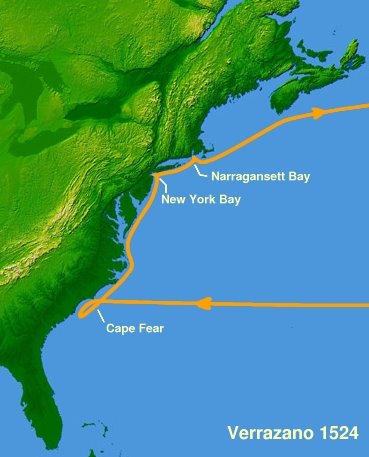
Meanwhile, King Francis I of France and the Queen Mother, Louise of Savoy, commissioned a company of merchants to explore the Atlantic coast of North America and search for an all-water passage to the Pacific. The company appointed the Florentine navigator Giovanni de Verrazzano to undertake the mission, and after a few false starts Verrazzano set out in his caravel La Dauphine. From March to June 1524 Verrazzano charted the North American coast from Cape Fear to Cape Breton Island, stopping periodically to take on water and provisions and to describe the Indian peoples he encountered. The more southerly nations seemed relatively trusting and were willing to trade maize and venison for inexpensive trinkets, while those living to the north were more suspicious and would only accept useful merchandise (particularly metal blades) in trade. The northeasterners had apparently been trading with fishermen for several decades and had discovered a need for caution in dealing with Europeans. During one of his landings on the coast, in present-day Virginia, Verrazzano took an Indian (Algonquin) boy captive, presumably to present to the King and possibly to train as an interpreter. Whether or not Verrrazzano's captive actually survived the voyage is a matter for speculation, though the return voyage was quick and took place in late spring, so the probability of survival was higher for this Indian traveler than it would have been for Columbus's Indian slaves. (Quinn, op. cit., 153-158; Neal Salisbury, Manitou and Providence, 52-53.)
For the next entry in this series, click here.
Wednesday, March 22, 2006
Voyagers to the East, Part IV
For the previous entry in this series, click here.
During the first decade of the sixteenth century, European sailors began to explore the Atlantic coast of North America. Most sought to stake national claims to the Newfoundland fisheries, which European fishermen were just beginning to exploit. Many were (like Columbus) looking for gold or for an all-water route around North America to the Pacific Ocean. And many brought Indian travelers back with them to Europe, though apparently these early explorers viewed Native Americans as curiosities, rather than slaves or potential translators.
In 1501 three Portuguese adventurers from the Azores -- Joao and Francisco Fernandes and Joao Gonsalves -- formed a syndicate with three Bristol merchants to explore and exploit new lands in the vicinity of Newfoundland. Armed with a patent from King Henry VII (founder of the Tudor dynasty), the Azoreans put to sea in 1501 and again in 1502, exploring the coast of Newfoundland and (most likely) Labrador and Nova Scotia. The 1502 expedition returned to England in the fall, its two ships bearing the surviving sailors and officers, several hawks, an eagle, and three Indians.
According to David Quinn, these first Native American visitors to England wore skins and ate half-raw meat, which suggests that they might have been Inuit (the word Eskimo means "eaters of raw meat"). If not, they were probably Micmacs. The travelers attended Henry VII's court wearing English clothes, "but were not heard to speak." (Quinn, North America from Earliest Discovery to First Settlements, 124-128, quote 126). Alden Vaughan is fairly certain that the three Indians were captives, since a contemporary chronicler writes that they were "takyn in the Newe ffound Ile land." (quoted in Vaughan, "Sir Walter Ralegh's Indian Interpreters," William and Mary Quarterly, Third Series, 59 [April 2002], 344.)
By contrast, the first Native Americans to visit France may have come voluntarily. In 1508 the Norman explorer Thomas Aubert set out for Newfoundland in search of a Northwest Passage. The following year, after exploring the Gulf of Saint Lawrence and part of the Saint Lawrence River, he returned to Normandy in his ship La Pensee, bringing seven Indian men (again, probably Micmacs) with him. Aubert put the visitors on display in the port city of Rouen, and the Italian scholar Eusebius published an account of them in his Chronicle (1512):
They are of the colour of soot, have thick lips, and are tattooed on the face with a small blue vein from the ear to the middle of the chin, across the jaws. The hair is thick and coarse, like a horse's mane. They have no beards nor hair on any part of the body, except the hair of the head and eyelids. They wear a belt on which is a kind of little bag to hide their private parts. They speak with their lips, have no religion, and their canoes are made of the bark of a tree. With one hand a man can place it on his shoulders. Their arms are large bows with strings of gut or sinews of animals, their arrows are of reeds pointed with a stone, or fish-bone. Their food is of cooked meat, and their drink, water. They have no kind of money, bread, or wine. They go naked or else in the skins of animals, bears, deer, seals, or the like. (From James Howley, The Beothuks or Red Indians: The Aboriginal Inhabitants of Newfoundland [Cambridge: Cambridge University Press, 1915].)
This is actually the first published European description of a native of North America, and is remarkably similar to later accounts. Like future chroniclers, Eusebius characterized the Micmac visitors as much by identifying things they lack -- money, bread, wine, clothing, religion, body hair -- as by physically describing them and their artifacts. Seventeenth-century French essayists would summarize Indians as men who had "ni loi, ni foi, ni roi" -- neither laws, nor faith, nor kings. Such descriptions allowed many observers to dismiss Native Americans as primitive curiosities, which is probably how the Rouen bourgeoisie viewed the Micmacs.
Neal Salisbury, citing Quinn's book (above) and Bernard Hoffman's Cabot to Cartier (1961), asserts that there were four European kidnappings of Micmacs between 1501 and 1509. (Manitou and Providence [New York: Oxford University Press, 1982], 52). We have seen three so far, by the Corte-Reals, the Fernandes-Gonsalves expedition, and Aubert's. Either Salisbury counted incorrectly or there is another case of Indians being taken to Europe before 1510. If so I haven't found it yet, but I'll keep looking.
For the next entry in this series, click here.
During the first decade of the sixteenth century, European sailors began to explore the Atlantic coast of North America. Most sought to stake national claims to the Newfoundland fisheries, which European fishermen were just beginning to exploit. Many were (like Columbus) looking for gold or for an all-water route around North America to the Pacific Ocean. And many brought Indian travelers back with them to Europe, though apparently these early explorers viewed Native Americans as curiosities, rather than slaves or potential translators.
In 1501 three Portuguese adventurers from the Azores -- Joao and Francisco Fernandes and Joao Gonsalves -- formed a syndicate with three Bristol merchants to explore and exploit new lands in the vicinity of Newfoundland. Armed with a patent from King Henry VII (founder of the Tudor dynasty), the Azoreans put to sea in 1501 and again in 1502, exploring the coast of Newfoundland and (most likely) Labrador and Nova Scotia. The 1502 expedition returned to England in the fall, its two ships bearing the surviving sailors and officers, several hawks, an eagle, and three Indians.
According to David Quinn, these first Native American visitors to England wore skins and ate half-raw meat, which suggests that they might have been Inuit (the word Eskimo means "eaters of raw meat"). If not, they were probably Micmacs. The travelers attended Henry VII's court wearing English clothes, "but were not heard to speak." (Quinn, North America from Earliest Discovery to First Settlements, 124-128, quote 126). Alden Vaughan is fairly certain that the three Indians were captives, since a contemporary chronicler writes that they were "takyn in the Newe ffound Ile land." (quoted in Vaughan, "Sir Walter Ralegh's Indian Interpreters," William and Mary Quarterly, Third Series, 59 [April 2002], 344.)
By contrast, the first Native Americans to visit France may have come voluntarily. In 1508 the Norman explorer Thomas Aubert set out for Newfoundland in search of a Northwest Passage. The following year, after exploring the Gulf of Saint Lawrence and part of the Saint Lawrence River, he returned to Normandy in his ship La Pensee, bringing seven Indian men (again, probably Micmacs) with him. Aubert put the visitors on display in the port city of Rouen, and the Italian scholar Eusebius published an account of them in his Chronicle (1512):
They are of the colour of soot, have thick lips, and are tattooed on the face with a small blue vein from the ear to the middle of the chin, across the jaws. The hair is thick and coarse, like a horse's mane. They have no beards nor hair on any part of the body, except the hair of the head and eyelids. They wear a belt on which is a kind of little bag to hide their private parts. They speak with their lips, have no religion, and their canoes are made of the bark of a tree. With one hand a man can place it on his shoulders. Their arms are large bows with strings of gut or sinews of animals, their arrows are of reeds pointed with a stone, or fish-bone. Their food is of cooked meat, and their drink, water. They have no kind of money, bread, or wine. They go naked or else in the skins of animals, bears, deer, seals, or the like. (From James Howley, The Beothuks or Red Indians: The Aboriginal Inhabitants of Newfoundland [Cambridge: Cambridge University Press, 1915].)
This is actually the first published European description of a native of North America, and is remarkably similar to later accounts. Like future chroniclers, Eusebius characterized the Micmac visitors as much by identifying things they lack -- money, bread, wine, clothing, religion, body hair -- as by physically describing them and their artifacts. Seventeenth-century French essayists would summarize Indians as men who had "ni loi, ni foi, ni roi" -- neither laws, nor faith, nor kings. Such descriptions allowed many observers to dismiss Native Americans as primitive curiosities, which is probably how the Rouen bourgeoisie viewed the Micmacs.
Neal Salisbury, citing Quinn's book (above) and Bernard Hoffman's Cabot to Cartier (1961), asserts that there were four European kidnappings of Micmacs between 1501 and 1509. (Manitou and Providence [New York: Oxford University Press, 1982], 52). We have seen three so far, by the Corte-Reals, the Fernandes-Gonsalves expedition, and Aubert's. Either Salisbury counted incorrectly or there is another case of Indians being taken to Europe before 1510. If so I haven't found it yet, but I'll keep looking.
For the next entry in this series, click here.
Wednesday, March 15, 2006
The First Surfer Nation
This week's TIME Magazine has a good cover story on Kennewick Man, the 9,400-year-old skeleton discovered in Washington in the 1990s. The essay had two main points of interest: A) recent analysis of Kennewick Man indicates that he probably resembled an Ainu or native Siberian, not a European as previously thought, and B) he probably belonged to a coastal culture that relied on fishing and shellfish-collecting for its livelihood. The latter observation links Kennewick Man to a growing body of evidence that early Americans migrated from Beringia down the Pacific coast of North America, thereby bypassing the glaciers that covered Canada and the northern United States during the last Ice Age.
The coastal-migration thesis makes it unnecessary to assume that early Americans reached the non-glaciated parts of the Americas by using an "ice-free corridor" through the ice sheets, a hypothesis advanced by W.A. Johnston and Ernst Antevs in the 1930s and popularized by C. Vance Haynes in the 1960s. Johnston, Antevs and Haynes postulated that the ice-free corridor appeared about 12-13,000 years ago, shortly before melting ice caps submerged the Bering Land Bridge. They used this odd hypothesis to support the notion that there could not have been any human presence in the Americas prior to 10,000 BCE, a belief that archaeologists held for decades before it was finally discredited by Tom Dillehay.
The article notes that researchers are now pushing the date of first human migration to the Americas as far back as 28,000 BCE, based on mitochondrial DNA studies. That said, it is startling to realize that the first Americans may have been primarily boaters and beach dwellers. I suspect it's only a matter of time before we find the first Native American surfboards.
The coastal-migration thesis makes it unnecessary to assume that early Americans reached the non-glaciated parts of the Americas by using an "ice-free corridor" through the ice sheets, a hypothesis advanced by W.A. Johnston and Ernst Antevs in the 1930s and popularized by C. Vance Haynes in the 1960s. Johnston, Antevs and Haynes postulated that the ice-free corridor appeared about 12-13,000 years ago, shortly before melting ice caps submerged the Bering Land Bridge. They used this odd hypothesis to support the notion that there could not have been any human presence in the Americas prior to 10,000 BCE, a belief that archaeologists held for decades before it was finally discredited by Tom Dillehay.
The article notes that researchers are now pushing the date of first human migration to the Americas as far back as 28,000 BCE, based on mitochondrial DNA studies. That said, it is startling to realize that the first Americans may have been primarily boaters and beach dwellers. I suspect it's only a matter of time before we find the first Native American surfboards.
Sunday, March 05, 2006
One Man's Trash
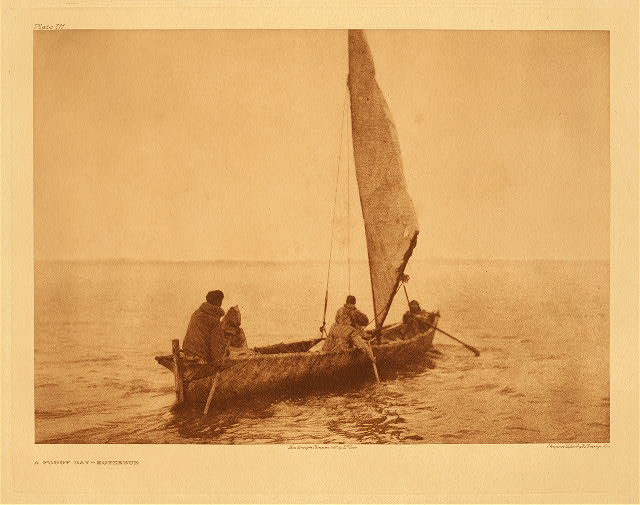
With the approach of spring, a person's thoughts turn naturally to...Eskimos. Well, perhaps not everyone's, but the Inuit have been somewhat on my mind lately, partly because I recently watched Nanook of the North for the first time, and mostly because I've just finished Edward Beauchamp Maurice's posthumous memoir of a year spent with the Native peoples of Baffin Island, Last Gentleman Adventurer.
Maurice, who died in 2003, was the son of an impoverished middle-class English widow. In 1930 his family decided to move to New Zealand and try their luck as farm workers. Maurice, who was about to finish school, found the prospect of becoming a field hand unpleasant and jumped at an opportunity suggested by one of his teachers: becoming an employee of the 260-year-old Hudson's Bay Company. At the age of 17 Edward signed his work contract, became one of the "company of gentlemen venturing into Hudson's Bay" (in the words of the HBC charter), and took ship for Labrador, probably the most desolate place in the Western Hemisphere.
During his first year as an HBC employee, Maurice was stationed at an icebound post on Baffin Island (the second most desolate place), where he befriended the local Inuit. His memoir is chiefly useful as a source of ethnographic information on his Native American neighbors: their survival skills, hunting practices, family structures and eschatology. Some details have probably been left out or bowdlerized by the descendants who edited the memoir for publication; for instance, the book gives almost no space to the "country marriage" which Maurice contracted with at least one Inuit woman, Innuk. On other points, though, Maurice doesn't hesitate to shock. His description of how polar bears hunt seals, for instance, makes you realize just how intelligent and cruel these giant stuffed toys really are.
As someone interested in the fur trade, I was particularly struck by Maurice's details on the uneven dynamics of Anglo-Inuit commerce. In one passage, he talks about two Inuit women who have just had an extremely successful winter hunting fox and other animals, and how after selling the furs they have spent many months accumulating, they hope to have earned enough money to buy some fuel and cloth and a couple of rifles. On the other hand, he observes that the prize fur of the Arctic fur trade was that of the white fox, which Eskimos traditionally used to wipe their babies' bottoms. The British employees of the HBC were willing to pay $10 for each of these things. Presumably they didn't tell their European customers the whole story about the furs' origins and their other...applications.
Sunday, February 26, 2006
Voyagers to the East, Part III
 For the previous entry in this series, click here.
 Columbus was not the last European to transport Native American slaves to Europe. In 1501 the Portuguese mariners Gaspar and Miguel Corte-Real sailed to Labrador, explored the coasts of Newfoundland and Nova Scotia, and claimed the lands they had "discovered" for Portugal. They assumed that these territories lay to the east of the demarcation line established in the 1494 Treaty of Tordesillas, in which Spain and Portugal divided the world between them. (Portugal received all the lands east of the line, including Brazil, Africa, and India.) In Nova Scotia Miguel Corte-Real encountered a large party of Micmacs who had come down to the shore for their summer fishing. Like Columbus, Corte-Real decided to see if the new territory could be turned into a source of slaves. Accordingly, he captured 50 Indians and shipped them back to Lisbon, where they were sold. (David Quinn, North America from Earliest Discovery to First Settlements [New York, 1977], 123; William Goetzmann and Glyndwr Williams, The Atlas of North American Exploration [New York: Prentice-Hall, 1992], 20-21.)
The fate of those 50 slaves is unrecorded. We may speculate that those who survived the voyage wound up as servants or laborers in Lisbon, where 10% of the population were slaves in the early 16th century. As for the Corte-Reals: Gaspar's ship was lost during the return voyage to Portugal in 1501, while Miguel was lost during a subsequent voyage in 1502. Indians were not the only people for whom early trans-Atlantic voyages could be hazardous.
[The photo above is of a reconstructed 16th-century caravela redonda, courtesy of that academic's bete noire, Wikipedia.org.]
For the next entry in this series, click here.
Tuesday, February 21, 2006
Voyagers to the East, Part II
For the previous entry in this series, click here.
Hagiographers of Christopher Columbus have avoided drawing attention to the navigator's second voyage to America (1493-1496), an expedition featuring 17 ships and 1,500 men (mostly soldiers). That's because Columbus's actions on this voyage made it plain that he was a conquistador and a slaver, as well as an explorer.
Upon returning to Hispaniola, Columbus discovered that Indians had killed the 39 men he'd left on the island. The admiral used this as an excuse to make war on the Caribs and Tainos. For the next two years Columbus's men, with the help of their war dogs, hunted and killed hundreds of Indians, and forced thousands of others to work for them as gold miners and servants. The adventurers also decided to see if they could create a market in Europe for Native American labor. In February 1495 they herded 1,600 Indian captives into the settlement of Isabella and selected 550 men and women for transport to Spain, where they would be sold as slaves.
Michele de Cuneo, an Italian nobleman who accompanied Columbus, reported that the slave ships ran into contrary winds during their return voyage and did not reach Spain until April 1495, by which time 200 of the 550 Indian slaves had died. "I believe [this was] because of the unaccustomed air, colder than theirs," de Cuneo wrote. "We cast them into the sea." Of the remaining 350 bondsmen, half were sick by the time the fleet dropped anchor in Cadiz. "They are not working people," de Cuneo derisively observed, "and they very much fear cold, nor have they long life." (de Cuneo to Hieronymo Annari, 28 Oct. 1495, in Samuel Eliot Morison, ed. and trans., Journals and Other Documents on the Life and Voyages of Columbus [New York: Heritage Press, 1963], 226-227.)
King Ferdinand and Queen Isabella were not pleased to hear of the enslavement of their new subjects. They ordered that the surviving Indians be freed and returned to the Indies, though if half of the 350 survivors were already sick when they arrived in Spain it is unlikely that more than 150 ever made it home.
Columbus himself returned in 1496 to Spain with 30 more Native Americans, whom his crewmen had threatened to eat when supplies ran low. Ferdinand and Isabella henceforth forbade Columbus to enslave Indians, and according to accounts of Columbus's third and fourth voyages he did not bring any more indigenous Americans with him to Spain. (Morison, op. cit., 247, 250-251, 318.)
For the next entry in this series, click here.
Hagiographers of Christopher Columbus have avoided drawing attention to the navigator's second voyage to America (1493-1496), an expedition featuring 17 ships and 1,500 men (mostly soldiers). That's because Columbus's actions on this voyage made it plain that he was a conquistador and a slaver, as well as an explorer.
Upon returning to Hispaniola, Columbus discovered that Indians had killed the 39 men he'd left on the island. The admiral used this as an excuse to make war on the Caribs and Tainos. For the next two years Columbus's men, with the help of their war dogs, hunted and killed hundreds of Indians, and forced thousands of others to work for them as gold miners and servants. The adventurers also decided to see if they could create a market in Europe for Native American labor. In February 1495 they herded 1,600 Indian captives into the settlement of Isabella and selected 550 men and women for transport to Spain, where they would be sold as slaves.
Michele de Cuneo, an Italian nobleman who accompanied Columbus, reported that the slave ships ran into contrary winds during their return voyage and did not reach Spain until April 1495, by which time 200 of the 550 Indian slaves had died. "I believe [this was] because of the unaccustomed air, colder than theirs," de Cuneo wrote. "We cast them into the sea." Of the remaining 350 bondsmen, half were sick by the time the fleet dropped anchor in Cadiz. "They are not working people," de Cuneo derisively observed, "and they very much fear cold, nor have they long life." (de Cuneo to Hieronymo Annari, 28 Oct. 1495, in Samuel Eliot Morison, ed. and trans., Journals and Other Documents on the Life and Voyages of Columbus [New York: Heritage Press, 1963], 226-227.)
King Ferdinand and Queen Isabella were not pleased to hear of the enslavement of their new subjects. They ordered that the surviving Indians be freed and returned to the Indies, though if half of the 350 survivors were already sick when they arrived in Spain it is unlikely that more than 150 ever made it home.
Columbus himself returned in 1496 to Spain with 30 more Native Americans, whom his crewmen had threatened to eat when supplies ran low. Ferdinand and Isabella henceforth forbade Columbus to enslave Indians, and according to accounts of Columbus's third and fourth voyages he did not bring any more indigenous Americans with him to Spain. (Morison, op. cit., 247, 250-251, 318.)
For the next entry in this series, click here.
Monday, February 20, 2006
Voyagers to the East: Indians in Europe, Part I

Last semester my students and I were discussing Alfred Crosby's term "Columbian Exchange," first used in his 1972 book describing the exchange of people, animals, plants and diseases between the Old World (Eurasia and Africa) and the Americas. We observed that most of these exchanges were one-way: the spread of diseases and domestic animals from Europe to the Americas far outweighed the spread of American microbes and animals to the rest of the world. The exchange of people was the most uneven: about 15 million people journeyed from Africa and Europe to the Americas between 1492 and 1850, while few Native Americans made the journey in the other direction.
It occurred to me that there were so few Indian travelers to Europe that it might be possible to write accounts of nearly all of those for whom we have records, and to construct a preliminary census. So today's post will be the first of a series on these "voyagers to the east" and their historical significance.
Christopher Columbus, of course, bears the responsibility for starting the Columbian Exchange, and it was he who first carried Native American travelers to Europe. On November 11, 1492, while sailing along the coast of Cuba, the navigator decided to take several Taino Indians to Spain so that they could learn the Spanish language and religion, and act as translators and missionaries to their people. Language and faith would serve as tools of empire, making the peoples of the West Indies easier to govern and exploit, though Columbus opined in his diary that the Tainos were already so "timid" and "trusting" that they were nearly ready-made servants. (Robert Fuson, trans., The Log of Christopher Columbus [Camden, Maine: International Marine Publishing, 1987], pp. 106-107.) "They are suitable to be governed and to be made to work and sow and...to build villages and be taught to wear clothing and observe our customs." (ibid, 138)
Columbus apprehended 20 people -- ten men, seven women, a boy and two girls -- from Taino villages in Cuba and Hispaniola. He took women and children along in order to ensure the good behavior of the men, for all-male groups tended, in his experience, to be dispirited and unruly. Columbus had done this sort of thing before: in the 1480s he took several men from the Guinea coast of western Africa to Portugal in order to train them as translators. The absence of women in the African group, however, had made the men ill-tempered. (ibid, 107)
Most of the Tainos who returned with Columbus after his first voyage were involuntary passengers. Three men whom the captain picked up on Cuba escaped before Columbus left the Indies. One man, the father of the three children, volunteered to go, doubtless because his children were hostages. There may have been other volunteers, but the captain did not make note of it, which tells us a great deal about his attitude toward Indians. Columbus notes in his log that the Indians on his ships did try to make the best of their situation by fishing or swimming when they got the chance (pp. 110, 179).
Columbus presented at least six of his passengers to King Ferdinand and Queen Isabella when he arrived back in Spain in the spring of 1493, but as to whether any became translators or Christians, or ever returned to the Western Hemisphere, he does not say. We may guess that at some of the seventeen Indian voyagers perished of disease en route or in Europe, beginning a long and grim story.
For the next entry in this series, click here.
Tuesday, February 14, 2006
Undaunted Puppy Flinging

2006 concludes a four-year commemoration of the bicentennial of Lewis and Clark's overland journey to the Pacific Ocean. The two explorers have been back in the public eye for nearly a decade, owing to Stephen Ambrose's Undaunted Courage and Ken Burns' PBS series. The bicentennial commission has sponsored commemorative events along the Lewis andClark National Historic Trail, and the U.S. Mint has issued a series of commemorative nickels displaying a keelboat, a peace medal, a buffalo, and the Columbia Gorge. Naturally, our public remembrance of the explorers has been adulatory, emphasizing their courage, their scientific curiosity, and their sympathy for and good relations with the western Indians.
I think it useful to remember that Meriwether Lewis and William Clark were only human, and that their personal shortcomings became particularly pronounced as they entered the last year of their journey. By 1806 Lewis and Clark were flea-bitten, footsore, exhausted, and homesick, and had lost all patience with the nominally-friendly Indians, even though their commission from President Jefferson had assigned them the dual role of explorers and diplomats. The highly strung Captain Lewis complained about acts of petty theft committed by members of the Wahclella and Eneeshur nations (in northern Oregon), whose beliefs about personal property -- i.e., that friendly people shared their goods with one another -- were very different from his own. In April Lewis beat up an Indian man who tried to steal "an iron socket of a canoe pole" and threatened his kinsmen with fire and sword if it happened again (John Bakeless, Journals of Lewis and Clark, 306-307).
A few weeks later, on May 5th, there was an even more noteworthy confrontation, stemming from Meriwether Lewis's acquired taste for dog meat. A young Nez Perce man "very impertinently threw a poor, half-starved puppy nearly into my plate by way of derision for our eating dogs, and laughed very heartily at his own impertinence." Rather than behaving diplomatically, Lewis responded violently: "I was so provoked at his insolence that I caught the puppy and threw it with great violence at him and struck him in the breast and face, seized my tomahawk, and showed him by signs if he repeated his insolence I would tomahawk him." (ibid, 313). The Nez Perces' replies to Lewis's action are not recorded. Neither is the puppy's.
Somehow, I doubt that Lewis's bloodthirsty threats, the fistfights, or the flung puppy will make it onto coins or into future television programs on the expedition. Americans need their myths, and the tale of the Corps of Discovery is the closest thing to the Odyssey that we have. On the other hand, a reader familiar with this story at least knows one fact that differentiates Meriwether Lewis from the more phlegmatic William Clark, whom most Americans otherwise tend to confuse with one another.
(There are some very good Websites on the Lewis & Clark expedition, including "Discovering Lewis and Clark.")
Introduction
I've been thinking of starting a weblog for two years now, and have finally decided to take the plunge. Since there are several million English-language weblogs currently in existence, some degree of specialization seems appropriate here. I will therefore use this space primarily to post interesting stories I've come across in the course of my research and reading in American and Native American history. (I will make occasional detours into movies and current events, but for the most part this will be a history blog.) I plan to post once per week, but you know the saying about best-laid plans...
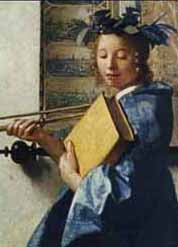
The illustration at right is a detail from Johannes Vermeer's "The Art of Painting" (1666), depicting Clio, the Muse of History. The trumpet in her right hand reminds us that Clio is often a long-winded muse.
Subscribe to:
Posts (Atom)