Showing posts with label Anniversaries. Show all posts

Friday, June 28, 2019

To Crush Your Enemies and See Them Driven Before You


Signed one hundred years ago today, the Treaty of Versailles contributed more to the outbreak of World War Two than any other event not named "Adolf Hitler." Meeting amidst the splendors of Louis XIV's palace with representatives of the German state, the victorious Allies kicked their Great War adversaries in the teeth, hard. Germany lost most of its armed forces and twenty-five percent of its territory, and took on a reparations bill of 130 billion marks (about 400 billion dollars in modern currency), a sum so great that it fueled the hyperinflation that ruined the Weimar Republic. Germans also had to accept responsibility for World War One, declaring themselves the sole guilty party and Britain and France spotless victims. The German commissioners had no choice but to accept this humiliating treaty: thousands of their countrymen were dying from Britain's blockade, which the Royal Navy continued after the Armistice to keep Germany on its knees. The British and French planned to keep the German nation in that posture for years to come.

Joseph Finnemore, Signing of the Treaty of Versailles (Public Domain, 1919)
As important as the onerous terms of the Versailles treaty was the Allies' decision to conclude it with a united Germany. The victors of World War One had broken up the other two empires in the Central Powers (Austria-Hungary and the Ottoman Empire), but left the German polity of 1871 intact. A.J.P. Taylor drew attention to this peculiarity of the post-1918 peace settlement in Origins of the Second World War (1962). He did not need to explain why the German exception proved a fateful one. When a violent nationalist regime took power in Berlin in the 1930s, and began looking for vengeance, a united Germany's population and resources ensured that it would be able to take revenge on its former conquerors.

Also worth noting: the statesmen at Versailles and the other post-WWI treaty conferences may have thought themselves makers of a lasting peace, but hundreds of thousands of more obscure men still had guns in their hands and wounded pride in their hearts. The guns fell silent in France and Italy but continued their deadly work elsewhere. Germany surrendered, but the reactionary freikorps kept killing in Bavaria and the Baltics, gunning down socialists and Latvian nationalists. Fighting continued on the old Eastern Front for years, until the Bolsheviks triumphed over the counter-revolutionary armies who opposed them. By then over a million people had died, not including those who succumbed to famine in southern Russia and Ukraine. Turkish nationalists did not accept the Allies' colonization of the Ottoman Empire. Under Kemal Ataturk they defeated a Greek army sent to colonize western Anatolia, forced Britain and France out of Istanbul, and created a united Turkish ethnostate. At the southern end of the Ottoman domain, the Saud family cancelled the political victory of Britain's clients, the Hashemites, seizing the Hejaz in 1924-25 and establishing the independent Kingdom of Saudi Arabia. Domination and humiliation make poor foundations for peace, particularly if those doing the dominating and humiliating are themselves exhausted by years of war. (See Robert Gerwarth, The Vanquished: Why the First World War Failed to End [2016].)

Wednesday, February 13, 2019

The Shabbiest Horse Traders Get to Be "Statesmen"

Rep. James Tallmadge of New York introduced on this day 200 years ago the amendment that would bear his name and precipitate a famous inter-sectional controversy. The U.S. Congress was preparing to admit Missouri to the Union, and Tallmadge proposed a gradual ban on human slavery in the new state. Tallmadge's proposal gained considerable traction in the free northern states, whose white freemen had little love for African-American slaves but even less for wealthy slave owners. Public meetings expressed support for the free-state amendment, and the motion gained a majority vote in the U.S. House of Representatives. Southern whites were, shall we say, much less supportive. Their representatives blocked the amendment in the Senate (where free and slave states enjoyed parity), and Southern political leaders demanded that slavery remain legal in Missouri. The highest-ranking Southern white politician, President Monroe, argued that calamity would ensue if Congress blocked slavery's expansion: older states like Virginia could not rid themselves of "surplus" slave laborers, human property would fall in value, and overcrowding in the East would make slave rebellions more likely.

Ultimately, Northern and Southern Congressmen worked out one of their usual shabby compromises. Slavery would remain legal in Missouri and permissible in the new territory of Arkansas, but outlawed in the rest of the Louisiana Purchase, which in any event remained firmly in the possession of Native Americans. Northern white politicians would later regard the "Missouri Compromise" as a sacred compact of the Union, and its negotiator, Henry Clay, as their "beau ideal of a statesman." Southern whites would cast the Compromise aside as soon as they felt politically powerful enough to do so.

Sunday, August 09, 2015

Nagasaki: Day Zero


Seventy years ago today, an American B-29 bomber dropped a 21-kiloton nuclear bomb on the Japanese city of Nagasaki. In her new book, Nagasaki: Life after Nuclear War, Susan Southard describes what happened next:

“The thermal heat of the bomb ignited a fireball with an internal temperature of over 540,000 degrees Fahrenheit...Within three seconds, the ground below reached an estimated 5,400 to 7,200 degrees Fahrenheit. Directly beneath the bomb, infrared heat rays instantly carbonized human and animal flesh and vaporized internal organs.

“Where the northern half of Nagasaki had existed only an hour before, a low heavy cloud of smoke and dust hovered over a vast plain of rubble. Nothing remained of the dozens of neighborhoods except tangled electrical wires and an occasional lone chimney. The huge factories that had lined the river near Nagasaki Station were crumpled into masses of steel frames and wooden beams, and the streetcar rails were, in one survivor’s words, 'curled up like strands of taffy.'”

The article, and (I strongly suspect) the book from which it is excerpted, are worth reading in full, courtesy of Tom Dispatch and Salon.com.

(My thanks to Shana Dennis for bringing this piece to my attention.)

(Above image via atomicheritage.org)

Thursday, January 08, 2015

The Battle for New Orleans: Making Louisiana Safe for Slavery


As longtime fans of The Simpsons know, the Battle of New Orleans, whose bicentennial we celebrate today, occurred two weeks after the War of 1812 ended. This turns out to be one of things we know that just ain't so: Donald Hickey points out in Don't Give Up the Ship (U. of Illinois, 2006) that while British and American commissioners signed a peace treaty in December 1814, it did not go into effect until both governments ratified it in February, so the war legally continued for several weeks after Andrew Jackson's lopsided* victory. This observation raises an intriguing counterfactual question: if the British had captured New Orleans in 1815, would Britain have been able to retain the city, and a chunk of the Louisiana Purchase, as prizes of war? After all, the United Kingdom had not recognized the legitimacy of France's sale of Louisiana to the United States. The question becomes more interesting when we realize how close Britain came to capturing the vital seaport. David and Jeanne Heidler recently observed** that though British troops failed to take New Orleans from the south, another army planned to move on the Crescent City from the less defensible north, via Mobile and Baton Rouge. British General John Lambert captured Mobile's harbor defenses in February 1815. He and his colleagues would have stood a good chance of occupying New Orleans if the war had lasted a few more months.


I doubt, however, that Britain would have kept New Orleans for long. The Treaty of Ghent specifically restored the status quo ante bellum, denying Britain a legal right of conquest to Louisiana. Even if British officials decided to challenge  the validity of the Louisiana Purchase, doing so would have obliged them to return New Orleans to its previous European owners, the French. I doubt they would have found this an attractive alternative. More importantly, Whitehall's primary objective during and after the War of 1812 was the defense of its existing North American colonies, Upper and Lower Canada. It had authorized the attack on the Gulf Coast as s diversion, to draw American forces away from the vulnerable Canadian provinces. Holding territory in the Gulf region would have interfered with Whitehall's post-war efforts to secure the U.S. - Canadian border through diplomacy (e.g. the Rush-Bagot agreement that  demilitarized the Great Lakes). New Orleans might have provided Britain with a bargaining chip in future negotiations with the Americans, but I've seen no evidence that Foreign Office ministers were thinking this way in 1815.


I don't mean to suggest, though, that a hypothetical British capture and occupation of New Orleans would have had no consequences at all. But we need to move away from geopolitics and the American master narrative of war and expansion to determine those consequences. We should follow the lead of Alan Taylor, Gene Smith, and Nathaniel Millett, all of whom have drawn our attention to a previously under-studied aspect of the War of 1812: the decision by thousands of African-American slaves to treat the British Army as a liberation force, and to flee to the protection of their lines. Millett observes that Edward Nicolls (no relation) recruited runaway slaves into a British volunteer force after Britain seized Pensacola in 1814. In Florida hundreds of those freedmen subsequently formed an autonomous maroon community (the “Negro Fort”) which stood until American troops destroyed it in 1816; others took refuge with the Seminoles. Nearby Louisiana had a large (35,000) and restive slave population in 1815, and it is very likely that Louisiana slaves, by the hundreds if not the thousands, would have responded to a British occupation of New Orleans by seeking refuge with the invaders. How this would have altered the “big picture” of American history I know not, but consider: Louisiana had its own maroon communities in the late eighteenth century, and in 1811 had generated the largest slave revolt in North American history, the German Coast uprising. The state already had a culture of slave defiance, and it is probable that a slave exodus to British-occupied New Orleans would have strengthened this culture in the 1810s and '20s. In any case, abscondance and the possibility of liberation would have changed and improved the lives of hundreds of people, and that is as worthy of comment as speculation about the impact of a British victory on American national power. History is about people, not just nation-states.


* About 50 Americans were killed and wounded, versus more than 2,000 British casualties.


** "'Where All Behave Well:' Fort Bowyer and the War on the Gulf, 1814-1815," in Tohopeka: Rethinking the Creek War and the War of 1812, ed. Kathryn E. Holland Braund (U. of Alabama Press, 2012), pp. 182-199.

Tuesday, December 09, 2014

The Big One, Plus One Hundred

Your humble narrator has not devoted much attention to this year's big centennial, the hundredth anniversary of the outbreak of World War One, for which he offers this explanation: the critical events of the First World War rarely fit into a single day, but rather stretched over several days or weeks or (in the case of battles like the Somme) several months. The assassination of Franz Ferdinand, to be sure, was exceptionally sudden, but it took another month for German leaders to goad Austria into picking a fight with the Russians and the Serbs. It took another week after that for France, Belgium, and Britain to enter the war, and when the first major engagement on the Western Front, the Battle of the Marne, erupted in September, it took the Allies another full week of barrages, alarms, and excursions to halt the German advance. One can't easily devote a day here and a day there to commemorating the anniversaries of important battles and events, as one can do with, for example, the Napoleonic Wars.


I can suggest one excellent recent book on the outbreak of the war, David Fromkin's Europe's Last Summer (2004).* Contra Barbara Tuchman's classic but dated The Guns of August (1962), Fromkin observes that WWI resulted not from a series of interlocking blunders but from definite decisions by two of the Great Powers: Austria, which wanted to use the Sarajevo assassination as an excuse to crush Serb nationalism, and Germany, which made the price of its assistance an Austrian war against Serbia's ally Russia, whose growing economic and military might German generals feared. As Norman Stone pointed out in his own study of the war, Gavrilo Princip took the fall for a disaster that Germany would probably have engineered anyway. (World War One [Basic Books, 2009], p. 23)


For the war itself, Mental Floss's blogger Erik Sass has been doing a fine job summarizing the major developments of 1914, using seldom-seen photographs and witnesses from both sides of the battle lines. Among the events he's covered so far are the Battle of the Marne (5-12 September 1914), whose outcome he connects to two of the largest problems facing the commanders of wartime offensives: the huge advantage that rail transport (not to mention Paris taxis) gave defending armies, and the difficulty of coordinating the movement of multiple corps of soldiers. Sass also offers essays on the German capture of Antwerp (7-10 October), whose final days one observer described as a “glorious and fascinating nightmare”; the First Battle of Ypres (12 October – 12 November 1914), which sucked in a million soldiers and killed or wounded 300,000 of them, allegedly including several divisions of German college students; and the forgotten battles beyond Europe, like Qingdao, Basra, and Coronel. I look forward to his account of the famous “Christmas Truce” a few weeks hence.


Finally, while it is a trifle shallow, this Daily Mail article demonstrates that life in wartime Britain wasn't nearly as dowdy and stoical as Britons later remembered, unless there is something dowdy about cocaine, binge drinking, and casual sex.

The images above are from "Apocalypse at Ypres," the third Mental Floss link from paragraph three, and "The Marne Taxis," by Leon Loupy (http://www.worldwar1.com/heritage/marnetaxis.htm).


* One caveat to my review of Fromkin's book: the “cheering crowds” that greeted the war actually represented a small minority of their countries' populations, most of whom found the news bewildering or dismaying.

Monday, October 13, 2014

1592 and All That


By 1592, a century after Columbus’s first voyage and nine decades after his death, Spain had created an empire as vast and ruthless as the Mongols.’ Spanish officials and soldiers ruled much of the Western Hemisphere, from Florida to Peru, and Spain’s banners flew over much of western Europe as well. By then, too, Spain’s imperium had begun to suffer from imperial overstretch: King Felipe II’s finances were deteriorating, his New World subjects dying en masse from smallpox and enslavement, and Dutch rebels and English heretics preyed on his European provinces and American treasure ships. It was in this context that the engraver Theodore de Bry published one of the more influential visual representations of Columbus’ “discovery.”


De Bry (1528-1598) made the picture for a series of illustrated volumes on the European voyages of discovery. It shows a well-dressed Columbus, accompanied by soldiers, encountering a party of Indians, who present him with gifts of jewelry. To one side several men erect a cross, legitimizing the Spanish conquest, while in the background other Indians flee from other disembarking explorers.


I learned of this engraving from a recent article by Michiel van Groesen, who notes that De Bry’s engraving established an iconic image of Columbus’s landing that recurred in European illustrations throughout the eighteenth century. Van Groesen suggests that De Bry wanted an illustration that appealed to Europeans’ superiority complex, emphasizing their material culture (clothes, weapons, ships) as well as their more confident bearing and Christian faith. At the same time, De Bry had a less-than-favorable view of the Spanish, having been driven from his native Liege for practicing a faith (Calvinism) that Spain considered heretical. Hence, the picture contains a few subversive elements: some of the Indians are clearly frightened by the intruders, and their offering of gold reminds viewers of Spain’s greed. Since De Bry was publishing his books for Europeans of all confessions and nations (as long as they could read Latin), he didn’t want to alienate Spanish or Catholic readers, but there is at least a whiff of the “Black Legend”* in this ostensibly celebratory engraving. 


* Introduced by the reformed encomendero and slave-owner Bartolome de Las Casas, whose accounts of Spanish cruelty in the Caribbean De Bry covered and illustrated in his series.

Tuesday, September 10, 2013

The Most Important Battle Ever Fought on Lake Erie

Today marks the 200th anniversary of the Battle of Lake Erie, a short but intense* shoot-out between American and British naval squadrons that killed or wounded 260 people and resulted in the disabling or capture of six British ships.  The battle made American commandant Oliver Hazard Perry a war hero - one of the few that the inglorious War of 1812 produced - with a popular tagline, "We have met the enemy and they are ours."

It was also, however, an important episode in Native American history, even though no Indians fought in the naval engagement.  Prior to the battle of September 10th, British ships controlled most of the Great Lakes and used this control to seize American forts in the region and to supply His Majesty's Native allies. After the Battle of Lake Erie, the Americans were able to ship 5,000 men across the west end of Lake Erie to Detroit, which they retook from British forces before marching into southwestern Ontario. It was there that the Indian confederation of Tecumseh and his brother Tenskwatawa made their wartime headquarters, and there that American forces smashed the confederacy on October 5th, at the Battle of Moraviantown. Native American casualties in the battle were light, but they included Tecumseh, whose death fatally demoralized his already exhausted confederates. 

In this case, it wasn't just superior American numbers that mattered, but also superior American mobility, without which the United States would not have been able to move so many men so far away from their supply base.  The fall of Tecumseh's confederacy thus resulted, part, from a fateful imbalance between U.S. and Northwest Indian forces: one side had a navy, and the other did not. (H/t to Gregory Evans Dowd, A Spirited Resistance [1992], 184-185.)


* British sailors who'd fought in both the Battle of Trafalgar and the Battle of Lake Erie said that the 1813 engagement was more vicious and violent.

Monday, July 01, 2013

Over-Rated, but Inspiring Nonetheless

Today (with tomorrow and Wednesday) marks the 150th anniversary of the Battle of Gettysburg, which, in addition to producing enough casualties to fill a cemetery, came to inspire an iconic political address, a memorable William Faulkner quote, an excellent historical novel, a mediocre movie, and an array of board and computer games. In his 1990 Civil War series Ken Burns called the three-day battle “the most important...fought in the Western Hemisphere,” which strikes me as exaggerated to the point of inaccuracy. I can think of at least two other battles, namely the 1521 siege of Tenochtitlan and the 1759 Battle of Quebec, which proved more important than any American Civil War engagement, insofar as they determined which European cultures would come to dominate the New World. Moreover, I don't think Gettysburg was nearly as decisive a battle as many Civil War buffs assume. William Fortschen, in the conclusion to the anthology Alternate Gettysburgs (2002), makes a persuasive case for the battle's strategic irrelevance: even if Robert Lee had defeated George Meade at Gettysburg, he would not have been able to go on and take Washington, as that would have required him to slog through several days of hard rain (which began the evening of July 3-4) and attack a well-fortified city defended by 40,000 federal troops. Perhaps a federal defeat at Gettysburg would have fatally undermined Union morale, but I doubt it, given that the Union would shortly learn of the surrender of Vicksburg (July 4), a far more important event. Today I think the Battle of Gettysburg remains important more for the political speech it inspired than the strategic reverse it inflicted on the Confederacy. If one were so inclined one could add a comparative remark about pens and swords, and which was stronger than the other.

Thursday, April 19, 2012

The Virtual Chamber Pot War


To commemorate the forthcoming bicentennial of the War of 1812, the U.S. Navy is organizing a media and public-events campaign highlighting its role in the conflict. According to the Washington Post, these include a commemorative book and Twitter feed, a web video starring Richard Dreyfuss, several Tall Ships displays, and an interactive online game "allowing children to experience virtual life at sea by emptying chamber pots off the side of a ship." No, really.

The article notes that during the current era of defense cutbacks, the Navy is trying to use the 1812 bicentennial to revive public interest in its mission. This seems misguided to me on two counts:

First, Americans only care about two or three of their wars, and the War of 1812 isn't on the list. Americans remain fascinated by the Civil War, because many associate it with a chivalrous feudal civilization tragically crushed by a modern industrial society. (That this is a myth goes without saying, but most people prefer the legend.) We also like remembering World War Two because we got to fight Nazis, and because tanks and planes are fun. The Vietnam War is still remembered by Americans because it wrecked the lives of so many Baby Boomers, but few people in this country actually celebrate it. That's about all. No-one today much cares about the War for American Independence, as important as it was, because the causes for which the combatants were fighting seem arid and legalistic. The Mexican War and Spanish-American War remain largely forgotten, except that the latter evinces an image of Teddy Roosevelt in a cowboy hat. Modern Americans also care little about the First World War, the First Gulf War, and (pace M*A*S*H) the Korean War. The late unpleasantness in Iraq and Afghanistan will probably fade into obscurity in twenty years' time. And the War of 1812? Who cares, apart from me, Don Hickey, and the benighted Canadians? It was merely a three-year episode of incompetence and hooliganism, best forgotten by anyone who wants to retain any respect for the United States.

Secondly, the U.S. Navy actually performed rather badly in the War of 1812. Individual ships fared well in single-ship duels with British frigates, but the Navy as a whole could not prevent the Royal Navy from blockading the American coast and strangling the U.S. economy. The only strategic naval victory won by the U.S. during the war was the Battle of Lake Erie, which gave the U.S. control of that vital waterway during the 1813 campaign. Otherwise the Navy merely won a little glory while failing, as it was bound to fail (given Britain's overwhelming naval superiority), to defend the shores of the homeland. This is perhaps the wrong example to give to a Congress and a people who are growing tired of spending billions of dollars on nuclear-powered supercarriers, and who legitimately wonder what purpose such vessels serve in an era of drone warfare and terrorism. If the Navy wants to build support for its mission, perhaps it would be better off sticking to subliminal messages buried in boy-band music videos.

Wednesday, February 29, 2012

Happy Leap Year


Given its rare appearance on the calendar, it is unsurprising that February 29th was seldom a day of great moment in American history. However, there are two significant events that occurred on Leap Year during the colonial era, both involving Puritans and Indians. The first (1692) was the formal filing of a legal complaint by Thomas Preston, Joseph Hutchinson, and Thomas and Edward Putnam of Salem Village against three women whom they accused of injuring their daughters and servants by witchcraft. The accused were Sarah Good, a woman "previously suspected of witchcraft by her neighbors," Sarah Osborne, a middle-aged woman involved in a land dispute with the Putnam family, and Tituba, a Native American slave. The three women set the pattern for what would become known as the Salem Witchcraft Trials or the Essex County Witchcraft Crisis, a crisis originating with legal disputes in Salem Village, actual belief in witchcraft, and fears of "devilry" left over from the Indian wars of the 1670s and early '90s. Before they was over, the trials would implicate 185 defendants (mostly women) from 22 towns and result in deaths of 20 people - all so that Salem could become a happening place on Halloween thenceforward. (Mary Beth Norton, In the Devil's Snare [Vintage, 2002], 8, 21-23, quote 23; see also Joseph Conforti, Saints and Strangers: New England in British North America [Johns Hopkins, 2006], 124-127.)

The other noteworthy event which took place on Leap Year in colonial New England was the Deerfield Raid of 1704, wherein a war party of Abenakis, Hurons, and Caughnawagas attacked the Massachusetts town of Deerfield, killing 50 people and taking another 100 captive. The raid led to one of the most famous captivity narratives of the colonial era, The Redeemed Captive Returning to Zion (1707), written by the most prominent of the ransomed prisoners, Rev. John Williams. It also resulted in the decision by Williams' daughter Eunice to stay in Canada, convert to Catholicism, and marry a Mohawk man. Her grandson, Eleazar, led an equally famous life in the nineteenth century: educated by Congregationalists in New England, he went to Oneida country in 1816, successfully converted a number of Oneidas to Christianity, and became an advocate for voluntary removal of the Oneida nation to a new homeland in Wisconsin. Williams also asserted, later in his life, that he was the lost Dauphin of France, demonstrating that outrageous self-pronouncements were not merely the province of Anglo-Americans. (Conforti, 131-32; Karim Tiro, The People of the Standing Stone: The Oneida Nation from the Revolution through the Era of Removal [University of Massachusetts Press, 2011], 135-144.)

Tuesday, April 12, 2011

Where They Are Now


To mark the 150th anniversary of the start of the American Civil War, USA Today ran a cover story this weekend on the descendants of some of the principal leaders of that conflict. Who would have guessed that Robert E. Lee the Fifth would be a football coach, J.E.B. Stuart the Fifth an orthopedic surgeon, and Stonewall Jackson's great-great-grandson a song-writer? Someone with more imagination than your humble narrator, certainly.

I also wouldn't have guessed that there were still one hundred living children of Civil War veterans, but I shouldn't be surprised; some veterans of that war married late and had children in their 70s. These included my own great-grandfather, Willes Bruce (no relation to Bruce Willis), who according to my sister Corinna's research was 72 when our grandfather Jack was born. Willes was from Tennessee and was supposedly an officer in the Confederate army. He was born in 1829, when Andrew Jackson was president and work had just started on the United States' first railroad; his son died in 1979, 150 years and 32 presidents later, and nearly ten years after the first Moon landing.

Tuesday, July 07, 2009

How Empires Die


I've written before in these pages about the fall of the Soviet Union, and referred to Yegor Gaidar's provocative thesis about the long-term economic causes of Soviet decline. This year marks the twentieth anniversary of the collapse of communist power in Eastern Europe, and one of the most significant, if more obscure, episodes in that narrative of collapse occurred twenty years ago today.

As Michael Meyer recounts in his Slate Magazine article "The Wink That Changed the World," by the summer of 1989 the communist regime in Hungary had pursued more far-reaching reforms than any of its neighbors, drafting a new liberal constitution and planning multi-party elections. (The party also gave Imre Nagy, leader of Hungary's 1956 revolution, a formal reinterment and state funeral, and began cutting down the border fence with non-communist Austria.) Alarmed and outraged, the party bosses of the other Warsaw Pact nations scheduled an emergency summit in Bucharest, where they angrily denounced the Hungarian premier, a 40-year-old economist named Miklos Nemeth, as a traitor to the socialist cause.

Fearing a repeat of the Russian invasion that destroyed Hungary's 1956 revolution, Nemeth turned to look at the man who held everyone's leash, Mikhail Gorbachev. To his surprise, Gorbachev seemed ready to laugh out loud at his blustering satraps. He and Nemeth, Gorbachev's expressions implied, were on the same page, and old-guard communists like Erich Honneker were not. Realizing that the Soviet Union had no intention of intervening in Hungary's internal affairs (not that it could afford to do so), Nemeth went home and doubled down on his party's radical reforms. Hungary removed the hammer and sickle from its flag, and on September 10th fully opened the border with Austria, which allowed East Germans - who could travel freely to Hungary - to escape to the West. The Berlin Wall, which the Hungarian government's decision rendered obsolete, fell less than two months later. (See also Patrick Brogan, The Captive Nations [New York, 1990], 140-142.)

Monday, June 30, 2008

Tunguska Centennial

Today is the 100th anniversary of the Tunguska Event, a massive explosion in the Siberian wilderness whose cause remained a mystery for most of the twentieth century. The explosion flattened eighty million trees over an 800-square-mile area, but left no discernible impact crater. The remoteness of the site impeded research into the origins of the explosion, and Soviet scientific findings diffused only gradually into the West. Consequently, astrophysicists, earth scientists, science fiction writers, and random crackpots developed a variety of hypotheses about the explosion - that it was caused by a comet, a chunk of interstellar antimatter, a quantum black hole (a popular hypothesis among sci fi writers), or a malfunctioning alien spacecraft. In the 1950s and '60s, however, Soviet researchers discovered microscopic glass nodules in soil samples from the site; the nodules contained high levels of nickel and iridium, both telltale markers of an asteroid. It seems likely, therefore, that the explosion was produced by a meteor - a small (20-30 meters) asteroid or a fragment of one - exploding in the air above the Tunguska River basin.

I don't usually direct readers to Wikipedia, but the entry on the Tunguska event appears judicious; it includes several firsthand accounts of the explosion from observers, a careful weighing of causal hypotheses, and the observation that these sorts of midair meteor explosions are actually rather common - but they generally occur over the ocean, where (until the advent of earth-observation satellites) there haven't been many witnesses.

While we're on the subject of asteroids intercepting the earth, we may note that Greg Easterbrook isn't the only person worried about the consequences of a large meteor impact in the near future. The U.S. House of Representatives just passed a bill (HR 6063) which, among other provisions, directs NASA to plan an unmanned monitoring expedition to the Apophis asteroid (which will pass uncomfortably near the Earth in 2029) and the White House Office of Science and Technology Policy to develop an asteroid-deflection strategy. The bill didn't estimate the cost of the program, but I can't imagine it will cost more than, say, a week or two of the Iraq War. No mention of any role for Bruce Willis, either, but he's still got 21 years to wait for the phone to ring.

Wednesday, October 03, 2007

October 4, 1957


"One day in 1957 everybody in the United States was minding his or her own business when suddenly the Russians launched a grapefruit-sized object called Sputnik (literally, ‘Little Sput’) into Earth orbit, from which it began transmitting back the following potentially vital intelligence information (and we quote): ‘Beep.’ This came as a severe shock to Americans, because at that point the best our space scientists had been able to come up with was a walnut-sized object that went: ‘Moo.’”
(Dave Barry Slept Here, pp. 139-140 [1989 edition].)

Friday, August 17, 2007

Steam-Engine Time


Another anniversary: two hundred years ago today, on August 17, 1807, the first commercial steamboat in American history began its maiden voyage. Developed by Robert Fulton and named the North River Steamboat, the 130-foot-long vessel (also known as the Clermont) ascended the Hudson River to Albany in record time, covering 160 miles in just 32 hours. The North River's average speed – five miles per hour – may seem slow to modern readers, but it achieved that velocity against both the current and a strong headwind, proving the feasibility and reliability of steam transportation.

While first tested on the Hudson River, steamboats had a more revolutionary impact when brought to the shallow interior rivers of the United States – the Ohio, Mississippi, Missouri, and others. Shallow-draft steamboats could navigate rivers as low as 10 feet in depth, could attain speeds as high as 25 m.p.h., and could carry up to 70 tons of cargo. The first steamboat on the western waters traveled from Pittsburgh to New Orleans in 1811; by 1820 there were over 400 of them in the greater Mississippi Valley; and by the 1830s they had lowered interior transport costs by 75%, dramatically easing trade and travel between the East and the Midwest and accelerating the economic integration of the United States.

Steam navigation also enlivened the existence of villagers in the Midwest, one of the duller parts of the United States. In Old Times on the Mississippi, Mark Twain recalled the excitement that attended the arrival of a steamboat in his home town:

"The town drunkard stirs, the clerks wake up, a furious clatter of drays follows, every house and store pours out a human contribution, and all in a twinkling the dead town is alive and moving. Drays, carts, men, boys, all go hurrying from many quarters to...the wharf. Assembled there, the people fasten their eyes upon the coming boat as upon a wonder they are seeing for the first time. And the boat is rather a handsome sight, too. She is long and sharp and trim and pretty; she has two tall, fancy-topped chimneys…a fanciful pilot-house, all glass and "gingerbread," perched on top of the 'texas' deck behind them; the paddle-boxes are gorgeous with a picture or with gilded rays above the boat's name; the boiler deck, the hurricane deck, and the texas deck are fenced and ornamented with clean white railings; there is a flag gallantly flying from the jack-staff; the furnace doors are open and the fires flaring bravely; the upper decks are black with passengers; the captain stands by the big bell, calm, imposing, the envy of all; great volumes of the blackest smoke are rolling and tumbling out of the chimneys - a husbanded grandeur created with a bit of pitch pine just before arriving at a town; the crew are grouped on the forecastle; the broad stage is run far out over the port bow, and an envied deck-hand stands picturesquely on the end of it with a coil of rope in his hand; the pent steam is screaming through the gauge-cocks; the captain lifts his hand, a bell rings, the wheels stop; then they turn back, churning the water to foam, and the steamer is at rest. Then such a scramble as there is to get aboard, and to get ashore, and to take in freight and to discharge freight, all at one and the same time; and such a yelling and cursing as the mates facilitate it all with! Ten minutes later the steamer is under way again…After ten more minutes the town is dead again, and the town drunkard asleep by the skids."

Saturday, October 14, 2006

The End of History


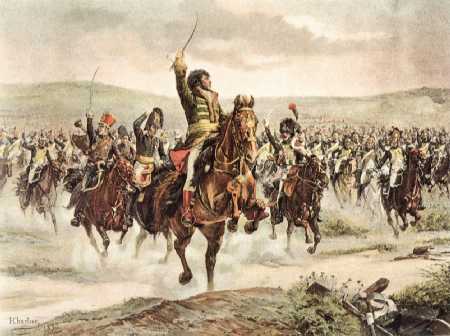
In addition to other important historical anniversaries (Happy Birthday, Mom!), today is the 200th anniversary of the battles of Jena and Auerstadt, at which Napoleon's Grande Armee (particularly its cavalry) destroyed the Prussian army and drove Prussia out of the Third Coalition. Georg Wilhelm Friedrich Hegel later described the battles as "The End of History," which should warn all of us not to read too much into current events.

Friday, June 09, 2006

Pine Trees and Sovereignty

June 10th marks the anniversary of the issuance of the Pine Tree Shilling (1652), the first coin minted by English-speaking settlers in North America. Those who might regard this as mere numismatic trivia are invited to read Mark Peterson's fascinating essay in the April 2006 issue of Common Place, "Big Money Comes to Boston." In it, Peterson notes the difference between what he calls "big money" (gold and silver coins issued by sovereign states) and "little money" (informal currencies like cowrie shells) in the 17th-century Atlantic world, and identifies the minting of the Pine Tree Shilling as the moment when Bostonians formally shifted to a big-money economy. He also explains how Bostonians' efforts to establish first a little-money economy, based on wampum, and then a big-money economy based on precious metals reflected the colony's ambitious territorial and commercial aspirations, linking coinage to the fur trade, the Pequot War, the silver mines of Potosi, and the West Indies. Finally, he describes the amusing -- and, for a long time, successful -- efforts of colonial officials to convince Charles II that they had not usurped his royal prerogative. (I particularly liked Sir Thomas Temple's insistence that the pine tree engraving was actually the Royal Oak, in which Charles II had hidden after losing the Battle of Worcester [1651], and that the coin was therefore a hidden tribute to the exiled king.) Charles' brother James was not taken in by such arguments and put an end to the new coinage when he became king, but this was merely a temporary setback for New England officials, who in the eighteenth century found a new way to produce money: by printing it.

(Image above is from the National Museum of American History, Washington, DC, via http://amhistory.si.edu/coins/printable/coin.cfm?coincode=1_00. Added 11 June 2018.)

Thursday, April 13, 2006

Jefferson and the Beringian Migration

In commemoration of Thomas Jefferson's 266th birthday, and as a follow-up to my post of March 15th, let me note that the Sage of Monticello was one of the earliest English-speaking Americans to speculate that American Indians originated in Siberia and migrated to North America via the Bering Strait. "From whence came those aboriginal inhabitants of America?" Jefferson asked in Query XI of Notes on the State of Virginia, his only book. "The late discoveries of Captain Cook, coasting from Kamschatka to California, have proved that, if the two continents of Asia and America be separated at all, it is only by a narrow strait...The resemblance between the Indians of America and the Eastern inhabitants of Asia, would induce us to conjecture, that the former are the descendants of the latter, or the latter of the former." (Merrill Peterson, ed., The Portable Thomas Jefferson [New York: Penguin, 1977], 142.)

Jefferson was not, however, the first European to hypothesize a Siberian origin for Native Americans. The concepts of a Bering land bridge and a Siberian migration to the Americas had been germinating for two centuries before Jefferson published them in his book. In Historia Natural y Moral de las Indias (1589), the Jesuit Jose de Acosta argued that since European animals were present in the Americas, they must have crossed over using a land bridge (which human beings could also have used). In the early 1600s the Spanish engineer Enrico Martin concluded that if such a land bridge existed, it must be in far northeastern Asia and the emigrants who used it must be Siberian. Around 1650, Bernabe Cobo asserted that the physical similarities between the various Indian peoples in North America pointed to a common origin, while in 1674 Daniel Gookin of Massachusetts noted that the most believable theory about the origins of Native Americans was that they were descended from the "Scythian" peoples of northeastern Asia and crossed into America via a land bridge. (Thanks to Charles Martijn, Daniel Mandell and John Faragher for the above information.)

Thomas Jefferson was a man of many talents: writer, inventor, lawyer, diplomat, scientist, naturalist, university founder, and, of course, president of the United States. Originality, however, wasn't necessarily his strongest suit.