Wednesday, March 28, 2018

Britain 0, Spain 0, Anopheles 4,000


Spain's loss of Gibraltar in 1704 eventually proved permanent, but the Spanish Crown took many decades to acquiesce in the cession. The rocky promontory beckoned to glory-seeking Spanish officers and revanchist monarchs, who made multiple attempts to recover the Rock in the eighteenth century. One of these helped trigger one of the more obscure conflicts of the era, the Anglo-Spanish War of 1727-1729. 


Despite its chronological subtitle, the fighting in this war lasted only a few months. A Spanish army of 18,000 mounted a desultory siege of Gibraltar, pausing its bombardment daily for siesta, a practice their British counterparts eagerly adopted. (They were as likely to spend the time drinking and copulating as sleeping.) Royal Navy ships provided effective covering fire for the defenders until Spain lifted its siege. Across the Atlantic, Britain's navy used the war to justify an offensive of its own, against the city of Portobello on the Isthmus of Panama. This had less amusing consequences. Admiral Francis Hosier's attacks on the port ran afoul of the Caribbean's deadliest resident, the mosquito Aedes aegypti, and 4,000 sailors (and the admiral) succumbed to yellow fever. To the north, one of Britain's North American colonies conducted a more successful raid against the Spanish province of Florida. Militia from South Carolina, assisted by Chickasaw warriors, attacked and dispersed the Yamasee Indians who had taken refuge near Saint Augustine after the Yamasee War (1715-16). White Carolinians didn't quite settle their scores with the Yamasees, but the raid doubtless pleased colonial governor Arthur Middleton.

The war of 1727-29 thus spread to three continents, and cost several thousand men (and a few women) their lives. It ended with a treaty that made no concessions of rights or territory, and both the war and its participants faded almost immediately into obscurity. Kings and princes usually promise those who fight for them honor and immortal glory. They lie.

*

Sources: James Falkner, Fire over the Rock (Pen and Sword, 2009), 8-10; John McNeill, Mosquito Empires (Cambridge UP, 2010), 1-2; Edward Cashin, Guardians of the Valley (University of South Carolina, 2009), 15.

Monday, February 12, 2018

Cotton Mather and the Bomb

In British America, in the eighteenth century, the month of November became known for the destructive revelry of Pope's Day. It was not anti-Catholic enthusiasm, however, that induced someone to fling a very large firecracker - a bomb, actually - through Cotton Mather's window on the fourteenth day of that month, in the year 1721. Rather, the anonymous bomber wanted to lodge a protest against a controversial new medical technique, smallpox inoculation, that the clergyman had just introduced to Boston. Like other remote European colonies, Massachusetts suffered from repeated outbreaks of the dread pox. The epidemic of 1721 infected a quarter of the city and left hundreds dead. Normally New England colonists dealt with smallpox through quarantine. Deliberately inoculating a healthy person with infectious pus in order to induce a (usually mild) case of smallpox, thus bestowing immunity on whomever survived the treatment, seemed both dangerous and perverse. That Mather learned of inoculation from Boston's African slave community further undermined his credibility in the eyes of white colonists, even though West Africans had been dealing with smallpox for centuries.

The bomb, a gunpowder-and-turpentine-filled grenade, failed to detonate, allowing Mather to die peacefully in his bed six years later. It also allowed him to read the note attached to the deadly billet-doux: "Cotton Mather, you dog, damn you, I'll inoculate you with this." Such sentiments remained common in Boston for some years thereafter. Former Bostonian Benjamin Franklin declined to inoculate his own offspring, later lamenting his decision when one died of smallpox in childhood. Military necessity obliged George Washington to inoculate the Continental Army in 1777. His soldiers might have disdained the procedure but their commander didn't allow them to vote on it. Even quarantine could provoke violence, as during riots in early 1774 against the inmates of a Boston smallpox hospital. 

The notion of injecting oneself or one's children with a foreign substance, even through a very safe procedure like vaccination (inoculation with a dead or weakened microorganism), remained an uncomfortable one for many. Indeed, opposition to vaccination can be revived even in a more scientific age, and adults who religiously vaccinate their children still find the procedure creepy enough to ignore the needs of their own immune systems. How many of my readers get their flu shots every year?

*

Sources: Mark Peterson, "Life on the Margins: Boston's Anxieties of Influence in the Atlantic World," in Wim Klooster and Alfred Padula, eds., The Atlantic World: Essays on Slavery, Migration, and Imagination (Prentice Hall, 2005), 45-59, esp. 57-58; Pauline Maier, "Popular Uprisings and Civil Authority in Eighteenth-Century America," William and Mary Quarterly, Third Series, 27 (Jan. 1970): 3-35, esp. 5-6.

Thursday, January 11, 2018

Is it Steam Engine Time Yet?


In re-reading Alfred Crosby’s Children of the Sun (2006), I was struck by the Rube-Goldberg-like complexity of the first practical steam engine. Thomas Newcomen’s machine, which first went into operation in 1712*, used coal - the remains of Mesozoic plants - to heat water within a large boiler, the steam from which then discharged into a large, cylindrical brass chamber. The steam filled the cylinder with vapor pressure and raised a piston connected to a rocker beam. Then the mechanism cooled the cylinder with a spray of cold water, condensing the steam and creating a vacuum. Atmospheric pressure, whose power Europeans had only discovered a few decades earlier, then pushed the piston back down into the evacuated cylinder and delivered the power stroke to the rocker beam. The cycle then began anew with the refilling and condensation of the engine chamber.
 

Newcomen’s engine (the “Common Engine”) was clumsy and crude by the standards of later inventors, but revolutionary enough in its day: it generated five horsepower in a confined space, using fuel far cheaper than the fodder and upkeep for five living horses. Its two-cycle rocker beam could power a pump capable of draining some of the deepest coal mines in southern England. One feature of the Newcomen engine strikes me as particularly magical: the way it combined all four of the Classical elements to do its work. From the earth came the machine's black and sulfurous** fuel, and to the earth its labor returned. The common air supplied the pressure for the engine's power stroke. Water became the eponymous steam, and cooled that steam to produce the all-important vacuum. Fire generated the steam itself and thereby drove the piston upward. The chartered firm that patented Newcomen's device in 1715 encapsulated in its name the bizarre and contradictory nature of the engineer's experiment: "The Society for Moving Water by Fire." It sounds almost like an alchemists' club. I imagine Isaac Newton, who considered astronomy and astrology of nearly equal interest, would have found its work intriguing if its members weren't so declasse.


*Hellenistic Greeks knew of steam’s power and one or two had built a simple steam engine, but these functioned only as toys. The Greeks had sufficient slaves to discourage their replacement with labor-saving devices.


** I presume it used bituminous coal.

Friday, December 08, 2017

We Hate Illinois Nazis


So, this actually happened:

Last December, as my partner Susan and I were on our way to O'Hare Airport, our interurban bus driver struck up a conversation with us about the new president-elect. The driver, a white man in his sixties or early seventies - we'll call him Reinhard - expressed great satisfaction with Donald Trump's electoral victory. Now the United States could do something about all the dangerous immigrants crossing its borders and endangering its people.

It was early in the morning, and Susan and I were as yet the only passengers on the bus. Susi maintained a polite if deeply uncomfortable silence. I decided to talk with Reinhard and see where he was coming from. I asked him which countries he thought had the most dangerous immigrants. "Oh, Syria, Iran..." He stopped there, acknowledged that his familiarity with current affairs didn't extend exceptionally far, but assured me that Americans needed protecting. We talked a little about our own immigrant ancestors, and found we both had people from Germany. My predecessors (on my mother's side) came from the Palatinate, his from, IIRC, Saxony. Reinhard reported that two of his uncles had immigrated from Germany as recently as the 1950s. Both had to lie about their identities, he said, because both had been in the SS a decade earlier. "It had been expected of them," Reinhard said of his uncles' service to the Third Reich, because they both came from respectable families. He did not seem to see the irony of fearing allegedly dangerous immigrants when his own uncles had belonged to a dangerous, indeed famously hostile, terrorist military force, and had then entered the United States illegally. I suspect he and his family would describe his SS relatives as "some very fine people."

People will tell you the damnedest things if you'll just listen to them, sometimes.

I let the conversation dwindle, and Susi and I kept to ourselves for the rest of our trip to Chicago and our subsequent flight to Taiwan. I was only reminded of our encounter with Reinhard and his Illinois Nazi relatives when his employer made national news for its blatantly racist, anti-Asian advertising. Our driver worked for Suburban Express, you see, and on December 2nd of this year the company advertised itself as a university shuttle service for white people, promising "You won't feel like you're in China when you're on our buses." When their ad met with protests, SubExpress issued a non-apology, asserting that Chinese students imposed an unfair burden on Illinois's institutions and taxpayers, and claiming that anyone critical of the company was merely advancing a political agenda. I wonder if Reinhard has moved from driving the company's buses to running its public relations department?

Monday, November 27, 2017

First Peoples in Revolution


Age of Revolutions has just finished (more or less) a series on Native Americans in the era of the American Revolution. The authors in the series wrote of efforts by the Iroquois, one of the groups most devastated by the Revolutionary War, to mitigate conflict between their own Six Nations. They studied the Chickasaws’ successful balancing of their alliance with Britain (and the vital supplies it brought) with their desire to stay out of another damaging war. They noted how the Odawas used Britain's growing demand for their military services to leverage greater material concessions from the Crown. They described how traditional masculinity, the desire to defend hunting grounds and display martial valor, drew some Cherokee men into the conflict, and how some Cherokee leaders sought to cool the tempers of warriors from the Chickamauga faction. One looked at eastern Native Americans’ efforts to mitigate the destruction of the war by shifting to a new, diversified commercial economy. One, Andrew Frank, found the Revolution a non-event from the perspective of nations like the early Seminoles.


Most of the series’ writers agree, I think, that Native Americans did not view the American Revolution as a positive good. Why would they? The rebel colonists wanted freedoms that either endangered or did not apply to American Indians: the freedom to acquire more (indigenous) land, and freedom from arbitrary, non-consensual taxation Some First Peoples did share the rebels’ distaste for the British army, the intrusive force that radicalized rural New Englanders, white Carolinians, and others as the war progressed. Few, however, trusted the Patriots enough to join force with them against that army. Those few who did generally lived “behind the frontier” in New England reserve communities, or in districts like the Catawba homeland, a capsule of southern Indians surrounded by white backcountry settlers. Indians in these regions shared at least some interests with their white neighbors. Some First Peoples also supported the rebels because they believed the alliance would bring them political advantages, or because they had personal connections to colonists that preceded the Revolution (e.g. the Oneidas). The great majority of Native Americans, however, either supported George III or stayed out of the Revolutionary War altogether.

In general, in a global context, revolutionaries don't seem to make much effort to appeal to indigenous peoples. If one is trying to overthrow a state, it makes sense to focus one's recruitment efforts on the state's constituents, on those who have to pay its taxes and obey its laws, and who also have some stake in the political community. Indigenes, who usually live independently of state authority or (all too often) live in subjugation at its margins, don't make optimal targets for revolutionary persuasion. I don't believe the First French Republic made an outreach to the Guaranis of Guyana,* for instance, nor the Bolsheviks to indigenous Siberians (at least not during the Russian Revolution), nor Mao's communists to the Miao of southwestern China. Indeed, indigenous peoples often provide fighting men to counter-revolutionary forces, as did the Senecas and Creeks in the American Revolutionary War, the Mapuches (whom my friend and colleague Pilar Herr studies) in the Chilean independence war, and the Hmong in the Second Indochina War. Incumbent regimes enjoy more familiarity with the divide-and-conquer tactics, like the use of "ethnic soldiers,"** essential to most kinds of imperial rule. Indigenous peoples, for their part, quite rightly view radical social change as more of a threat than an opportunity, particularly if Europeans introduced that change. Regrettably, their experiences after the Age of Revolution would only ratify what they had already learned.


* The First Republic's agents in the United States did try to recruit Creek and Cherokee warriors for a planned campaign against Saint Augustine, but no-one replied to their appeal. (Robert Alderson, Jr., This Bright Era of Happy Revolutions [South Carolina, 2008], 142-43, 160-61.)

** To borrow a term from Neil Whitehead. See his "Carib Ethnic Soldiering in Venezuela, the Guianas, and Antilles," Ethnohistory 37 (1990): 357-85.

Monday, October 23, 2017

Cattle, cotton, and capitalism in Indian country

Last summer the redoubtable editors of the Age of Revolutions weblog asked Your Humble Narrator to contribute a post on Native American history. I am pleased to report that my essay, "The Economic Revolution in Indian Country," is now live on the AoR site. It is part of a series that includes contributions from my friends and colleagues Karim Tiro, Kathleen DuVal, and Andrew Frank.

Had I written the piece five or seven years ago, when I first started contemplating Native American economic history, I probably would not have included my George Colbert quote, which came from my later research on the Chickasaws. I also would not have qualified my paragraph on cotton cultivation with the phrase "not found east of the Rio Grande"; I hadn't yet internalized the Pueblo Indians' pre-Columbian domestication of cotton and production of cotton cloth. It's sometimes hard for someone trained in the East, or even in the Midwest (Kentucky counts as Midwest), to recall that western Indians have a very rich history of their own prior to the nineteenth century.

The editors estimate that one can read my blog post in 11 minutes, but I suspect it will also inspire at least 66 seconds of historical musing. I always try to give 110 percent.


(The image above, "Benjamin Hawkins and the Creeks," is from the Greenville County (SC) Museum of Art, and is in the public domain.)

Tuesday, October 17, 2017

The Perduvian Network


In Winnipeg last week, at the annual meeting of the American Society for Ethnohistory, I had the privilege of participating in a panel* in honor of Theda Perdue, one of my graduate mentors. Here are the brief comments I offered on Theda and her leadership abilities:

My thanks to Rose Stremlau for inviting me to join this distinguished panel, to my fellow panelists for their narratives, to Theda Perdue for her friendship, guidance, and inspiration, and to the First Nations of western Canada for allowing us to hold this session in their homeland.

I’ve been thinking about leadership lately, and why some leaders have such a great record of success. My current research project is a history of the Chickasaw nation, whose survival in the eighteenth century depended in large part on the acumen of their chiefs and captains. Historians have described Chickasaw leaders in this era as divided into factions, depending on whether they sought the favor of the Spanish or the Americans. On closer inspection, it appears that men like George Colbert and Ugulaycabe sought instead to advance the collective fortunes of their entire nation, and to do so not by allying with one empire or another but by forming the most extensive possible networks of trade and alliance. Piomingo, to take the best example, spent his political career making friends with most of the Chickasaws’ distant connections: with the Cherokees (he had spent his youth with them), with the new commonwealth of Virginia, with George Washington and his cronies in Philadelphia, with James Robertson and his fellow settler-speculators in Nashville, with the officers of the American army at Cincinnati, and even, through his associates the Colberts, with the Spanish. Piomingo was no stooge of empire, no pursuer of self-aggrandizement. He simply saw that success for his people depended on reaching out to outsiders, making them friends and allies, and persuading them that the fortunes of one group rose or fell with the others in the network.

The themes of friendship, alliance, mutual aid, and networking necessarily bring me to Theda Perdue. I first encountered Professor Perdue when I applied to the graduate program at the University of Kentucky. She very kindly wrote me a letter of welcome and encouragement. Noting her interest in the senior-thesis chapter I had enclosed with my application, Theda went on the sing the praises of U.K.’s faculty and, especially, its graduate students, “whom I think you will find challenging, professional, and ambitious as well as congenial and supportive.” But even if I did not come to Lexington, Dr. Perdue said I should consider her a friend and mentor. “If you would like me or Mike Green to take a look at your…work on Native Americans with a view towards publishing an article or presenting a professional paper, please let us know. Our role as teachers does not end at the university boundary or state line, and we are happy to help you in any way we can.” A close friend of mine asked when I read her this letter, twenty-three years later, “Who in the academic world does something that fantastic?” Obviously, someone exceptional, someone more interested in supporting scholarship and teaching, and in building the ethnohistorical nation, than in self-aggrandizement.

In any event, when I began my studies at Kentucky I became a student of Lance Banning, an intellectual and political historian of the early American republic, and undertook a dissertation on the Federalists’ policy toward First Nations. These subjects lay outside of Theda’s area of interest, and yet she and Michael Green still treated me as well as any of their own students, pushing me to make connections with other beginning scholars and to present my work at national conferences. As I began my own career I began to see that this kind of network-building and encouragement were not activities Dr. Perdue confined to her discussions with graduate students. She combined her two professional domains, the interdisciplinary study of Native North America and the study of the American South, not only in her staggeringly prolific scholarship but in her leadership of the American Society for Ethnohistory and the Southern Historical Association, and of course in the series on Southeastern Native Americans she co-edited for Nebraska with Michael Green. She encouraged Native Americanist scholars to build relationships with presses normally known for Southern or for political history, in an effort to bring entities like UNC Press or Virginia into our scholarly network.

And she sought, either directly or through her former students, to make friends and shape agendas in some of the most conventional, even reactionary associations. In conversation with me some years ago about the Liberty Fund, a quasi-libertarian foundation that hosts scholarly study groups in luxury resorts, Theda characterized the organization as a far-right think tank (essentially true), and in the same breath asked me to make sure she and Mike were invited to their next conference. I maintain she was less interested in the Liberty Fund’s promise of good food and wine than in the possibility of making contacts – including prominent law professors and judges – who would benefit her students, colleagues, and professional associates. Concurrently, Theda has maintained an indirect relationship with the Society for Historians of the Early American Republic. SHEAR’s membership includes some deeply reactionary men, and its annual meetings always fall at the wrong time of year for anyone engaged in serious research. However, Theda’s students, the “southeastern Mafia” as it were, have turned the Society into an organization far more amenable to Native American studies, and one of them, Craig Friend, is currently the SHEAR president. Theda’s influence, like Piomingo’s, extends into groups that may sometimes seem antithetical to our enterprise. They will not remain so for long. The Perduvian network has proven more extensive and persistent than the Piomingan, and has grown in pursuit of goals at least as laudable. And unlike Piomingo, Theda built her community entirely without the use of artillery. Well, so far as I know.


* "Scholar, Mentor, Advocate, Friend: A Celebration of Theda Perdue," 14 October 2017.

Wednesday, September 27, 2017

Flush Times in Mississippi (and Terre Haute)

Your humble narrator spent much of the past month preparing and giving research presentations to several regional audiences: to students and faculty at the University of Mississippi, to the attendees of the Chickasaw Days celebration in Holly Springs, MS; and to the invitees of Indiana State University's Center for Global Engagement in Terre Haute. The three talks concerned, respectively, the Chickasaw Indians' perception of coinage and currency, the adoption of commercial agriculture by the same nation in the early nineteenth century, and the history and culture of the Great Lakes Indians from the Mississippian era (had to work Mississippi in there somewhere!) to the Relocation program of the mid-twentieth century.

The currency talk, which Robbie Ethridge kindly invited me to give, observed that the Chickasaws first acquired coinage, diplomatic medals, and silver jewelry at more or less the same time (between ca. 1765 and 1790). I argued that they probably saw these three novelties as commensurable objects, as diplomatic tokens and prestige symbols. Chickasaw men and women knew how Europeans used money, and were glad to acquire it, but they appear to have either hoarded it or only to have exchanged it for other "prestige goods" until the 1820s.

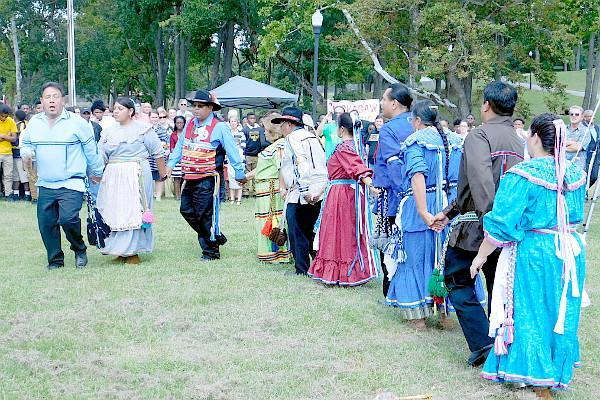
My address to the Chickasaw Days festival, "Stock and Trade," discussed the nation's similarly conservative approach to stock-raising and cotton cultivation, activities they adapted to their own gendered division of labor and desire not to abandon other traditional enterprises (like hunting and maize horticulture). I adapted the talk from a similar address I gave at the Ittafama Ithana conference on Chickasaw History last February, an address that I assumed most history enthusiasts in northern Mississippi had missed.* Most, but not all: some of the Chickasaw Nation Dance Troupe, ten of whom performed in Holly Springs, had been in my audience in Oklahoma.

I had formed the idea that Holly Springs was just a wide spot in the road. Actually, it is a fairly large courthouse town with several museums - including the birthplace of famed anti-lynching activist Ida Wells - and at least one restaurant serving first-rate fried pickles. It is a majority-black community, and the Chickasaw Days event drew a predominantly white crowd. Perhaps the region's Native American history doesn't appeal as much to an African-American audience. The nineteenth-century Chickasaws were slave-owners, after all, and later made a strenuous effort to exclude their freedmen from citizenship. Perhaps the town's black families were preoccupied with the huge homecoming-day parade which took place around the main square the same day as the festival, and in which many African-American children and teenagers were featured participants. I rather hope the latter interpretation is the more accurate one.


* My conference talk has since been reprinted in the Journal of Chickasaw History and Culture, Spring 2017 issue.

Wednesday, August 30, 2017

Half-Woke

I have been quiet here this month because current events have, for once, rendered me speechless. The late unpleasantness in Charlottesville, and Washington's response to it, made abundantly clear what I had previously tried to ignore: the president, vice president, and attorney general of the United States, and upwards of 30 million other Americans, are Nazi sympathizers. Probably another 30-plus million Americans are okay with this. We have yet to stage our own national Kristallnacht, but the men who want to smash the store windows, burn the churches and synagogues, and raise the gallows are out and marching. Our garden-variety white supremacists have done this before, of course, but never with such clear support from the national government.

There isn't much I can physically do about the American fascists' coming-out party. I'm too decrepit and socially anxious to counter-march. I can try to atone for my own complicity with white supremacy, which though minor is real enough.

Fifteen years ago I accepted a professional writing award (the only one I ever expect to receive) named, it turns out, for a Confederate apologist, segregationist, and racist historian of some former repute. I have long avoided confronting the ugliness of the connection, but now I have decided to stop running from it. I have not publicly repudiated or returned the award - the society which so honored me is not intrinsically racist - but I have taken the certificate down from the wall, removed references to the prize from my resume, and donated the award money (a sum equal to it) to the NAACP, the UNCF, and the Equal Justice Initiative. I have also begun reading Ibram Kendi's Stamped from the Beginning, a history of racist ideas not previously on my reading list. When I complete that particular journey through social ugliness I plan to post a link to my review on this blog.

I won't pretend to be "woke" to the ubiquity of violence, white supremacism, and para-militarism in the United States. I can at least start the process of educating myself, and make myself less a part of the problem than I otherwise would remain.


(Update, September 8: my review is up at Goodreads; link above.)

Monday, July 31, 2017

Then Iceland Struck Back


The Economist of 22 July 2017 reports an intriguing piece of historical detective work that ties together an early medieval famine, a buried volcano, ice cores, and tree-ring isotopes.

Shortly after the death of Charlemagne, western Europe experienced three years (821-24) of terrible weather: hard winters, frozen rivers, failed crops, and famine. The Frankish monk Paschasius Radbertus recorded these “years without summer” but could only attribute them to the wrath of God. Environmental scientists tend to associate “summerless” years not with divine displeasure but with volcanic eruptions, and a large one apparently occurred in this period. Ice core extractions from Greenland show elevated levels of sulfate particles, a marker for volcanism (which ejects sulfur dioxide into the atmosphere), during the third decade of the ninth century.

Identifying the specific volcano responsible for Radbertus’s famine would seem impossible, but in 2003 serendipity provided an important clue. Flooding in southern Iceland uncovered the remains of an old forest 20 miles from the Myrdalsjokul glacier. 2,200 feet beneath that glacier lies Katla, a volcano that periodically erupts through its ice cover, producing powerful floods. Such a flood likely killed the now-buried forest: the ancient trees, which had all been knocked down at the same time, pointed away from Katla, indicating that some force from that direction had felled them. 

According to Ulf Buntzen (Cambridge), the trees’ rings give a precise date for their demise: 47 years after 775 CE, when an unknown event (probably heightened solar activity) deposited high levels of Carbon-14 isotope in tree rings worldwide. The flood thus took place in 822, soon after the start of the frigid weather observed by our Frankish monk, and during the period of elevated sulfate levels found in the Greenland ice. This is as close to absolute proof of a volcanic eruption in Iceland as one can get in the absence of on-the-spot observers, who wouldn’t arrive on the island for another half-century.

Iceland has suffered a great deal from outside illnesses and calamities, but one should recall that it is contributed to one or two of its own (crop failures, disrupted air travel, bad music) over the centuries. The world is a small place, and small places can exert an outsized influence on it.

Monday, July 03, 2017

Pity Poor Iceland (1707 Edition)


When I teach my students about the impact of Old World diseases on Native Americans, I stress that the lethality of these illnesses resulted from Indians’ geographic isolation, not their genetic background or lack of medical knowledge. Without prior experience of maladies like measles and influenza, indigenous peoples became vulnerable to the “virgin-soil” effect, where no-one had acquired immunity to a disease and thus everyone in an infected community became sick. Any similarly isolated population, even a European one, could suffer a deadly virgin-soil epidemic. As Exhibit A, I present the case of Iceland. Hard winters (especially during the Little Ice Age) and rough northern seas cut Icelanders off from the European mainland, allowing them to develop their distinctive and venerable culture*, but also allowing generations to grow up without exposure to crowd diseases.


In 1707 this led to disaster. A ship from the mainland brought smallpox, one of the most dangerous Eurafrican maladies. Smallpox is airborne and highly contagious in confined spaces, like the smoky interiors of Icelandic farmhouses. It kills around a quarter of those who become infected without modern medical treatment - more if they lack food, water, and warmth. Those who survive usually suffer permanently disfiguring scars on their faces, hands, and feet, the result of the weeping pustules that characterize the final stages of the disease. Relatively few Icelanders bore these scars in 1707. The island had experienced several smallpox epidemics in the past, but the last outbreak ended in 1670, so almost no-one under 40 had an immune system that could recognize the disease.


The disease spread slowly, but relentlessly, through the countryside. By 1709, when the last cases of sickness were recorded, variola (the virus that causes smallpox) had killed 12,000 people, nearly one-quarter of Iceland’s population. Most likely there were enough survivors of the earlier outbreak to take care of the sick, which kept the death rate slightly below its usual pre-modern level. Still, so great a loss, especially of children and young people, must have been a heavy blow to a small, rural society. The only benefit was the immunity conferred to the survivors, which made the next few incidences of smallpox less lethal.

Visiting officials kept a good record of the 1707-09 epidemic, but this probably didn't produce significant changes in Icelanders' behavior. Epidemics rarely do, somehow. In any case, warnings about the dangers of smallpox would not have helped the survivors' grandchildren when they faced the next great disaster in their island's history, a concatenation of natural disaster, famine, and disease that slaughtered cattle, poisoned the land, and left 10,000 people dead. 

Arguably, Iceland would have been better off if the eighteenth century had never happened.

Sources: Alfred Crosby, "Virgin Soil Epidemics as a Factor in the Aboriginal Depopulation in America," William and Mary Quarterly, Third Series, 33 (1976): 289-299; J.N. Hays, Epidemics and Pandemics (ABC-Clio, 2005), 131-133

Image above by Diego Delso (delso.photo), License CC-BY-SA.


* Icelanders preserved to the present day their medieval language, their sagas, and their mythology, including the famous Norse myths that became lost or corrupted on the mainland.